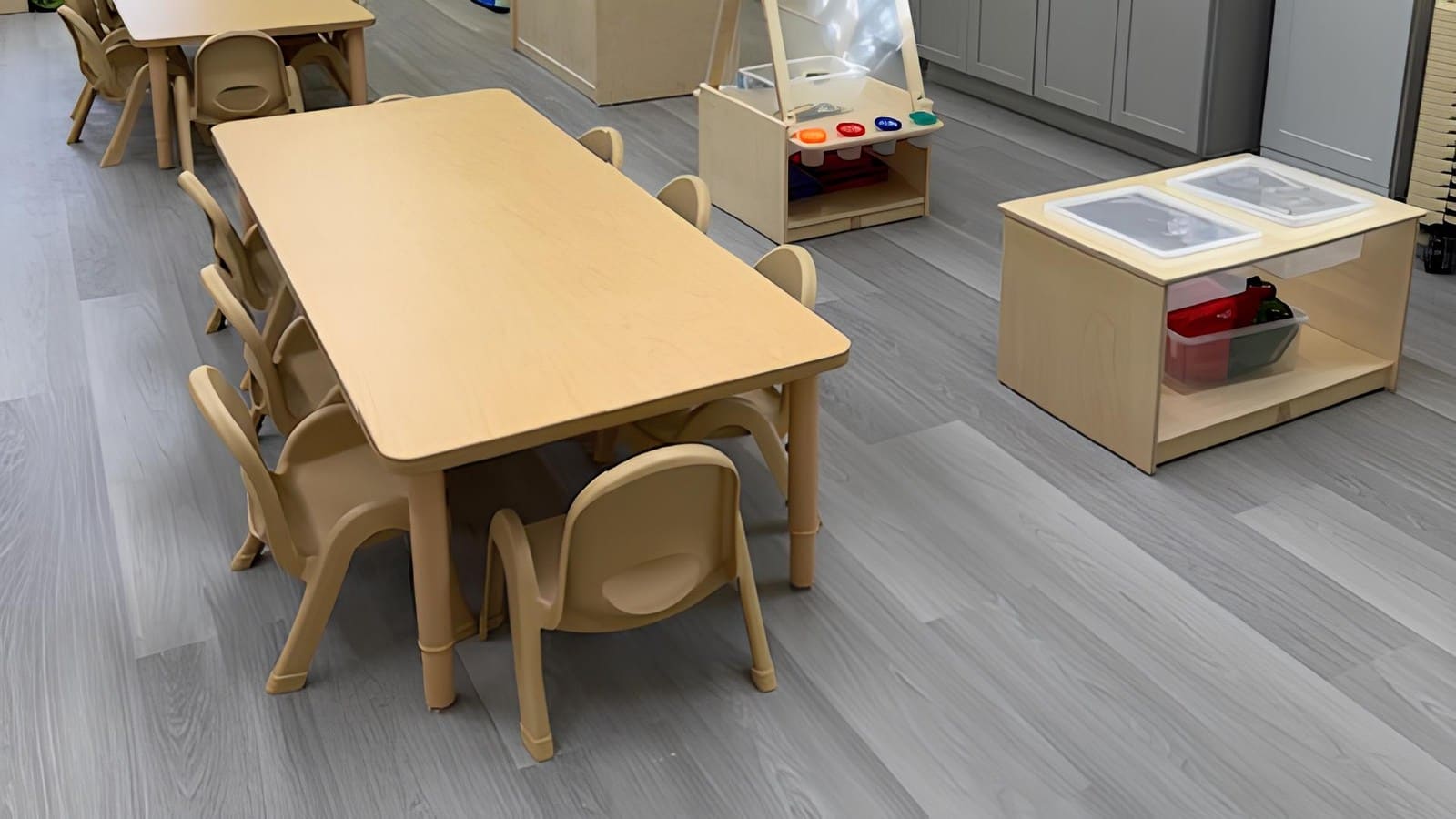
Classroom Chairs: Seat Heights by Age and What Lasts
Key takeaways:
- Buy classroom chairs by the age of the children, not by the room: we plan an 8-inch seat for 18 months to 2.5 years and a 14-inch seat for 5.5 to 9 years, with the tabletop 8 inches above the seat in every band.
- A 2023 Heliyon study of kindergartens in Skopje, Sofia and Zagreb found that of the 28 chair types it could compare with two- to three-year-olds, only 3 had a seat height that fit them, so measure the children and their chairs each fall.
- Below school age, Illinois licensing rules ask for chairs with backs, and in the rooms for three- to five-year-olds, one chair per child with no folding chairs. A backless stool is an extra on top of that count.
- Ohio's school design manual rates hard molded plastic more durable than soft plastic. Look for a braced frame too, and match the glide to your floor before you order, not after the first scratch.
Watch a three-year-old at the art table on a chair built for a six-year-old. Her feet swing, she perches on the front edge to get her feet nearer the floor, and within a few minutes she's kneeling on the seat or standing beside it. Nothing about her behavior needs fixing. The chair does.
Classroom chairs look interchangeable in a catalog, so they get less planning than almost anything else in a room. Yet the seat height, the matching table, the frame, the feet and how they stack decide whether children can sit through a 15-minute activity, and whether the chairs still look the same in five years.
What a Good Classroom Chair Does for a Child
A chair that fits does three jobs at once. It lets a child put both feet flat on the floor, it supports her lower back so she isn't holding herself upright with her stomach muscles, and it puts the table where her forearms rest on it without her shoulders lifting.
Get those three right and a child can stay with a puzzle or a lump of clay until the activity ends. Get one wrong and she spends her energy on staying balanced. Children rarely say a chair is uncomfortable. They show it by sliding forward, sitting on one foot, tipping back on two legs or leaving the table.
Fit has a safety side too: a chair a child has to climb into is one she can fall out of. Depth counts as well. A seat that's too deep presses its front edge into the back of the knee, which is why a small child keeps shifting forward.
Classroom Chair Heights by Age: The Sizing We Plan With
The seat and table heights below are the ones we plan with when we size a room. Each row is an age band rather than a single age, because two children with the same birthday can differ by a seat size. The first two bands overlap between 2 and 2.5 years, and the rest meet at a shared age, so a child near a boundary may fit either chair. The sit test below settles it.
| Children's ages | Seat height we plan | Tabletop to pair it with | Rooms it usually serves |
|---|---|---|---|
| 18 months to 2.5 years | 8 inches | 16 inches | Young toddler room |
| 2 to 3.5 years | 10 inches | 18 inches | Twos rooms and younger threes |
| 3.5 to 5.5 years | 12 inches | 20 inches | Older threes, the 4s room and younger fives |
| 5.5 to 9 years | 14 inches | 22 inches | Older kindergartners and grades 1 to 3 |
The pattern in the two middle columns is the part to remember. The tabletop sits 8 inches above the seat in every band, which leaves room for a child's thighs and brings the surface close to elbow height.
A 3s room usually needs both the 10- and 12-inch seat in September, and more 12s by spring. Infants have no row; the section on the youngest children covers their seating.
Why plan from the child rather than the catalog? Because chairs often run too tall for the youngest children using them. One 2023 study in Heliyon measured 848 children in 27 kindergartens in North Macedonia, Bulgaria and Croatia, along with the 36 types of chairs those rooms used.
The researchers compared each seat with the children's popliteal height, the distance from the floor to the back of the knee when seated. The study's fit table gives no Sofia figures for children under four, which leaves 28 chair types from Skopje and Zagreb for those ages. Of those 28, only 3 matched two- to three-year-olds within 10 millimeters, and 7 suited the three- to four-year-olds.

Most matches came for children five and older, and the authors caution that the results describe those kindergartens rather than every room. Their practical recommendation was to measure children at the start of each new school year and match the furniture to them. Measuring your own chairs, a few sections down, puts that habit to work.
Pairing Each Chair with the Right Table
A classroom table and chair work as one unit, and a common fit problem is a pair that drifted apart. A room moves up a chair size as its children grow, the tables stay put, and every child is now hunching over a surface 2 inches too low. The reverse happens when a new table arrives and the old chairs stay.
The 8-inch gap lets you check any pair in seconds: subtract the seat height from the tabletop. A 12-inch seat at a 20-inch tabletop is right. The same seat at a 22-inch tabletop leaves a 10-inch gap, so a four-year-old lifts her shoulders to reach her paper.

When you order tables and chairs for classroom use, order them as pairs from the same row of the sizing table, so the gap is right on delivery day.
Mixed-age rooms need one more step, because a single set of classroom chairs and tables can't serve a two-year-old and a four-year-old at once. Give the youngest a second, lower table with its own chairs. Height is the same test that decides whether a center gets used: if a child can't reach it comfortably, she works somewhere else.
Where a room's age mix changes from year to year, set adjustable table legs to the chairs, since most classroom chairs come in fixed heights. A classroom chair with table pairing that fits in September can be a size small by spring, so recheck the pair whenever you check the chairs.
How to Measure the Chairs You Already Own
Many buildings already have the right chairs somewhere, sitting in the wrong room. An afternoon with a tape measure usually settles it before anything is ordered, the same measure-first order we use in a full classroom setup.
Measure the Furniture
Work room by room through every classroom chair, table and bench, and keep the numbers on a sheet taped inside a cabinet door so the next person doesn't repeat the job.
- Measure each chair's seat height at the front edge, from the floor to the top of the seat.
- Measure each tabletop from the floor.
- Subtract the seat from the table for each pair and note any gap that isn't 8 inches.
- Write the age band each chair fits beside it, using the sizing table above.
- Mark chairs that rock on uneven glides, wobble at a joint or have a cracked shell.
- Swap classroom tables, chairs and benches between rooms first, then list the gaps that are left.
What remains is your real shopping list, and it's usually shorter than a room-by-room replacement. It's also the list to bring to anyone helping you plan seating.
Watch the Children Sit
Numbers get you close, and the children settle the rest. Sit each group at its tables for a normal activity and look from the side. Feet should rest flat with the knees at roughly a right angle, backs should reach the backrest, and forearms should rest on the table without shoulders rising.

Dangling feet mean the seat is too high, and knees higher than the hips mean it's too low. A child perched on the front lip with a gap behind her back usually has a seat that's too deep.
Classroom Chair Types and When Each Earns Its Place
Every type below has a room where it's the right answer and a room where it's a problem. The table sets them side by side. The ages and checks in it are our own planning judgment, not a published standard.
| Chair type | Where it earns its place | Ages we'd use it for | What to check |
|---|---|---|---|
| Four-leg stack chair | Table work in rooms that clear the floor daily | 2 years and up | Crimped-on glides and a braced frame |
| Sled-base chair | Carpeted rooms, where legs would catch | 3 years and up | A glide on the sled for hard floors |
| Hardwood chair | Rooms that want warmth and a long service life | 18 months and up | Rounded edges and a sealed finish |
| Cube chair | The youngest table sitters, who need sides | 18 months to 3 years | Back and sides high enough to hold a child |
| Scoop rocker | Floor seating in a book corner | 2 to 5 years | A smooth, crack-free seam |
| Stool | An extra seat for a child who needs to move | 3 years and up | A stable base, kept in adult view |
| Bench | Shoe-tying spots and shared reading | 3 years and up | A height that matches the room's chairs |
The four-leg stack chair is the workhorse in many rooms, because it covers table work and still clears away for group time. The sled base, a continuous steel loop under the seat, is its partner on carpet, where four separate legs catch in the pile.
Cube chairs belong to the youngest children who sit at a table. Their back and sides hold a toddler who is still learning to sit steadily, which matches what the Illinois Department of Early Childhood (IDEC) asks of toddler seating: backs, plus sides or arms where a child needs them.
Stools need the most care. A wobble stool may help a child who can't hold still through a short activity, though it tips more easily than a chair and works against scissors and pencil work, so it belongs beside her chair as one choice, where an adult can see it. The evidence behind flexible seating in early learning supports offering that choice, not converting a whole room.
Materials and Build: What Lasts in a Classroom
Classroom chairs get dragged, stood on, tipped back, stacked, wiped with disinfectant every day and carried across the room by children. The ones worth keeping share three things: a seat material that holds up to cleaning, a braced frame, and joints that can't trap a finger.
Plastic, Wood or Upholstery
Molded plastic is a common seat, and it comes in two kinds. The Ohio School Design Manual describes soft plastic shells as more comfortable and generally less expensive, while hard plastic seats are much heavier, easier to keep clean, and more durable with a longer use life. For children who carry their own chairs, that weight is the trade-off.
Hardwood chairs last for years when the finish is sealed and the edges are rounded, though they're heavier for a child to carry. Upholstered seating needs one more check in Illinois: the licensing rules on equipment, 23 Ill. Adm. Code 2008.380(e)(1), require padded or upholstered chairs and benches to meet the state's Furniture Fire Safety Act and the fire marshal's furniture regulations.
That check applies to much of what's new. In our NeoCon 2026 recap, we noted low stools and ottomans in soft, durable upholstery showing up again and again across the show floor, sized for small bodies. They suit a reading corner, as long as the fabric carries the fire-safety rating and wipes clean.
The Frame and the Joints
For solid plastic chairs, Ohio's manual, written for K-12 schools, recommends an H-style leg frame over an A-style base, with cross-bracing between the legs and continuous welds. On a low early childhood chair the brace sits close to the floor, so check that it's there rather than measuring it. Bracing is what keeps four legs square after years of being dragged across the floor.
Look closely where a plastic seat meets a metal frame. On some chairs a gap opens between the shell and the frame, and a three-year-old's finger fits it. A one-piece shell or a flush joint removes the pinch point.
Tested to a Standard
Ask whether a chair has been tested to ANSI/BIFMA X6.1, the national consensus standard for educational seating, and whether that test covered the chair's size. The standard sets out the tests and recommended minimum levels for safety, durability and structural adequacy, and its 2018 revision raised test forces and loads to reflect heavier adults and children.
The Ohio manual also requires student chairs to comply with the Consumer Product Safety Improvement Act of 2008, the federal law that sets testing requirements for children's products.
Glides and Feet That Don't Score Your Floors
The glide is the cheapest part of a chair and the one that decides what your floor looks like in two years. The Ohio manual notes that most manufacturers fit nylon glides as standard, which suits some floors better than others.
| Floor | What to pair with it | Why, and what to watch |
|---|---|---|
| Vinyl or other hard floors | Steel glides, crimped on | Ohio's manual prefers steel to nylon here: it may leave black marks but is less likely to scratch over time |
| Carpet | Sled-base chairs | The manual notes sled bases are generally used on carpet |
| Mixed rooms with rugs | Sled base with a glide underneath | Our pick: a glide on the sled lets the same chair work on the hard floor too |
| Hard floors you want kept free of marks | Felt protectors fitted on site | The manual says they protect resilient flooring such as vinyl but need periodic replacement |
Whatever the glide, check that it stays on. The Ohio manual notes that glides sometimes come off four-leg chairs even when crimped on, and the exposed leg then damages carpet and hard floors alike. A look at the feet during your fall measuring catches a missing glide before it gouges a path across the room.
Noise is the other floor problem, and covers that slip over each chair foot quiet it cheaply. Our shop carries chair socks in packs of four for that job.
Stacking and Putting Chairs Away
Most early learning rooms change shape several times a day. Tables become a lunch area, the floor becomes a group time rug, and in many rooms the chairs have to clear away before cots come out for rest. Putting chairs away is part of the daily routine, so plan it as carefully as the chairs.
Stack height is the first limit. The Ohio manual says common student chairs only stack about 5 to 7 high, and that even high-density stack chairs should stack no higher than 60 inches above the floor. In a room of young children, we'd keep stacks lower, at a height an adult can lift from without reaching overhead.

A short end-of-day routine keeps stacks safe and the room ready for the morning.
- Clear the seats and anything hung on the chair backs before you stack.
- Stack chairs of one size together, so the stack sits straight.
- Park stacks against a wall, away from exits and the path to the door.
- Use a chair cart or dolly when chairs travel between rooms.
- Check feet and glides as the stack comes down in the morning.
The routine takes a few minutes, and it's what keeps a stack from leaning into the walkway or toppling when a child pulls on the bottom chair.
How Many Chairs a Room Needs
Your licensing rules set the minimum. Illinois child care licensing moved to IDEC on July 1, 2026, and the center rules now sit in 23 Ill. Adm. Code Part 2008. Outside Illinois, your state's licensing agency publishes its own list, and the numbers can differ.
For the rooms between toddler care and school age, the Illinois rules' Appendix B asks for sufficient tables and chairs with backs for the children, one chair per child, no folding chairs, plus chairs with backs for staff. School-age programs follow a separate appendix that leaves the type of seating to the program.
Two planning points follow. A stool, ottoman or floor cushion has no back, so it can sit beside the chairs as a choice, never in place of them. And the safe reading of "one chair per child" is every child in the room at once, so a room licensed for 20 gets 20 chairs at the right height.

Beyond the minimum, plan one or two spare chairs per age band in a building, a planning margin rather than a rule. Spares cover the chair that cracks in March, the child who joins mid-year and the child who outgrows her band ahead of the room. It's a figure our team can add to a room plan beside the licensing count, so the two stay separate.
Seating for the Youngest Children and the Adults
Infants don't sit at tables, and their seating reflects that. Appendix A of the Illinois rules asks infant rooms for seating suited to each child's developmental abilities, safe, sturdy and with backs, along with infant seats.
A baby who can't yet sit up by herself spends most of her awake time on the floor, and an infant seat is for short stretches with an adult in view; one who falls asleep there moves to her crib. A baby who sits steadily on her own may use a low seat with sides at meals, with an adult beside her.
Toddlers are the first group to use real classroom chairs, usually a cube chair or a low 8-inch seat with a back. A child who still climbs in on her knees does better in the cube chair, whose sides steady her.
Adults need chairs too, and for infant and toddler rooms the same appendix is specific: adult-sized chairs with backs for staff, at least one rocking chair, and no folding chairs.
A teacher seated at a child's level can see the work and talk about it, which is the responsive, eye-level teaching many early learning rooms are working toward. Put the rocker where its sitter can see every child, and give each table group a low adult chair.
What to Check Before You Order Classroom Chairs
By the time you order, you know the seat heights, how many chairs you need at each and the floors they'll sit on. The last step is confirming the chair in the listing is the chair you planned, because seat height, glides and frame are easy to miss in a product photo.
- The seat height is stated in inches and matches the age band on your list.
- The tabletop it will sit at is 8 inches higher.
- The chair has a back, so it counts toward an Illinois chair count below school age (check your own state's list).
- The glides suit your floor, or the right ones are ordered separately.
- The frame is braced and the seat-to-frame joint can't pinch a finger.
- Upholstered or padded seats carry the fire-safety label your state requires.
- The maker can tell you how the chair was tested for durability.
When a center brings us that list, our work is matching it to real products and real rooms. Kim Klasky, one of our customers, named it in a testimonial: "selecting the right equipment for the best value." Chairs are on the same testimonial's list of what comes from us, too: "They are our go to for toys, furniture, chairs, cots, and so much more!"
That's the job SB Custom Learning's design and sourcing services are built around. We assess the room, recommend seating sized to each age group, source chairs through a wide network of vendors, have a piece made to order when the room calls for a size or shape that isn't stocked, and send a crew to deliver and set everything up.
Getting Every Child the Right Seat
Seating is one of the few classroom decisions you can check with a tape measure. Measure the chairs and tables, match both to the children's ages, and many fit problems that look like behavior problems settle once each child fits her seat.
Start with the room where children leave the table most often. Check its chairs against the age bands, check the 8-inch gap to the table and look at the feet. If the heights are wrong, swap chairs with another room before you buy anything new.
When the building needs more than a swap, SB Custom Learning plans seating room by room, with each project quoted on its own scope. Our deliveries cover the Midwest, we're working to reach other regions, and a sample is yours on request if you'd like to judge a finish in your own room before the whole center is ordered.
For a second pair of eyes on your numbers, talk to our team and send the ages in each room.
FAQs
What height should classroom chairs be for each age?
We plan an 8-inch seat for 18 months to 2.5 years, 10 inches for 2 to 3.5 years, 12 inches for 3.5 to 5.5 years and 14 inches for 5.5 to 9 years. Then check each child sitting: feet flat, knees near a right angle, back against the backrest.
How do you match a classroom chair with table height?
Set the tabletop 8 inches above the seat: a 16-inch table with an 8-inch seat, 18 with 10, 20 with 12 and 22 with 14. That gap leaves room for a child's thighs and puts the surface near elbow height, so a child can work without hunching or reaching.
Can stools replace chairs in a classroom?
They can sit alongside chairs, not replace them. Illinois licensing asks for chairs with backs, one per three- to five-year-old, so a backless stool doesn't count toward that number. Other states set their own rules, so check with your licensing agency.
What glides are best for classroom chairs on hard floors?
Ohio's school design manual prefers steel glides to nylon on hard floors, because steel is less likely to scratch over time. Sled-base chairs suit carpet. Felt protectors work on resilient floors but need replacing periodically.
How high can classroom chairs be stacked?
Ohio's school design manual puts the limit for high-density stack chairs at 60 inches off the floor, and says ordinary student chairs only manage five to seven in a stack. With young children in the room we'd stop well short of that, so a teacher lifts the top chair at chest height, and we'd keep every stack clear of the exits.