
Effective Teaching in Early Childhood: 7 Elements You Can See in the Room
Key takeaways:
- Effective teaching with two- to five-year-olds lives in the interactions, not the lesson plan: warm relationships, intentional play, rich talk, predictable structure, planning from observation, individual support and family partnership.
- The K-12 version of the phrase is about standards, lessons and test outcomes. With young children, effectiveness is what an adult does in the ordinary moments of a day, and the room either supports it or gets in the way.
- Head Start and many state systems measure it with CLASS, which scores three domains: emotional support, classroom organization and instructional support.
- A 15-minute walk-through of your own rooms this week will show you which elements already work and which single one to fix first.
A two-year-old hands you a block and waits for you to take it. That exchange is the work, and it is where the research points when the question is what good teaching looks like before a child can read.
Almost nothing written about effective teaching describes it. The guidance aimed at a middle school, a high school lab or a college lecture hall gives you lesson objectives, formative assessment, pacing and test data, all of it useful and all of it aimed at a different job than the one a toddler teacher does all day.
The early childhood version of the question lands on two things instead. One is how an adult handles the small, unremarkable moments that fill a day. The other is the room those moments happen in, because a shelf a child can reach and a corner a teacher can see into decide how much attention is left over for the block.
This guide gives the early childhood version of a phrase the search engines hand to K-12. It covers what the term means for two- to five-year-olds, the seven elements you can watch in a room, how effectiveness gets measured, where the room helps or hurts, and a short self-check you can run before Friday.
What Effective Teaching Means for Two- to Five-Year-Olds
To define teaching effectiveness for young children, start with where the learning happens. It happens in relationships and play, not in a lecture. An effective teacher in an early learning room is not delivering content.
They are arranging a day so a small group of children can concentrate, try things, talk, and come back to a trusted adult. Ask what is teaching effectiveness in a toddler room and the answer sits closer to care than to curriculum.
That flips the emphasis of the older-grades definitions. A framework built for K-12 rewards clear objectives, direct instruction and frequent checks for understanding. Those still matter here, but they sit on top of something more basic.
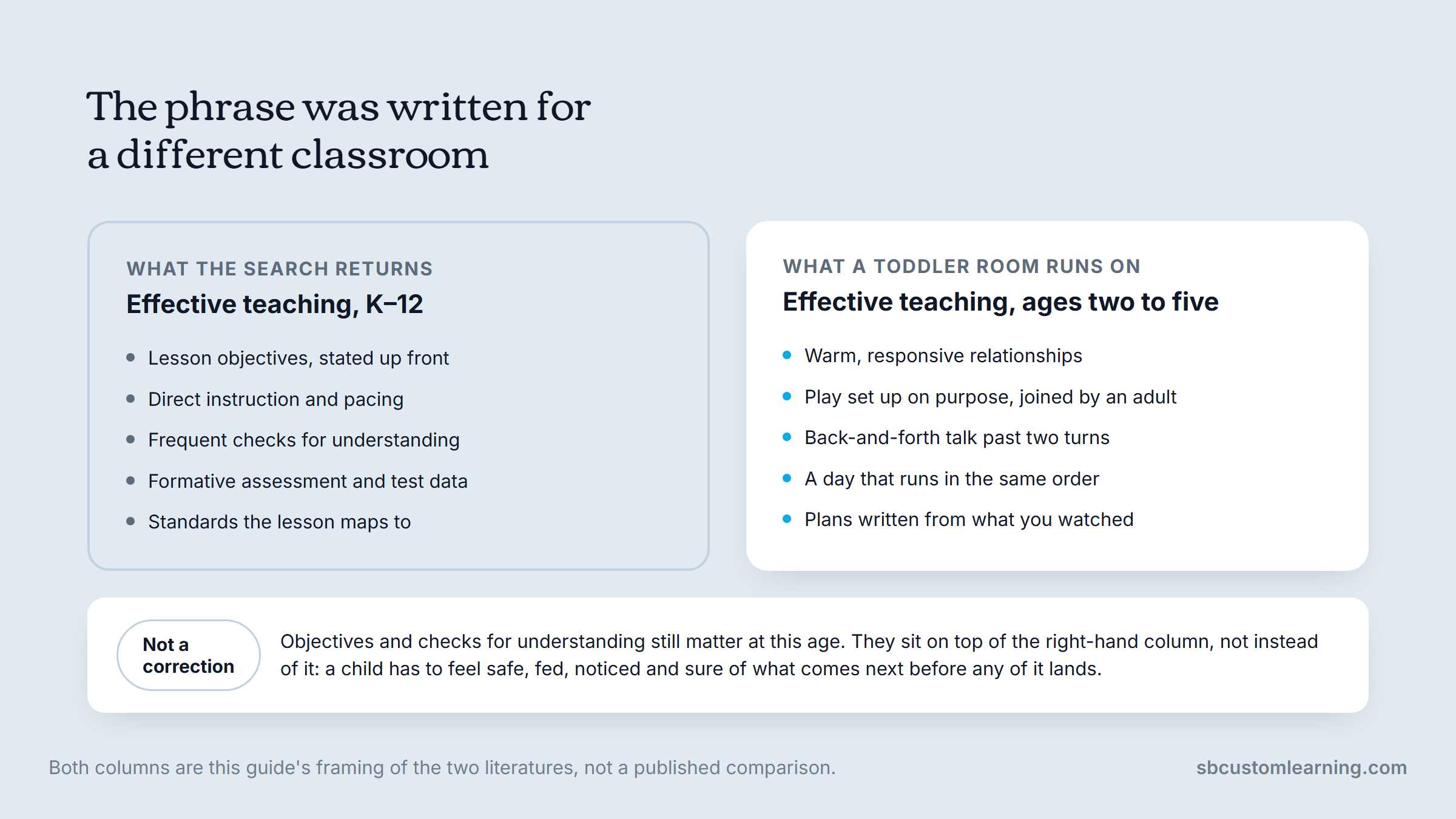
The effectiveness of teaching strategies depends on the age of the child, so a method that works with a ten-year-old can misfire with a two-year-old. Before a three-year-old can follow a direction, they have to feel safe, fed, noticed and sure of what comes next.
So the short answer is this: effective teaching in early childhood is the set of adult decisions that help a specific group of children learn and feel secure doing it. Most of those decisions are interactions, and the rest are about the space the interactions happen in.
A quiet corner with a soft chair, a shelf a child can reach, and a clear path from the sink to the art table are teaching tools, because they let a teacher stay present instead of policing.
We have spent our working lives around early learning rooms, and the pattern shows up in the finished work as much as in the research. A room that fits the children does more teaching than any wall display, the working rule behind our completed rooms. The moves repeat across age bands, from infant rooms to rooms for 3- to 5-year-olds.
The Seven Elements to Watch For in a Room
Seven elements separate a room where children are being taught from one where they are merely managed. None of them is a poster.
Together they are the effective strategies of teaching that hold up across age bands, and each one is visible once you know what to watch for. That is what makes them something a director can coach rather than a personality trait a teacher either has or does not.
The table below is the quick version. Read it as a set of things to look for on a walk-through, then use the sections after it to see how each one works in practice.
| Element | What you see in the room | What it sounds like |
|---|---|---|
| Warm, responsive relationships | A teacher at child eye level, greeting each child by name, noticing a new haircut | "I saw you build that tower, Maya. Tell me about it." |
| Intentional play | Centers stocked with a purpose, props that invite a role, adults playing alongside | "You're the vet today. What does this puppy need?" |
| Rich talk | Open questions, new words used in context, back-and-forth that lasts past two turns | "What do you think happens if we add more water?" |
| Predictable structure | A posted picture schedule, the same sequence daily, warned transitions | "Five minutes until cleanup, then we go outside." |
| Planning from observation | Notes on a clipboard, a photo of a child stuck on a puzzle, new materials the next day | "Yesterday you counted the bears. Today let's sort them too." |
| Individual support | A quieter spot for one child, a real job for another, a cue card for a third | "Try the picture card. First shoes, then outside." |
| Family partnership | Home photos and home words on the wall, a note that names one thing a child did | "She told us about the trip. Here's what we saw her do today." |
A table can only point at these. The work is in the details, so here is what each element looks like when a teacher is doing it well.
Warm, Responsive Relationships
Everything else rests on this one. A child who trusts the adult will take a risk, try a hard puzzle and ask a question, and a child who does not will spend the day watching the door.
The visible move is proximity and attention. Greet every child by name at the door, get down to their height, and respond to feelings before they turn into behavior. When a child melts down over a dropped cracker, name the feeling and stay close rather than rushing to fix it. Over a term, that habit is what turns a group of children into a room.
Intentional Play
Play is not the reward for finishing work. With children under five it is the work, and treating it as optional is the fastest way to weaken what works.
Intentional play means the adult sets up a center for a reason and then joins it for a few minutes at a time.
Stock the kitchen corner with real cartons, add a clipboard to the doctor set, and sit down to play a role rather than watching from the edge. That is when a teacher can stretch a child's language and thinking without turning it into a worksheet.
The same logic covers movement. Active, gross motor play builds the self-regulation that sitting still later requires, which is the case we make in our post on active play.
The pressure on a center usually runs toward the opposite of all this, toward a room that looks more like school. A three-year-old reciting letters is easy to show a parent, and a three-year-old negotiating who drives the bus is not, even though the second child is doing the harder work.
Rich Talk
Language is one of the elements most closely tied to later school readiness, and it grows out of ordinary conversation rather than vocabulary drills. Rich talk means long back-and-forth exchanges, open questions, and new words used where a child can see what they mean.
The practical moves are small. Ask a question that has more than one answer, wait a few seconds for a reply, and build on what the child says instead of redirecting it. Name what you are doing as you do it, so a child hears the words for scooping, pouring and comparing while their hands are busy.
Five of them cover most of the ground, and every one is talk rather than instruction: acknowledge what a child is doing, encourage the effort rather than the result, give feedback specific enough to act on, ask a question that needs thinking, and offer a hint when a child stalls. None of them adds a minute to the day.
Predictable Structure
A predictable day is what lets a young child relax and pay attention. Children who know what comes next do not have to spend energy guessing, and a two-year-old has little energy to spare.
Build the structure so the room carries it. Post a picture schedule at child height, keep the same sequence every day, and warn every transition with a song, a timer or a countdown. The moves are rarely dramatic. Most of them are the same small move made reliably.
Planning From Observation
Good planning starts with what you actually saw, not with a theme calendar. Watch a child for a few minutes, write down one thing they did or tried, and let that note decide what goes on the shelf tomorrow.
Keep a clipboard or a phone handy and jot the observation while it is fresh. Then look for the pattern across a week: three children avoiding the art table, one child always returning to the block corner, a group that cannot yet take turns with one truck. The plan writes itself once the observation is in hand.
Individual Support
A group of sixteen children is sixteen different starting points, and your approach has to flex across them. Individual support means matching the demand to the child instead of the average, which is one of the most effective ways to teach a mixed group.
Scaffold the task up or down: a child who is ready for a challenge gets one more step, and a child who is not gets a smaller task, a visual cue or a hand. Keep one quiet spot in the room for the child who needs to step away, and give real jobs to the children who need a reason to belong.
Family Partnership
A child brings their whole home into the room every morning, and the teaching gets stronger when it is coordinated with that home. Family partnership is the element most programs believe in and the hardest one to put on a schedule.
Start with the wall and the doorway. Put family photos and a few words in a home language at child height, send home a short note that names one specific thing a child did, and ask families what works at home when something is hard. Effective ways of teaching a young child rarely live at the center alone.
Where Explicit Instruction Fits in an Early Learning Room
Child-led and teacher-led are usually treated as opposites, and for young children that framing wastes time. Children need both, and the skill is knowing which one a moment calls for. There are more effective ways to teach a young child than talking at them for twenty minutes, and the most effective methods of teaching move between play and a short, direct lesson.
Explicit instruction earns its place when it is aimed at a moment the child is ready for. If a four-year-old is trying to zip a coat, a quick modeled sequence beats another minute of struggling. If she is deep in a story with a friend, the right move is to stay out of it. The art is in the timing, not the method.
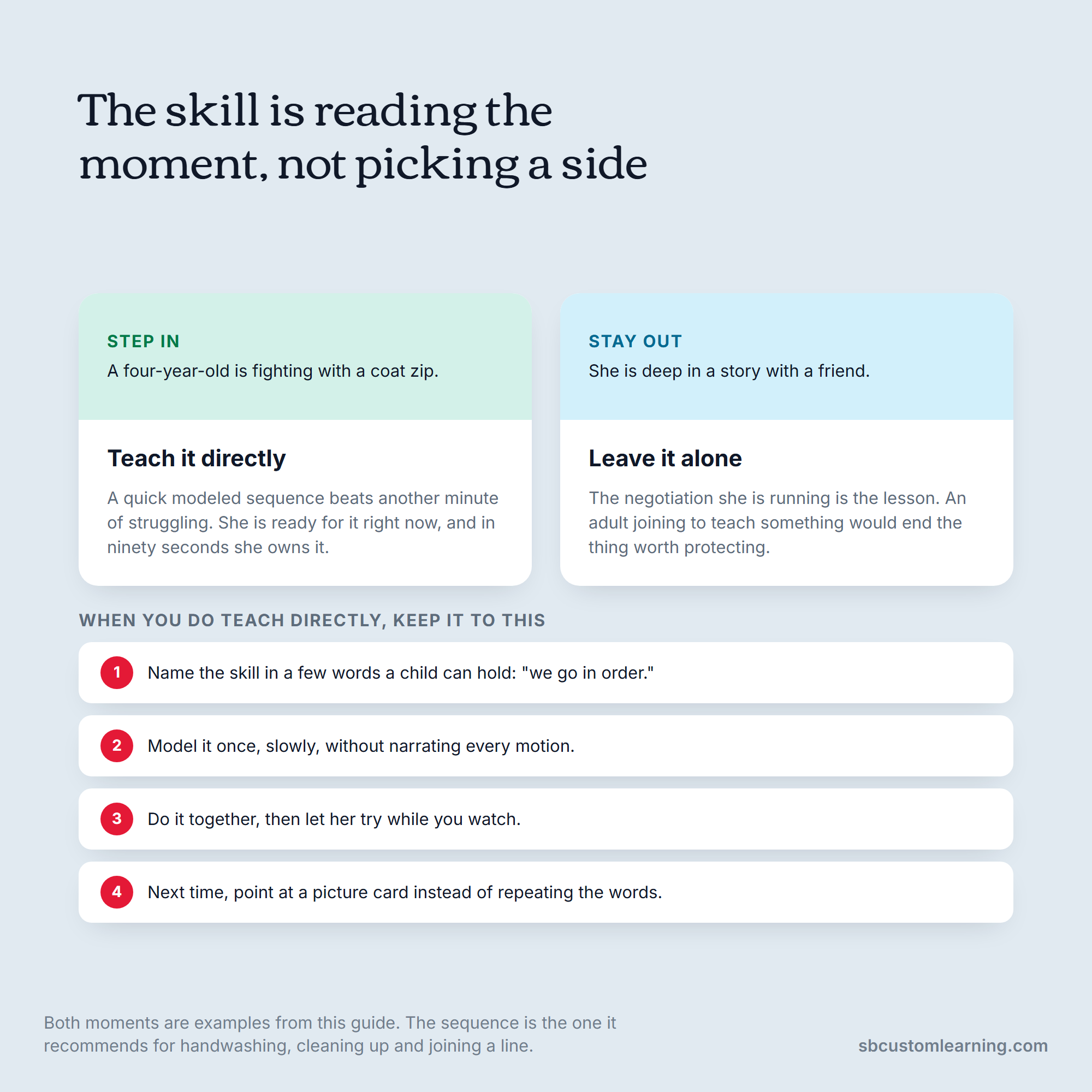
When you do teach directly, keep it short and concrete.
- Name the skill in a few words a child can hold, such as "we go in order."
- Model it once, slowly, without narrating every motion.
- Do it together while the child copies you.
- Let the child try while you watch, and step in only if they stall.
- Point to a picture card next time instead of repeating the words.
The same sequence works for washing hands, cleaning up and joining a line. What makes it land with young children is that it stays brief, it is matched to a real moment, and it hands control back to the child as fast as possible.
A child-led room still needs an adult who can step in and teach, and a teacher-led room still needs a child who has something to be curious about.
We see the balance break in both directions, and the rooms that get it right are the ones where the adults have thought about how a child learns, not only what a child should know, an idea we work through in designing a child-led room.
How Effective Teaching Is Measured: The Three CLASS Domains
Programs that want to know whether teaching is working need a measure, and in early childhood the most common one is the CLASS tool.
Teachstone describes it as the Classroom Assessment Scoring System, an observation tool that scores the quality of educator and child interactions rather than test scores or lesson plans. Teachstone's own research summary argues that interactions are the strongest predictor of a young child's academic, social and emotional growth, which is why the tool looks at what an adult and a child actually do together.
The Office of Head Start uses CLASS to monitor the programs it funds. CLASS groups teaching interactions into three domains, and each domain asks a different question about the room. A program can score well on one and poorly on another, which is exactly why the split is useful to a director.
| CLASS domain | What it scores | What a high score looks like |
|---|---|---|
| Emotional support | How warm and positive the room is, and how adults respond to feelings and behavior | Teachers notice and name feelings, help children solve problems, and hold a positive tone under pressure |
| Classroom organization | How well routines, time and behavior are managed so children stay engaged | The day runs on predictable steps, materials are ready, and few minutes are lost to chaos |
| Instructional support | How adults extend thinking, language and problem solving | Teachers ask open questions, add challenge, introduce new words and build on what a child says |
Instructional support is the hardest domain to score well on, and the federal thresholds say so outright. The Office of Head Start sets its quality expectation at 6 out of 7 for emotional support and for classroom organization, and at 3 for instructional support. The score low enough to make a grant recipient compete for its funding is 5 on the first two domains and 2.5 on instructional support.
That domain is also the one the seven elements above lean on most. Naming feelings and running a calm routine is something most rooms do within a week. Asking a question that makes a child think, and then waiting long enough for the answer, is the part that takes practice.
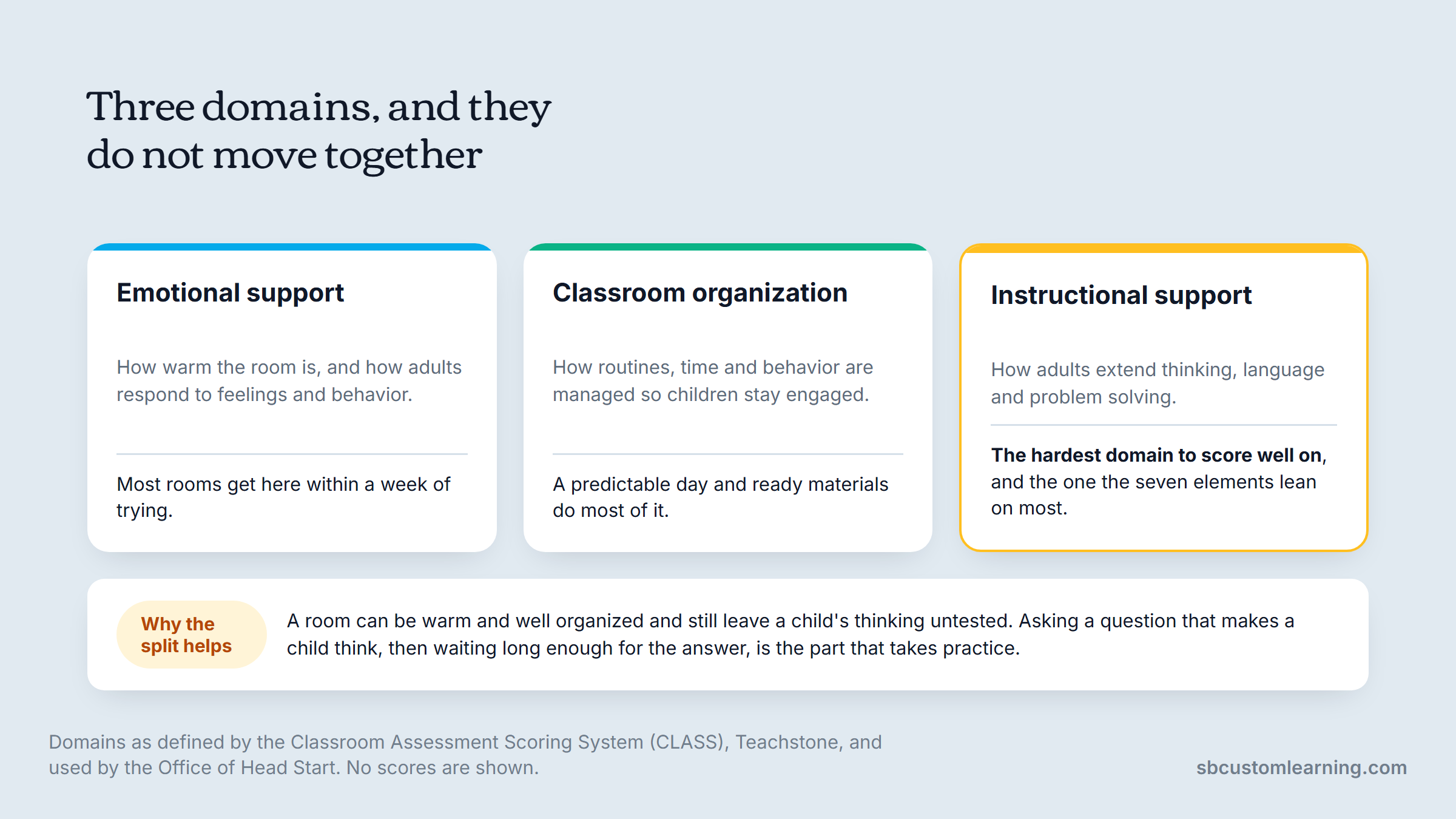
The domains are also a reminder that the effectiveness of teaching methods is not one score. A room can be warm and well organized and still leave a child's thinking untested, which is where a director can aim coaching.
The environment feeds all three domains at once, since a room a child can navigate lets the teacher spend attention on talking and thinking instead of managing, the case we make in designing a thoughtful room.
The Room Is a Teaching Tool
The physical room does quiet work on every element above. When the layout is right, a teacher can see every child, reach what she needs, and stay in the conversation.
When it is wrong, the same teacher spends the day chasing problems the furniture created. Reachable shelving, rotated materials and clear boundaries are unglamorous, and they do more for a room than any single change a teacher can make.
Start with three things a child should be able to do alone. Reach the shelf they use most, find where a material lives, and understand where one center ends and the next begins. Those three answer most of the questions that otherwise pull a teacher away from teaching.
A few moves do most of the work.
- Put the shelves and bins a child uses at their reach height, not the adult's.
- Rotate materials every few weeks so a center stays interesting without a new purchase.
- Mark each center with a low divider, a rug edge or a shelf back so the boundary reads at a glance.
- Keep the loud zones away from the quiet ones, so a block corner and a book corner are not competing for the same three feet.
- Leave the main paths clear and arrange centers so no play corner hides behind a wall.
None of this is decoration, and it is not a purchase you have to make at once. It is a plan. We start every project by planning the layout before anything is ordered, and for one Chicago early learning center that meant a custom play loft where no catalog piece fit the space, the build behind that play loft project.
Tall shelving is the most common offender, because it blocks the sightline a teacher needs and splits a room into blind spots. Lower it, or move it to a wall, and the room changes character in an afternoon.
What Gets in the Way of Good Teaching
Even a skilled teacher cannot hold all seven elements in a room that fights her, and the obstacles are usually structural rather than personal. Before you coach a teacher, check the room and the schedule.
The first obstacle is ratio and time. When the numbers are stretched, the adult who should be talking and observing is instead managing a line or covering a break. A day with no protected planning time loses the observation element by default, because there is no moment to write anything down.
The second is noise. A hard room with hard floors and no soft surfaces turns normal play into a wall of sound, and a teacher cannot hear the quiet back-and-forth that rich talk depends on. Adding a rug, a soft corner and some fabric lowers the volume without changing the program.

The third is the hardest to see from inside the building: a layout that makes the teacher police the room. If centers hide behind shelving or the paths cross in the middle, the teacher spends the day walking to problems instead of watching for them.
That is a design problem with a design fix, and it is the place where the setup order matters most, the sequence we lay out in setting up a room.
Fix the room and the schedule first. Both are changes a director can make without asking a teacher to be a different person, and coaching a teacher on instruction while the layout forces her to patrol is the shortest path to a frustrated staff.
A 15-Minute Self-Check You Can Run This Week
You do not need an evaluator to find out how effective the teaching in your rooms is. You need fifteen minutes during the busiest stretch of the day, not a calm one, and a few honest questions.

Walk one room and work through the list below. Score each item as a yes or a not yet, and resist the urge to fix all of them at once.
- Stand where the teacher actually stands and check whether every child is visible from there.
- Listen for one back-and-forth that lasts more than two turns between an adult and a child.
- Count how many open questions you hear in five minutes, compared with directions.
- Watch a transition and note whether the children saw it coming.
- Look for one shelf a child reaches without an adult.
- Find the child who is playing alone, and ask what an adult did for them today.
- Check whether the wall holds anything a child made or a family sent in.
Two or three honest no answers are normal, and they point at your first fix. If the sightline item fails, that is a layout job. If the talk items fail, that is a coaching and planning job, and it is the one most likely to move a CLASS score. The check is about the effectiveness of teaching strategies in your own rooms, not a score to chase.
This is also where an outside set of eyes can save time. We walk rooms the same way, with the licensing visit, the age groups and the budget in view, and design work starts from the space you already have rather than a catalog, through our space planning service.
Start With One Element, Not Seven
You do not have to rebuild a program this month. Pick the one element the self-check flagged, teach it to the team, and give it a few weeks to become a habit before you add the next. Effective teaching is a set of daily decisions, and the room is the one teaching tool you already own.
Orders go through online, and we post out samples so a chair or a carpet can be tried under your own lights before the rest follows. The Midwest is our delivery area and it keeps picking up new states. Each room carries its own quote, because what it needs depends on its shape and the ages in it.
More than two decades of early education work sit behind SB Custom Learning, and the classroom is where that experience shows. When you are ready to look at the room through the teacher's eyes, schedule a consultation and start with the space you already have.
FAQs
What should teaching look like in early childhood?
It is the set of adult decisions that help a specific group of young children learn and feel secure doing it. For two- to five-year-olds, that is mostly interaction: warm relationships, rich talk, intentional play and the planning that ties them together. It also includes the room, because the layout decides how much attention a teacher has left for teaching.
What are the 7 elements of strong teaching?
Warm, responsive relationships; intentional play; rich talk; predictable structure; planning from observation; individual support; and family partnership. Each one is visible in the room, which is why a director can spot it on a walk-through rather than waiting for a formal observation.
How is teaching effectiveness measured?
In early childhood, the most common measure is the CLASS tool, which scores three domains of educator and child interaction: emotional support, classroom organization and instructional support. It rates what adults and children actually do together rather than test results, and instructional support tends to be the toughest domain to score well on.
What are the most effective methods of teaching young children?
A mix of child-led play and short, explicit teaching, matched to the moment. Set up centers on purpose, join the play to stretch language and thinking, and teach a skill directly when a child is ready for it, then hand control back. Predictable routines and a room a child can navigate free the adult to talk, observe and respond.
How can a teacher improve this week?
Pick one element, not all seven, and practice it for a few weeks. Ask more open questions and wait a few seconds for an answer. Warn every transition. Write one observation a day and let it shape what you put on the shelf tomorrow. Small moves made reliably beat a new program every time.