Flexible Seating Ideas for Early Learning Rooms
Key takeaways:
- In an Illinois State University study of 40 second and fifth graders, flexible seating was chosen over traditional seating overall, but 16 of the 40 still preferred a regular chair.
- Seat height matters more than seat type. A three-year-old on a 14-inch stool has their feet four inches off the floor, and no amount of choice fixes that.
- Teachers who abandoned it usually cite the same two failures: equipment that breaks within a year, and the children who most need movement being least able to use wobbling seats safely.
- Budget for replacement. Soft seating in a toddler room is a two-to-three-year item, not a decade item.
Flexible seating arrived in early learning rooms through elementary school, and it arrived with a lot of photographs and very little arithmetic.
The photographs are appealing. Children sprawled on floor cushions, a reading nook with a small couch, wobble stools instead of a row of identical chairs. The arithmetic is the part directors ask about after the first year: which of these will still be usable next September, what happens when a three-year-old tips a stool, and whether any of it changed anything.
This guide takes the idea seriously and takes the objections seriously too. There is real evidence on both sides, some very specific dimensions that decide whether any of it works, and a durability problem that vendor pages tend not to mention.
What Flexible Seating Actually Means
At its simplest, the idea means offering more than one place and posture to work in, and letting children choose between them.
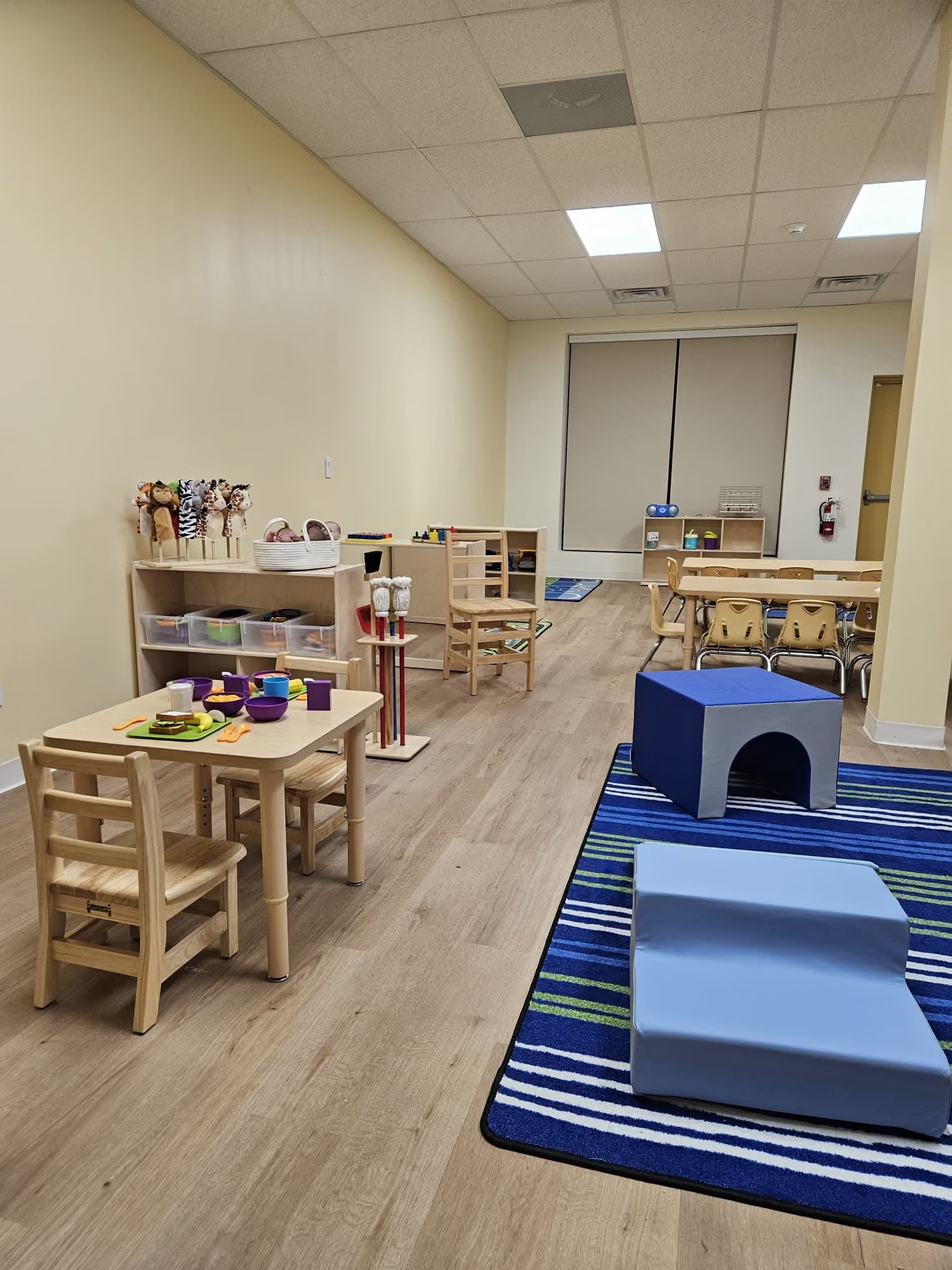
That is a lower bar than the photographs suggest. A room with a rug for group time, four chairs at a table, two floor cushions in a book corner and a bench by the window is already offering choice. It does not require replacing every chair or buying anything shaped like a ball.
The distinction worth holding is between choice and novelty. Choice means a child can pick the posture that suits the task, sitting upright to cut paper, lying on their front to look at a book. Novelty means there is something exciting in the corner. Novelty wears off in about three weeks; choice does not.
Nearly every failed rollout we hear about started as novelty and was measured as if it were choice.
What the Research Says, Including the Part That Gets Skipped
Two studies are worth knowing, and both are more interesting than the summaries of them.
Researchers at Illinois State University tracked 40 students in second and fifth grade classrooms using classroom maps and observation logs, in work published on ERIC. The alternatives were chosen over traditional seating overall. But 16 of the 40 students preferred a workspace with a regular chair, and over time children stopped rotating and settled on one spot where they worked best.
That second finding is the useful one. Two in five wanted a normal chair, and the rest converged rather than roaming. Choice is what mattered, not variety for its own sake.
The finding everyone quotes and the one nobody does, in the same sample.

The other study looked at stand-biased desks with 97 students in grades 3, 4 and 6, published in IJERPH in 2020. Standing desks did not affect fidgeting either way. They did affect attention, and specifically for the children who needed it most: students who were less attentive at baseline showed a 40% to 80% higher rate of non-attentive behavior at a traditional desk than at a stand-biased one.
Read those honestly and the headline is modest. The evidence supports offering options, particularly to children who struggle to stay settled. It does not support the claim that any of this raises achievement, and both studies are on children aged 7 to 12 rather than preschoolers, which is a real gap when you are furnishing a room of three-year-olds.
The Case Against, From Teachers Who Tried It
The most useful critique of flexible seating in the classroom comes from teachers who tried it and stopped.
A thread on Reddit titled "Flexible seating: overrated?" collected the pattern. The original poster's complaint was workload: it became one more thing to monitor on top of everything else.
The reply that has stayed with us went at the equipment directly, listing popped yoga balls, broken foot bands and tipping or rocking stools, and arguing that the students who should benefit most are the least able to use it safely. That teacher said they would settle for well-fitting, comfortable chairs.
There is a hard truth in that for anyone selling furniture. A wobble stool given to a child with poor impulse control is not a support, it is a hazard, and the fix is not more rules. The fix is choosing equipment whose failure mode is boring.
This is one thread and a set of opinions rather than data, so weigh it accordingly. It matches what we hear from centers closely enough to take seriously.
Seat Height Decides More Than Seat Type
Here is the specification that gets skipped, and it undoes most of the rest if you get it wrong.
A child sitting properly has their feet flat on the floor, knees at roughly a right angle, and the work surface at about elbow height. Sit a three-year-old on a 14-inch stool built for an eight-year-old and their feet hang four inches clear of the floor, their core works constantly to stay upright, and they will be out of that seat in four minutes. That is not a behavior problem.
| Age | Seat height | Table top height | Common mistake |
|---|---|---|---|
| Under 18 months | 5 to 6 inches | 12 to 14 inches | Adult-height feeding surfaces |
| 18 months to 2.5 years | 8 inches | 16 inches | One size bought for the whole room |
| 2 to 3.5 years | 10 inches | 18 inches | Chairs carried over from the infant room |
| 3.5 to 5.5 years | 12 inches | 20 inches | Stools sized for elementary children |
| 5.5 to 9 years | 14 inches | 22 inches | Tables kept while chairs are replaced |
The seat and table pairings above come from Community Playthings, which publishes a recommended age band for every size of its classroom chairs. Kaplan Early Learning publishes a comparable chart with wider ranges at each age, so read these as the center of a band rather than a single correct number.
Four inches of difference in the seat is four inches of air under a three-year-old.

Soft seating is where this goes wrong most often, because bean bags and floor cushions have no fixed height at all and compress differently under different children. That is fine for a book corner and wrong for anywhere a child is expected to write, cut or build.
Check the fit before you check the variety. If half your existing chairs are the wrong height for the children in that room, fixing that will do more than any new purchase.
Buy seating by age band rather than by room, since a mixed-age center needs three or four heights in stock at once. That is the same logic behind how we group the classroom supply list by what a given age can actually use.
Flexible Seating Options and What Each One Is Actually For
Every option solves a specific problem, and buying them as a set rather than for a reason is how rooms end up with a corner nobody uses.
| Option | What it is good for | Durability in a preschool room | Watch out for |
|---|---|---|---|
| Floor cushions | Book corners, group listening, floor play | 2 to 3 years with washable covers | Hygiene; needs covers that come off |
| Wobble stools | Children who need movement while seated | 3 to 5 years, commercial grade | Tipping; wrong for unsupervised corners |
| Low benches | Two children side by side, cubby areas | 10 years plus in hardwood | Heavy to move; place them deliberately |
| Scoop rockers | Cheap, stackable, easy to store | 1 to 2 years in plastic | Cracking at the seam; sharp edges when they fail |
| Small couches and armchairs | A genuine retreat, calming corners | 3 to 5 years upholstered | Fabric that cannot be wiped or washed |
| Standing surfaces | Sustained tasks, children who dislike sitting | 10 years plus | Footrest height, or feet dangle again |
| Lofts and platforms | Vertical space, defined retreat, gross motor | 10 to 15 years built in | Access route; needs a graded stair, not a ladder |
Pick two or three that answer real problems in that specific room, and give each a proper place rather than scattering them. The furniture trends we tracked at NeoCon this year leaned firmly toward durable frames with replaceable soft components, which is the right instinct for a room used by 20 children a day.
What Fails First, and How Fast
The durability question is the one directors actually need answered, and it is the one every roundup skips.
Inflatables fail first. Anything that holds air in a room with scissors, buckles and a tile floor has a short and unpredictable life, and it fails suddenly rather than gradually. Thin plastic is next, cracking at the stress points, and a cracked plastic seat has an edge on it.
Upholstery fails by soiling long before it fails structurally. A small couch in a toddler room is finished by the covers, not the frame, so a piece with removable washable covers can last twice as long as an identical one without them.
Hardwood and welded steel outlast everyone in the building.
The order is consistent enough to buy against.
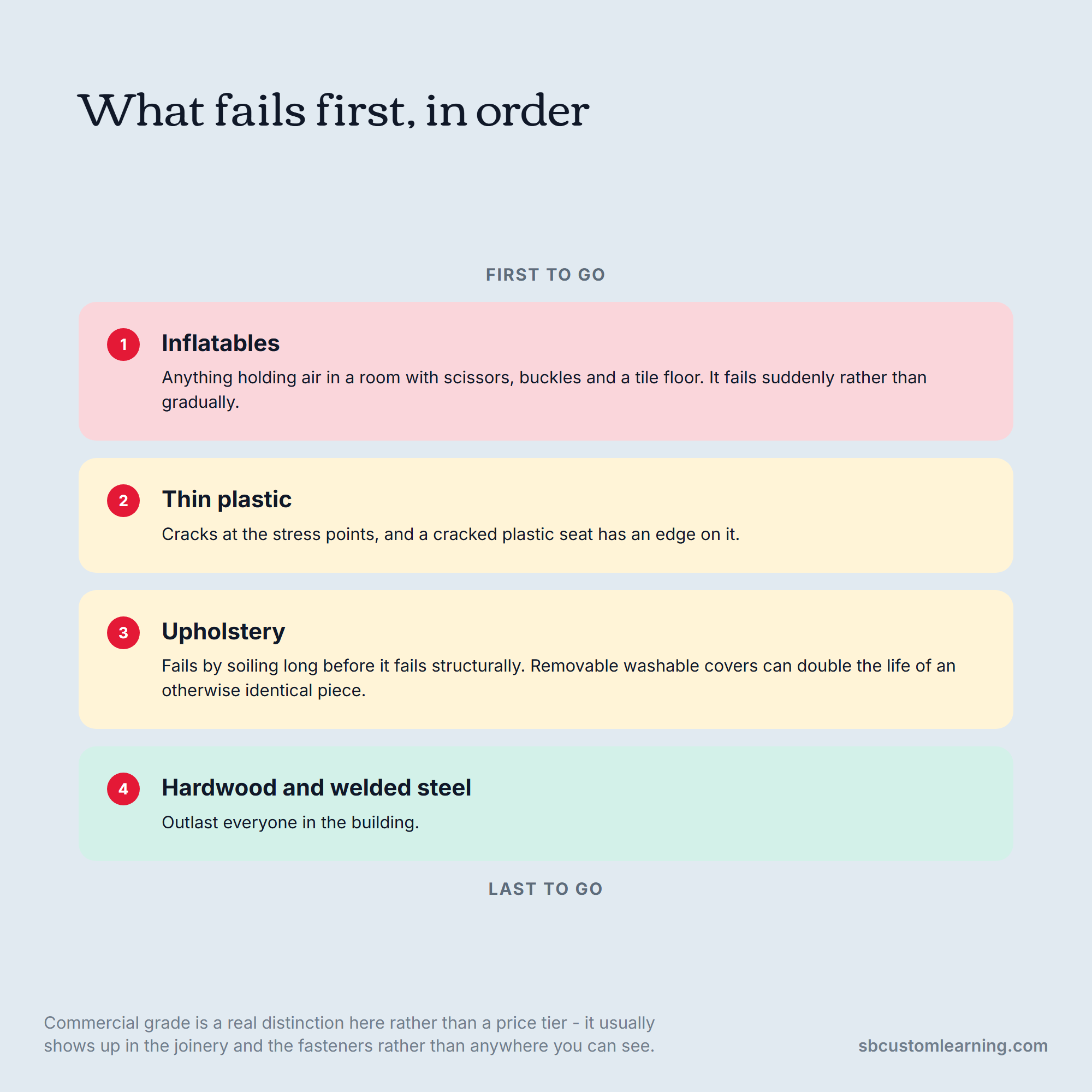
The commercial-grade distinction is real here and not just a price tier. Furniture built for a classroom is tested against a different use cycle than furniture built for a bedroom, and the specification usually shows up in the joinery and the fasteners rather than anywhere you can see.
We are a dealer and an installer rather than a manufacturer, so we have no reason to steer you toward one brand, and every reason to steer you away from things we will be back to replace in eighteen months.
Outdoor seating fails fastest of all, since it adds UV, damp and freeze-thaw to everything above. Our notes on outdoor learning furniture cover the pieces that genuinely survive a season outside.
Flexible Seating Rules That Make It Work
Rules are what separate the rooms where this works from the rooms where it gets quietly abandoned by November.
The most common mistake is treating the seat as a reward. Once a wobble stool is something a child earns, it stops being available to the child who needs it and becomes a behavior currency, and it is usually the least regulated children who lose access to it.
Keep the rules short enough that a four-year-old can hold them:
- Choose a spot before the work starts, not in the middle of it.
- Feet stay in contact with the floor or the footrest.
- One person per seat, every time.
- If you cannot do the work there, move once, and that is your move.
- The seat goes back where it belongs before you leave the area.
Post them with pictures rather than words, and expect two full weeks of practice before any of it is automatic. Skipping that practice period is the single most common reason a rollout collapses.
Floor Seating, Lofts and the Vertical Option
The floor is the most underused seat in any early learning room, and it is free.
Young children choose the floor constantly when allowed to. A defined floor area with a good rug, a low boundary and something to lean against does more for a reading corner than most furniture, and it costs a fraction of a small couch.
Going up is the other underused direction. A loft turns the same square footage into two areas, which in a room that is tight on space is worth more than any single piece of furniture. The area underneath becomes a quiet retreat almost automatically.
Access is the design decision that matters. A ladder excludes children with balance difficulties, lower limb differences, or simply less confidence, while a wide graded stair includes nearly everyone. We built the Educare Chicago play loft with exactly that trade-off in mind, and a graded stair costs less to specify at the start than to add later.
Movement Is Not a Substitute for Movement
Alternative seating is sometimes sold as a way to meet children's need to move. It is worth being precise about how far that goes.
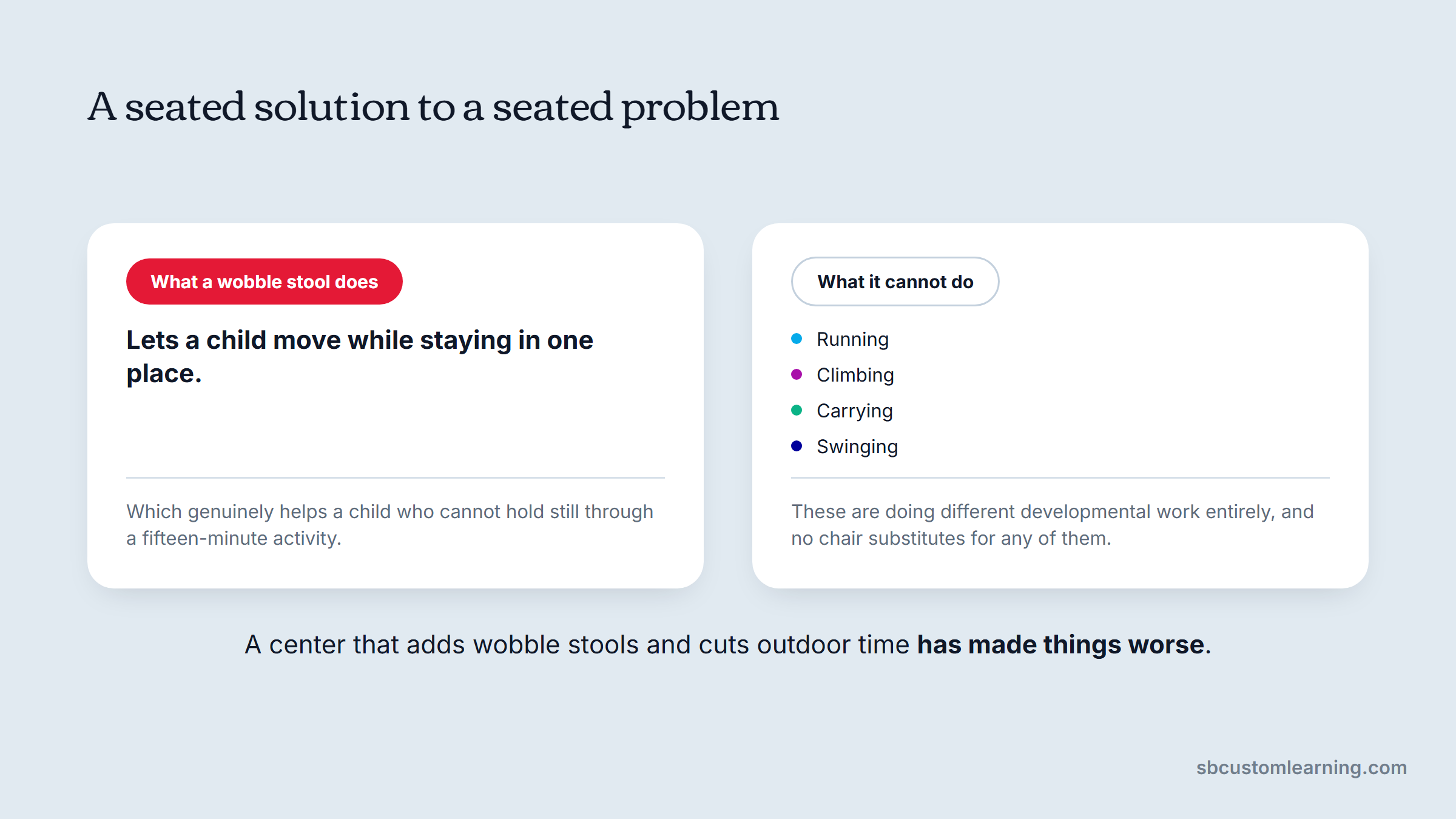
A wobble stool lets a child move while remaining in one place, which helps a child who cannot hold still through a fifteen-minute activity. It is a seated solution to a seated problem.
Running, climbing, carrying and swinging are doing different developmental work entirely, and no chair substitutes for them. A center that adds wobble stools and cuts outdoor time has made things worse, which is the case we lay out about gross motor play.
A wobble stool is doing one job, and it is not the job outdoor time does.
The strongest version of this is both: real movement in the schedule, and seating that does not fight a child's body during the parts of the day that are genuinely seated.
What It Costs to Do Properly
Cost is where flexible seating for classrooms becomes sustainable, or becomes a one-time grant purchase that degrades.
Think in two budgets rather than one. Durable items, meaning benches, lofts, standing surfaces and well-built stools, come out of the capital budget and last five to fifteen years. Soft items, meaning cushions, covers and small upholstered pieces, are consumables on a two-to-three-year cycle and should be budgeted annually.
Centers that skip the second budget end up with a room that looked excellent in year one and shabby in year three, which is worse than never having started.
Product prices sit on our storefront by item, but design consultation, custom builds and installation are quoted per project, because a loft for a 22-by-24-foot room with a column in it is not a catalog line.
Grant funding usually needs the two budgets separated on the quote itself, which is part of what our design consultation produces before anything is ordered.
Where It Does Not Belong
Three places where the honest answer is to keep conventional seating.
Anywhere fine motor work happens, seat height and stability beat choice. A child cutting with scissors or writing needs a stable base and a table at elbow height, and a wobbling seat actively works against both.
Anywhere adult supervision is intermittent, tipping seats are the wrong call. That includes corners around a blind spot, which is a good reason to fix the sightlines before adding the seating.
And in infant rooms, most of this simply does not apply. The floor, supported seating and adult laps cover it, and the flexible seating conversation belongs to children who are already walking confidently.
Three places where the conventional chair is simply the right answer.
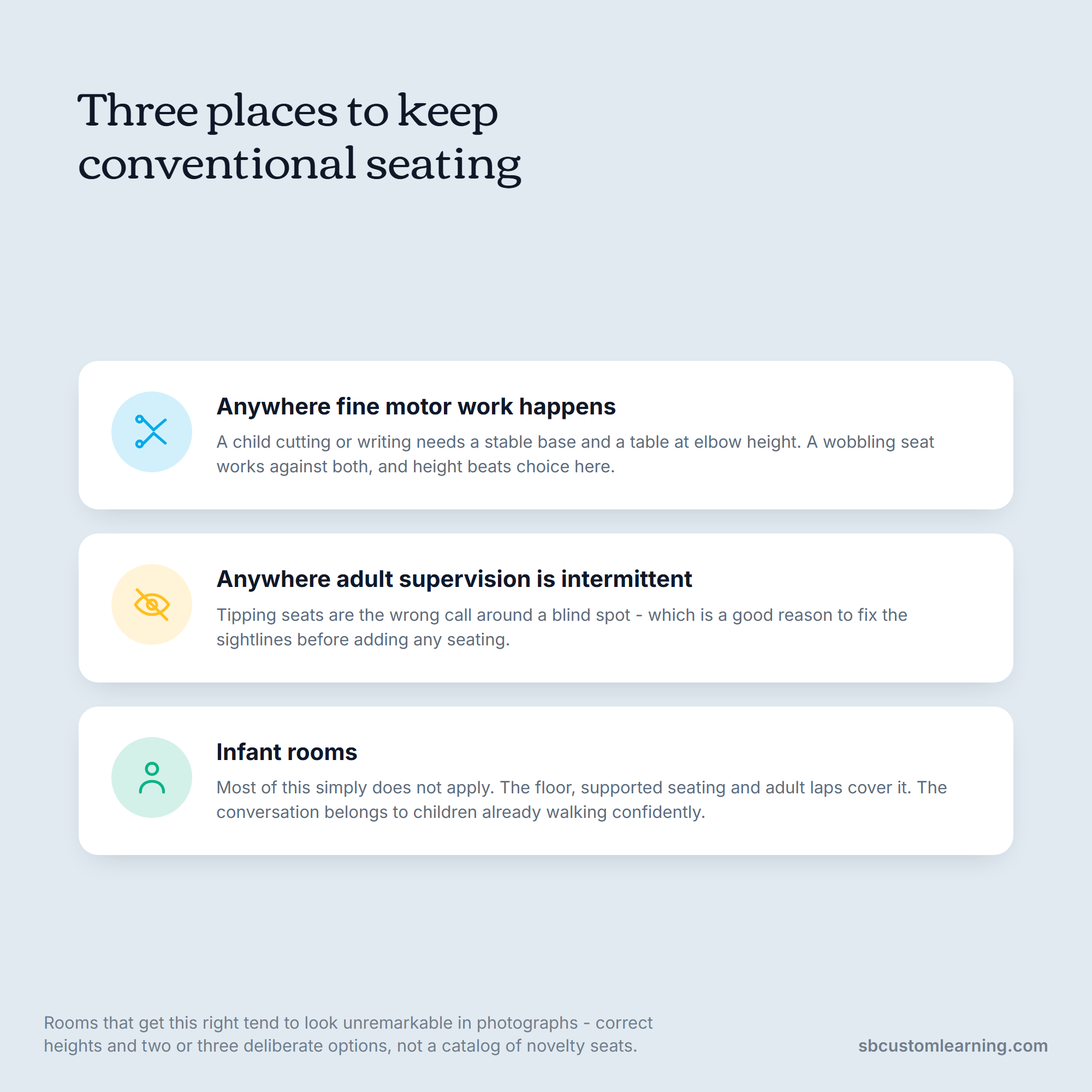
Rooms that get this right tend to look unremarkable in photographs. The finished spaces in our work gallery mostly show correct heights and two or three deliberate options, not a catalog of novelty seats.
Deciding What Your Rooms Actually Need
Start by measuring the chairs you already own against the age of the children sitting in them. That single check resolves more complaints than any purchase, and it costs an afternoon.
Add options after that, two or three per room, chosen because a specific problem exists rather than because a photograph looked good. Budget the soft items annually and the durable items once. Teach the rules for two weeks before judging whether it worked.
If you would rather check the numbers with someone before ordering, start a conversation. Send us the measurements and the ages using the room, and we will say plainly which of your seating problems is a height problem wearing a different hat.
FAQs
What is flexible seating in a preschool classroom?
It means offering more than one place and posture to work in, and letting children choose between them. In practice that is a rug for group time, chairs at the right height for tables, a defined floor area with cushions, and perhaps one or two alternative seats such as a low bench or a wobble stool.
It does not require replacing every chair. A room offering three genuine choices at correct heights is doing more than a room full of novelty seating at the wrong height.
Does flexible seating actually improve learning?
The honest answer is that the evidence supports offering choice, not that it raises achievement. An Illinois State University study found children did prefer flexible options overall, while 16 of 40 still chose a regular chair, and a 2020 IJERPH study found stand-biased desks helped attention specifically for children who were less attentive to begin with.
Both were conducted with children aged roughly 7 to 12, so treat any claim about preschool outcomes with caution.
What flexible seating rules should we set?
Keep them short and picture them: choose your spot before the work starts, feet stay on the floor or a footrest, one person per seat, one move allowed if the spot is not working, and the seat goes back before you leave.
The rule that matters most is the one about not making seats a reward. Once a stool is earned, the child who most needs to move is usually the one who loses it.
How long does flexible seating furniture last in a daycare?
It varies more than any other furniture category. Inflatables and thin plastic often fail within one to two years, upholstered pieces last three to five and usually fail through soiling rather than breakage, and hardwood benches, standing surfaces and built-in lofts run ten years or more.
Budget soft items as an annual consumable and durable items as capital. Removable washable covers roughly double the life of anything upholstered.
Is flexible seating a good idea for toddlers?
Partly. Toddlers benefit from floor space, low benches and defined soft areas, all of which count. Tipping and rocking seats are a poor fit at that age, because balance is still developing and supervision is not continuous.
For infants, skip the concept entirely. Floor time, supported seating and adult laps cover what that age group needs.