
Classroom Rugs in 2026: How to Choose Size, Pile and Safety
Key takeaways:
- Size the rug to the seated group. For a ring, we plan on about 20 inches of rug edge per child, so 16 three- and four-year-olds fit around a 6' x 9' rug. For rows of fives, we plan on about 3.5 square feet per child and keep about a tenth of the rug spare, so a 7'6" x 12' fits up to about 23 children, and a group of 24 or 25 needs a 9' x 12'.
- CPSC's federal rules (16 CFR Parts 1630 and 1631) require carpets and rugs to pass a flammability test, but a small rug (no side over 6 feet, 24 square feet or less) can still be sold after failing if it carries a permanent "FLAMMABLE" label. Turn every rug over and read it.
- Choose a low, level pile on a firm backing with bound edges. Shag rugs and rugs with a polyurethane foam cushion layer are the two types CPSC says typically fail the test untreated.
- Use washable area rugs over a hard floor. Run a HEPA vacuum over them daily, clean them weekly, and follow NAEYC's cleaning table for large rugs: a full wash every month in infant rooms and every third month in other rooms. Keep rugs away from the sand table, the easel and the sink.
Circle time starts, and the last four children sit on the bare tile because the rug is full. By the door, a corner of the reading rug has curled up again, and someone has taped it down for the third time this month. Both problems go back to the same decision: how the rug was chosen.
Classroom rugs look like the simplest purchase in the room, and they carry more decisions than most furniture does. A rug sets where a group gathers, how far noise carries, what a child trips on, and what you'll be picking out of the fibers in March. It also falls under federal flammability rules that many buyers never see, because the label is on the back.
At SB Custom Learning, we size and place classroom rugs as part of the room plan, so the advice below comes from fitting them into real early learning rooms.
What Classroom Rugs Do in an Early Learning Room
A rug does three jobs at once. It marks a zone without a wall, it gives children a warm, soft place to sit on the floor, and it takes some of the edge off a loud room.
The zone job is the one that changes behavior. A rectangle of carpet in front of the bookshelf tells a three-year-old where reading happens faster than a sign does, and a seating rug with marked spots tells a group where to land before an adult says a word.
The noise job matters most in shared rooms. Since July 1, 2026, the agency licensing Illinois centers has been the Illinois Department of Early Childhood (IDEC), and its rules at 23 Ill. Adm. Code 2008.370 require any room holding more than one group to have "an acoustical ceiling or its equivalent in carpeting or wall covering."
The same rule adds that carpet used for noise "shall not be required in water play, painting, and similar areas," which is a useful hint about where classroom rugs belong. Sound-absorbing materials are part of thoughtful classroom design, and a rug softens footfalls where children sit closest together.
Part 2008's equipment lists name the rug itself. The infant and toddler list includes an "area rug or carpeting," and the list for the three-to-five rooms asks for an "area rug or carpeting for each group, or individual carpet squares or cushions for each child to sit on." Outside Illinois, your state's licensing agency sets its own version.
How to Size a Rug for Circle Time
Circle time is where an undersized rug shows first, because every child needs a spot at the same moment. Two quick methods work out the size on paper: one for a ring, one for rows.
Measure by the Edge When Children Sit in a Ring
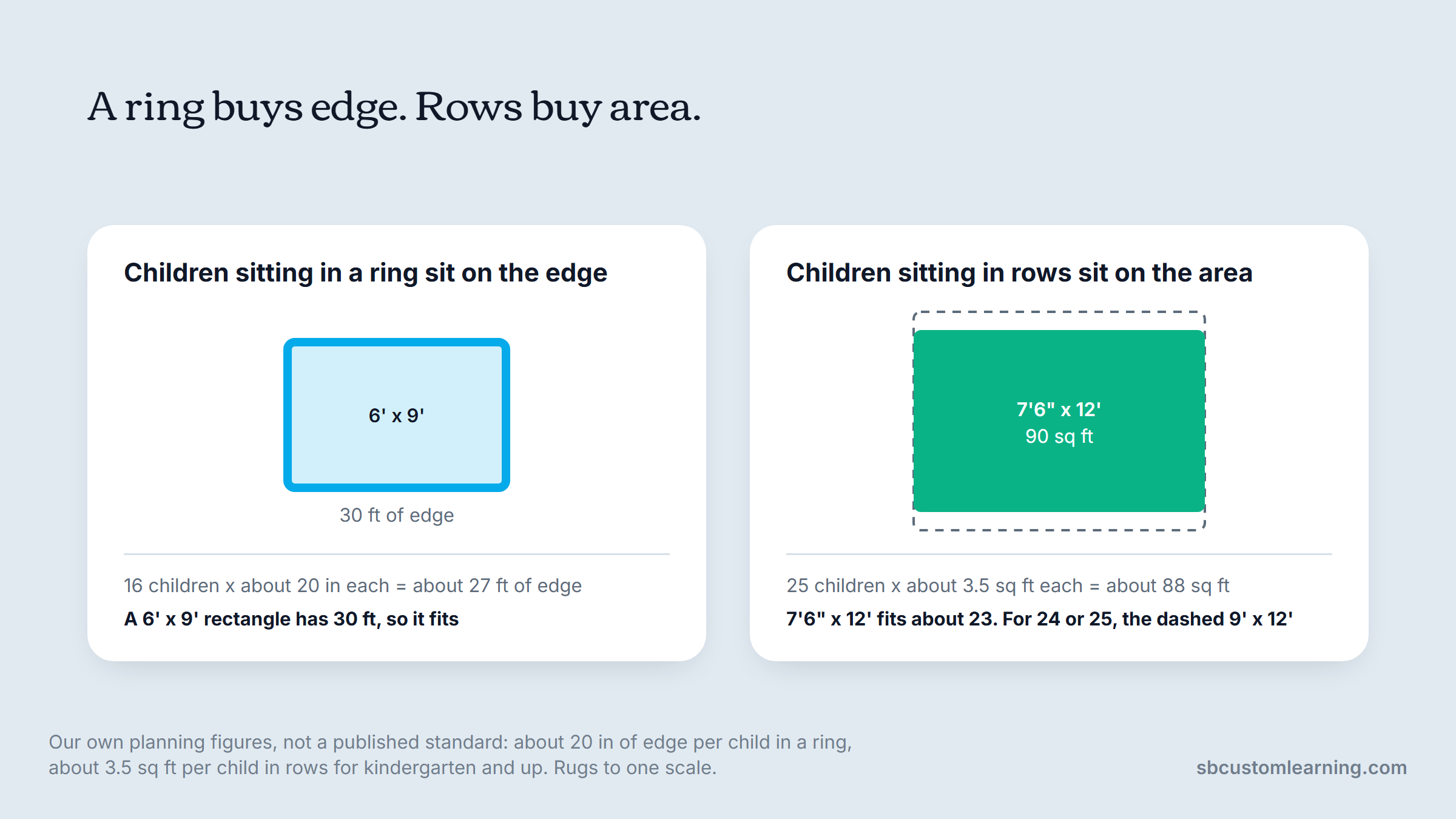
When a group sits in a ring, children sit along the edge, so the edge is what you're buying. We allow roughly 20 inches of rug perimeter, measured along the outer edge, for each cross-legged three- or four-year-old, which is our own planning figure, not a published standard.
Count the largest group that ever sits at once and multiply by 20 inches. A group of 16 needs 320 inches, about 27 feet of edge. A 6' x 9' rectangle has 30 feet of edge and a 9-foot round about 28, so both clear it, the round only just.
When the numbers are that close, go up a size if the floor allows. Keep the teacher's chair at a gap in the ring so it doesn't take two children's places.
Measure by the Area When Children Sit in Rows
When children sit in rows facing a teacher or a board, area matters more than edge. We plan for about 3 square feet per seated child in the 3s and 4s room and about 3.5 for fives and kindergartners, because bigger bodies take more room and shift more.
A group of 25 at 3.5 square feet needs about 88 square feet, and a 7'6" x 12' rug has 90, which leaves almost nothing spare. That's why we cap it at about 23 children.
Twenty-three take about 81 square feet and leave roughly a tenth of the rug free for the gaps between rows. At 24 the spare drops to about 6 square feet, the same "only just" margin that sends a ring up a size, so a 9' x 12' (108 square feet) is the safer pick at 24 or 25.
Getting the count right does more than prevent crowding. When the whole group fits, nobody spends the first five minutes negotiating for an edge, which is why sizing to everyone is one of the simplest moves toward a strong classroom culture. Before you order, tape the rug's outline on the floor and have the group sit inside it once.
Rug Sizes by Zone and Group Size
Circle time is one zone, and most rooms need two or three classroom rugs of different sizes. The "How we size it" column below is our own working rule from fitting rooms, not a licensing rule or a manufacturer's chart, so treat it as a starting point and check it against your own group sizes.
| Zone | Typical group | How we size it | Size that usually fits |
|---|---|---|---|
| Circle time, 3s and 4s room | 16 children in a ring | About 20 in. of edge per child | 6' x 9' rectangle (a 9' round only just) |
| Morning meeting, fives or kindergartners | 22 to 25 children in rows | About 3.5 sq ft per child | 7'6" x 12' up to about 23; 9' x 12' for 24 or 25 |
| Reading corner | 3 or 4 children lounging | Room to sprawl | 4' x 6' or a 5' round |
| Block area | 4 or 5 builders | The floor between two shelves | 6' x 9', low or flat pile |
| Dramatic play with a table | 4 children at a 48 in. round table | Table plus about 24 in. on every side | 8' round |
| Toddler floor play | 6 to 8 toddlers | The play area, clear of the walking path | 6' x 9', low pile |
Two rows deserve a note. The block rug wants the flattest pile you can find, because a tower built on plush carpet wobbles. And a dramatic-play rug has to be big enough that a chair pulled back from the table stays on it, so the legs don't catch the edge. The Carpets category of our completed projects shows some of the finished pieces, from logo entrance mats to an alphabet rug.
The reading-corner row also crosses a federal line. A 4' x 6' rug is exactly 24 square feet, which makes it a "small" rug under the flammability rules below.
Classroom Rug Flammability Labels and What They Mean
Carpets and rugs sold in the US fall under a federal surface-flammability standard, and the Consumer Product Safety Commission splits them by size. A rug with a side longer than 6 feet and an area over 24 square feet falls under 16 CFR Part 1630. A small rug, with no side over 6 feet and no more than 24 square feet, falls under Part 1631.

The test is the same for both. A lab cuts eight 9" x 9" samples, sets a metal frame with an 8-inch hole on each, and lights a timed burning tablet in the center. A sample passes if the char stops more than 1 inch from the edge of the hole, and the rug passes if at least 7 of the 8 do.
The Small-Rug Exception
A large rug that fails can't be sold. A small rug that fails can, as long as it carries a permanent label reading: "FLAMMABLE (FAILS U.S. DEPARTMENT OF COMMERCE STANDARD FF 2-70): SHOULD NOT BE USED NEAR SOURCES OF IGNITION."
So a 3' x 5' accent rug from a home store can be perfectly legal and still wrong for a room full of children. If a rug was donated or brought from home for a cozy corner, check it first, since home rugs are often this small.
The "T" and the Children's Product Certificate
A rug treated with a fire retardant, or made from treated fibers, must carry the letter "T" on its label or invoice. CPSC also names the two kinds of untreated rug that typically fail: shag or fluffy rugs, and rugs with a polyurethane foam layer for cushioning.
A rug designed for children 12 and younger is a children's product, so it must be tested by a CPSC-accepted third-party lab and come with a Children's Product Certificate. A general-use rug needs a General Certificate of Conformity.
Spec sheets sometimes add a Class I or Class II rating under NFPA 253 or ASTM E648, a building-code test aimed at corridors and exits, so ask your local fire authority whether your building needs it.
Before a new rug goes down, turn it over and run through these checks:
- Look for a "FLAMMABLE (FAILS...)" warning on any small rug, with no side over 6 feet and 24 square feet or less.
- Note whether the label or invoice shows a "T" for a fire-retardant treatment.
- Ask the seller for the Children's Product Certificate or the General Certificate of Conformity.
- Skip shag and foam-cushioned rugs unless the paperwork shows a pass.
- File the paperwork with your other licensing records.
That last step pays off at an inspection, when "where did this rug come from" has an answer on paper. Ask for the paperwork with the quote, whoever the supplier is.
Pile Height and Backing
Pile height is the length of the fibers above the backing, and in a classroom shorter almost always wins. A low, level pile vacuums clean, lets blocks stand, lets a child's mobility walker or wheelchair roll across, and doesn't hide crumbs.
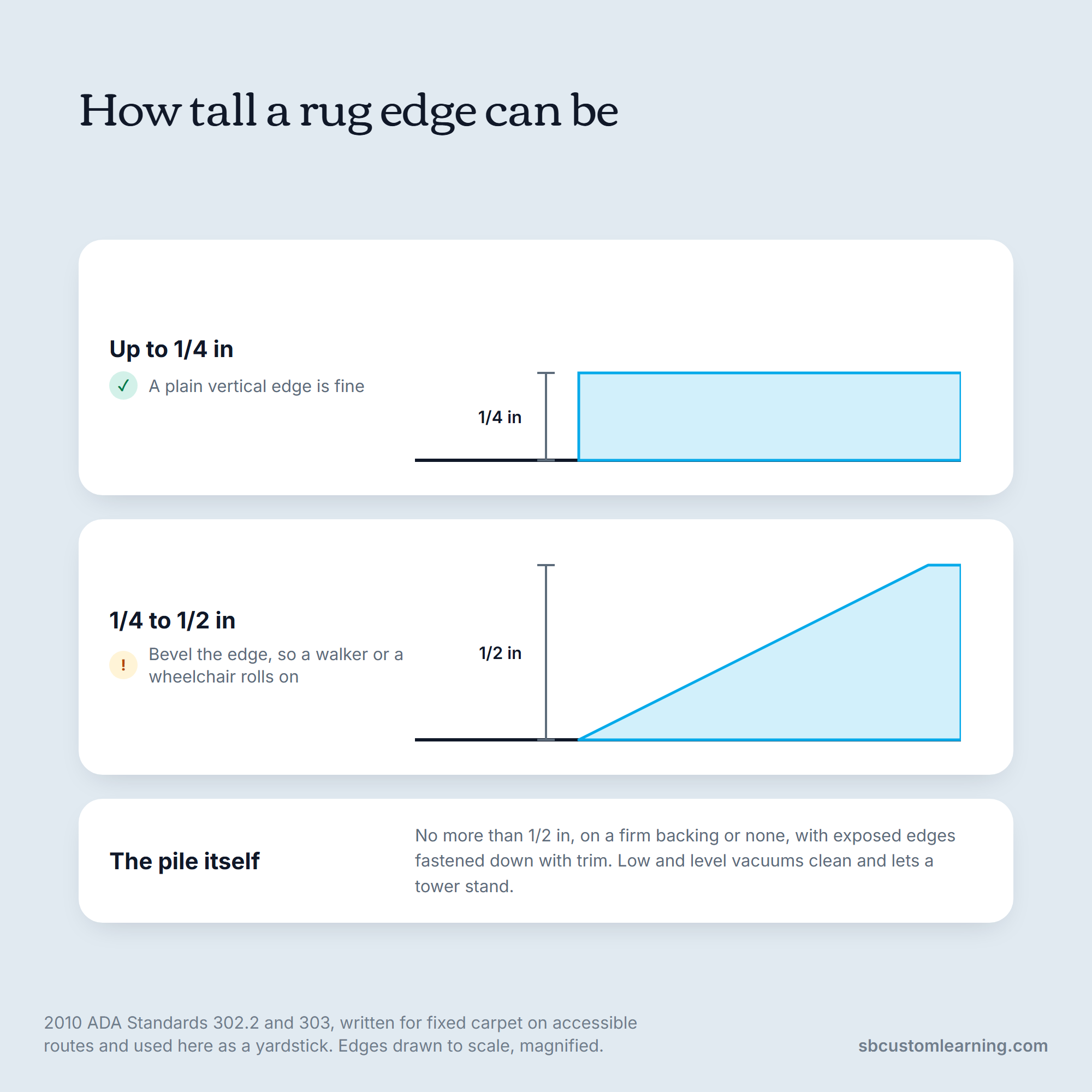
For a height yardstick, the 2010 ADA Standards carpet rule (§302.2) is written for fixed carpet on accessible routes, and its numbers still help: pile no more than ½ inch, a firm backing or none, and exposed edges fastened down with trim. Under §303, a change in level up to ¼ inch can be a plain vertical edge, and from ¼ to ½ inch it should be beveled.
| Pile or backing | Where it works | What to watch |
|---|---|---|
| Low, level loop or cut pile | Circle time, blocks, toddler rooms | Very thin pile gives little cushion on concrete |
| Plush or shag | Rarely in a group room | Hides dirt; untreated shag typically fails the federal test |
| Polyurethane foam cushion layer | Only with paperwork showing a pass | Typically fails untreated; hard to roll across |
| Firm latex or rubber non-slip backing | Most rugs over a hard floor | Check it won't mark the floor finish |
| Bound or serged edges | Every classroom rug | Keep the vacuum off the binding |
The backing decides whether the rug stays put. On a sealed hard floor, a firm non-slip backing usually holds on its own. On slick vinyl or over existing carpet, add a thin, firm gripper pad made for the job, because soft padding makes the rug harder to roll across and lifts the edge higher.
Alphabet Rugs and Seating Spots: When Pattern Helps
Seating rugs with letters, shapes or color blocks give each child an assigned spot, which cuts the jostling at the start of every group. Letters do double duty for fours and fives, because the spot itself becomes a letter to name.
Pattern works best where a rug is a gathering place. A quiet reading corner usually does better with a calm, low-contrast rug, and the same restraint that keeps walls readable applies to the floor, a balance we work through in classroom decor ideas. One patterned rug per room, with plainer ones around it, keeps the room easy to read.
If you'd like letters on the group rug, one alphabet classroom rug our shop carries is an A to Z animals design in the 7'6" x 12' size, with one animal per letter from Alligator to Zebra.
That rug stands 0.312 inches tall overall, past the ADA's ¼-inch plain-edge limit, and weighs 41 pounds, so keep its edge off the main path and plan on two people to lift it.
Cleaning Classroom Rugs: Daily, Weekly, Monthly and After a Spill
A rug that's easy to clean gets cleaned. That's the practical case for area rugs over a hard floor instead of wall-to-wall carpet, and it's where the child care health standards land too.
Reviewing 49 publications from 1980 to 2017, Becher and colleagues at the Norwegian Institute of Public Health reported studies finding that house dust mite allergen in carpet sat mostly in the deepest layers, whatever the construction, and that a vacuum sampler recovered less test dust from carpet than from smooth, hard surfaces.
The same review concluded that caution is still warranted with wall-to-wall carpet in schools and kindergartens, and noted that carpet needs more thorough, more expensive cleaning than hard floors, which raises the risk that cleaning gets put off. Caring for Our Children's cleaning schedule, Appendix K (last updated July 25, 2022), puts it in one line: "Washable area rugs are a safer choice than wall-to-wall carpeting."
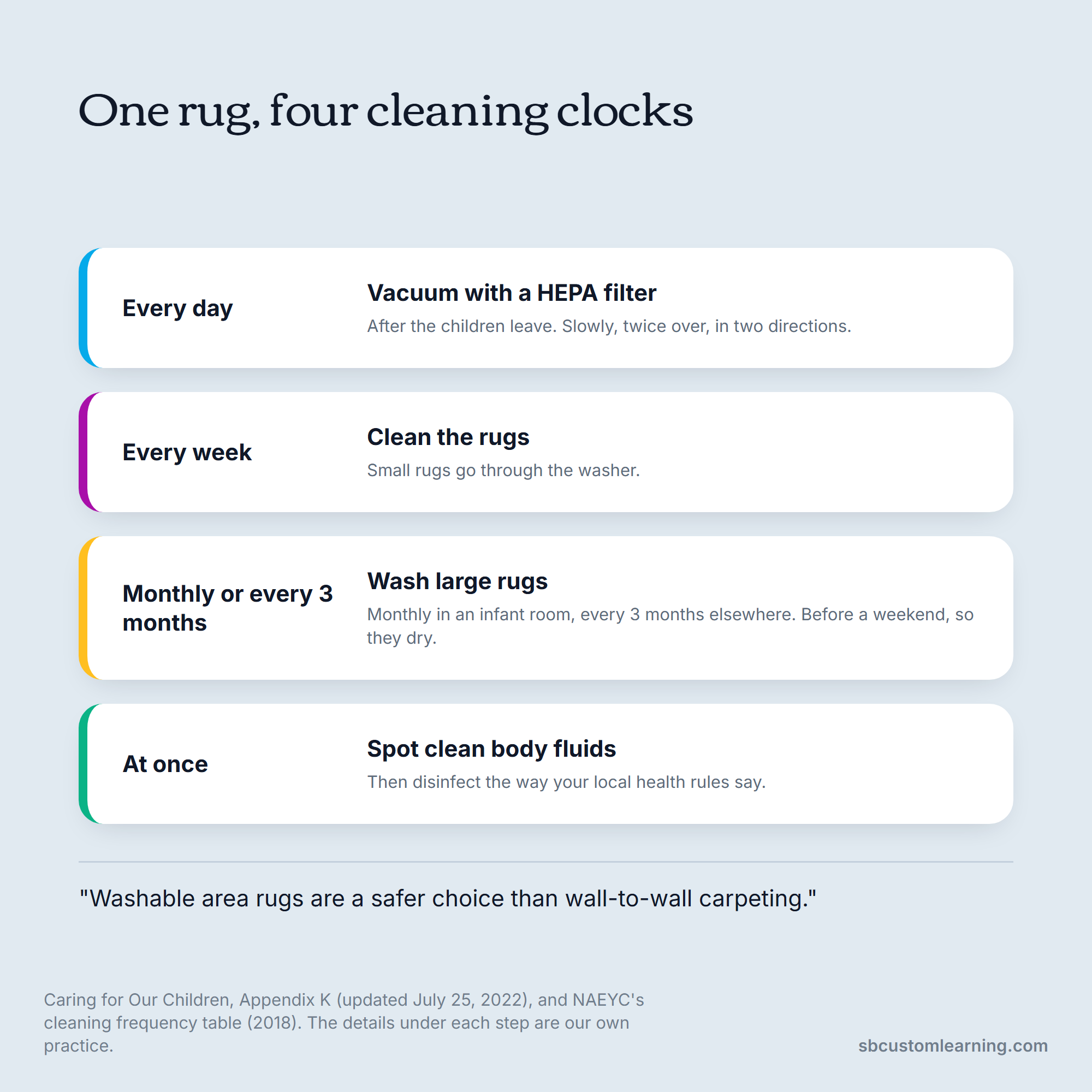
Appendix K's floor routine is short: vacuum daily with a HEPA filter, clean area rugs weekly, spot clean body fluids, and steam clean wall-to-wall carpet every 3 to 6 months.
NAEYC's cleaning frequency table, adapted from Caring for Our Children, sets a tighter clock for carpets and large area rugs: a wash at least monthly in infant areas and at least every three months elsewhere, with small rugs laundered weekly. We plan rugs to that tighter schedule. Steps 1 to 3 and 5 below come from the two documents, and the rest are our own practice:
- Vacuum every rug daily with a HEPA-filter vacuum, after the children have left.
- Push the vacuum slowly and cover the rug twice, in two directions.
- Spot clean anything soiled with body fluids right away, then follow your local health rules for disinfecting.
- Blot ordinary spills with a clean cloth, cold water and a little mild soap, and never scrub.
- Launder small rugs weekly, and deep clean large rugs at least monthly in an infant room and every three months elsewhere, before a weekend or a break so they're dry before anyone sits on them.
- Turn the rug a half turn at each deep clean so the busiest path wears evenly.
Licensing favors the area rug as well. In Illinois, 23 Ill. Adm. Code 2008.370(e)(2) says "floors and floor coverings shall be washable," which a rug you can lift, clean and dry meets more easily than carpet glued wall to wall. A small rug that fits a commercial washer is easiest of all.
Our store's Carpets category runs from small round reading rugs to large seating rugs sized for a whole group.
What Survives Near a Sand or Paint Table
Messy zones are where classroom rugs wear out fastest. Sand grinds into the fibers and works down to the backing, wet paint sets before anyone notices, and water from a sensory table soaks one edge every day until it smells.
The fix is distance. Keep the sand table, the easel, the water table and the sink on a hard, sealed floor, which the Illinois rule allows for, since carpet used for noise isn't required in water play and painting areas. We plan for at least an arm's span of bare floor between a messy zone and the nearest rug, so sand that falls off a child's shoes lands on tile first, where a broom gets it.
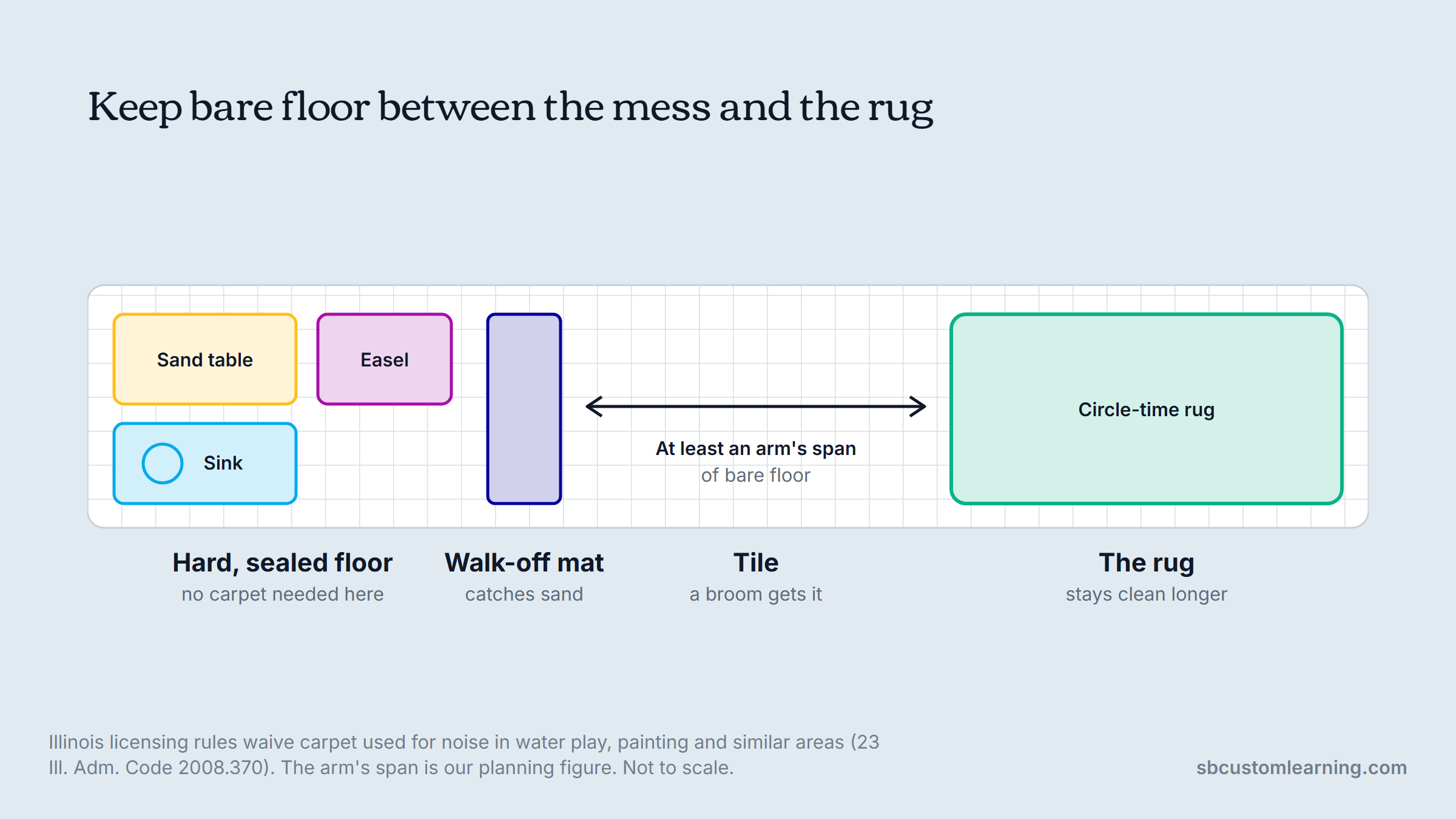
When a rug has to sit nearby, choose the one that copes best. A low, tight pile in a darker or patterned color hides staining, and a small washable rug can go straight in the washer. A walk-off mat at the edge of the sand zone catches sand on the way out, before it reaches the circle-time rug.
For paint that lands on a rug anyway, lift what you can while it's wet, blot with cold water and mild soap, and let it dry fully. Dried water-based paint usually softens with a little warm water and comes up with a dull scraper. Anything oil-based or permanent is a job for a professional cleaner.
Placement, Edges and Trip Hazards
Many rug problems come down to where the rug sits. An edge in a doorway, a corner in the path to the sink, or one rug laid over another makes a trip line that children and adults cross dozens of times a day.
Start with the paths. Keep rug edges out of doorways, exit routes and the walk between the sink and the tables, and don't layer one rug over another, since the top one shifts and bunches. Never run a cord under a rug: CPSC's extension cord warning says a covered cord can't release its heat and can start a fire.
Placement also has to keep your sightlines, so you can see every child while the group sits. Draw rugs into the same plan as the zones and shelves, the way every zone gets placed in classroom layouts, and check each rug's position against the view from the door before anything is ordered.
Once a rug is down, walk the room and check each of these:
- Every edge lies flat, with no curl at a corner.
- The rug doesn't slide when you push off it with one foot.
- No edge sits in a doorway or the path to an exit.
- A mobility walker or a wheelchair rolls on and off without catching.
- No cord runs under the rug.
- You can see every child on the rug from where you usually stand.
Repeat the walk every few weeks, because rugs creep. A corner that starts to curl is easier to fix with a gripper strip in October than after a fall in January.
Rugs for Infants and Toddlers
The youngest rooms need the most care, because the children spend their day on the floor and put everything in their mouths. Infants don't walk to circle time or sit at tables, so an infant rug is simply a floor-play surface for tummy time, rolling and crawling.
Choose a low, washable rug or mat with a firm backing and no loose fibers, and keep it in the play area, out of the sleeping space.
A licensed sleeping area uses cribs that meet the federal crib standard, spaced as your licensing rules require, and a rug never goes inside a crib, where it becomes soft bedding. Where the floor-play area sits relative to the cribs is one of the first decisions in setting up infant classrooms, and the rug follows it.
Toddlers are walking, so their rug has to be flat enough not to trip a child who's still unsteady. A low, level pile with bound edges, sized to the play area and kept off the main path, works best. Pick one two adults can lift and wash, and keep it at least an arm's span from the water table, the sink and the toileting area, because toddler spills travel.
Ordering, Delivery and Fitting the Rug to the Room
A large rug is heavy and awkward to send back, so settle the color and texture before the order goes in. We can share samples on request, so you can judge both before you commit.
Our installation crews set the room up when the furniture goes in. Busy Bees Learning School mentioned that part when it wrote that "professional installations are also provided, which makes everything much easier!" Its review also credits the range: "They offer a variety of high-quality, durable educational materials that meet all safety standards for our children's needs."
Our rugs and furniture come from several established makers, with custom furniture commissioned for the corners and heights that stock pieces miss, and each project is quoted on its own scope. Delivery covers the Midwest and keeps widening, and we can often source products the online store doesn't list, both covered in our frequently asked questions.
Start with Tape on the Floor
The fastest way to choose well is to measure the group, not the room. Count the children who sit together, tape the outline, sit them inside it once, and you'll know the size. Then read the label on the back, choose a low pile on a firm backing, and keep classroom rugs away from the sand and the paint.
A rug gets sat on, walked on and cleaned more often than almost anything else in the room, so it's worth getting right the first time. When you want someone to check the sizes and the placement with you, talk to our team at SB Custom Learning, and we'll start from your room, your age groups and the number of children who gather at once.
FAQs
What size classroom rug fits 20 children?
For 20 fives or kindergartners in rows, our planning figure of about 3.5 square feet per child comes to about 70 square feet, which an 8' x 10' or a 7'6" x 12' rug covers. In a ring of three- and four-year-olds, our 20-inch planning figure calls for about 33 feet of edge, which an 8' x 10' (36 feet) just clears and a 9x12 classroom rug (42 feet) clears with room for the teacher. Tape the outline and test it first.
Do classroom rugs have to meet a flammability standard?
Yes. Carpets and rugs sold in the US must pass the federal surface-flammability test in 16 CFR Part 1630 or 1631. The exception that matters in a classroom is the small rug, 24 square feet or less with no side over 6 feet, which can still be sold after failing as long as a permanent "FLAMMABLE" warning is attached. Check the back of every small rug.
What pile is best for kindergarten classroom rugs?
Low and level, because that pile vacuums clean, lets blocks stand, and gives a mobility walker or wheelchair an easy roll. The ADA's carpet rule caps fixed carpet pile at ½ inch, a useful upper limit. CPSC says untreated shag and foam-cushioned rugs typically fail, so ask for test paperwork first.
How often should area rugs for classrooms be cleaned?
Vacuum daily with a HEPA filter once the children have gone home, and spot clean any body-fluid spill right away. NAEYC's cleaning table asks for a full wash of large rugs once a month where infants play and once a quarter in other rooms, with small rugs laundered every week. Caring for Our Children's 3-to-6-month steam clean is for wall-to-wall carpet. Schedule each deep clean when the room can sit empty long enough to dry.
Can you put a rug on top of carpet in a classroom?
You can, with care. A rug over carpet tends to creep and bunch, so put a rug-on-carpet gripper underneath and check the edges every few weeks. Don't stack two loose rugs, keep the edges out of doorways, and never run a cord underneath.