7 Ways to Build a Positive Classroom Culture
Key takeaways:
- Classroom culture is the handful of habits a room repeats every day until children trust them: how you greet, what sits at their eye level, and who gets the real jobs.
- Belonging, predictability and shared agreements shape behavior more than any reward chart, and the room is what makes them easy to keep.
- Seven moves, from greeting every child by name to a family photo wall at child height, work in infant, toddler and 3- to 5-year-old rooms alike.
- The adults set the tone first. Staff who share the same greeting, the same words and the same signals give children a room that feels safe.
Walk into two rooms with identical furniture and you can feel the difference in ten seconds. One hums. The other bristles. The gap is culture.
Culture is everything a room does on repeat. It is the welcome at the door, the way you say a child's name, the pictures on the wall, and what happens when someone is sad.
For a two-year-old, those repeated moments carry more weight than any rule, because young children read a room through their senses long before they understand a sentence. Build the culture on purpose and the room starts working for you instead of against you.
At SB Custom Learning, we design and furnish early learning rooms for a living, and the pattern is always the same. The rooms that run smoothly are not the ones with the biggest budget. They are the ones where the adults decided what belonging would look like, then did it again the next day.
What Classroom Culture Means in an Early Learning Room
The working definition of classroom culture is simple: it is the set of repeated habits that tells a child, without words, "you are expected here, and you are safe here." When you define classroom culture that way, the work stops being about decorations and becomes about repetition. A room earns its calm the same way a child learns a song, one verse at a time.
For a director or owner, that definition is useful because it is measurable. You can watch the door. You can watch the wall. You can watch how long it takes a 3-year-old to find something to do after drop-off. Culture shows up in three places at once.
| Building block | What it gives a child | What it sounds like at 8 a.m. |
|---|---|---|
| Belonging | A reason to walk in and stay | "Good morning, Maya. I'm glad you're here." |
| Predictability | A reason to relax | "After snack we go outside, just like yesterday." |
| Shared agreements | A reason to cooperate | "In our room, we take care of the toys and each other." |
Every idea below feeds one of those three blocks. Each starts with a decision, made once and then repeated until children stop needing to be told. Each one also holds more easily in a room built to carry it: a doorway with somewhere to put a coat, a wall at child height, a floor big enough for the whole group.
Why Classroom Culture Matters More Than Any Poster
Why teach culture in the classroom at all? The environment matters, and culture is what makes the environment work. And why is it important to teach culture in classrooms this early, rather than once the learning goals are set? Because a child decides how a room feels on the first day, long before anyone introduces a goal.
Behavior is where the difference shows. NAEYC's peer-reviewed journal Young Children reports that 10 to 21 percent of young children show repeated challenging behavior such as tantrums, defiance or aggression, and that the share climbs to about 30 percent for children growing up in poverty. The same article names five culturally responsive strategies, and every one of them is a relationship habit rather than a consequence.

A strong culture also protects the adults. A room with clear, shared routines asks less of a teacher's voice, which leaves more patience for the child who needs it most. It also protects the children who arrive carrying stress from home, because a predictable welcome is one of the few things you can promise them.
Centers are where that promise gets tested. How you plan them, and who can reach what, decides whether children share or compete, a balance we plan for in planning learning centers. Get the culture right and the room mostly runs itself. Get it wrong and the teacher spends the day refereeing.
Way 1: Greet Every Child by Name at the Door
The cheapest culture tool you own is your doorway. A greeting by name tells a child that an adult noticed them and is now responsible for them, and it costs four seconds.
Stand where children and families arrive, at their eye level rather than above them, and make the first words about the child rather than the sign-in sheet. Say the name. Note one thing that is true that morning. Do it at pickup too, so the day closes the way it opened. A warm doorway is what turns a plain cultural classroom into one a child runs toward.
A few moves keep the greeting from hardening into a script.
- Stand at the door, not behind the tablet.
- Use the child's name first, every time.
- Drop to their height and make eye contact.
- Add one specific detail: a new haircut, a favorite color, a lost tooth.
- Say goodbye by name at pickup and name one good thing from the day.
None of that depends on age. Infants track your voice and face, toddlers beam when their name comes first, and 4-year-olds notice when the greeting is skipped. The doorway is the first signal and the wall is the second, and together they are what makes a cultural classroom feel calm. Directors who make the doorway a shared staff standard usually watch drop-off tears shrink within a couple of weeks.
Way 2: Build a Family Photo Wall Children Can Reach
A family photo wall is the fastest way to put belonging into a room, and the most common way to get it wrong is height. Photos placed high, where only adults look, become wallpaper. Photos placed at child eye level become a bridge between home and the early learning room.
The practical problem is durability. Framed photos fall off shelves and break, and glass belongs nowhere near the age band where children carry everything they can lift.
So skip the frames. Laminate the photos and fix them low, either on a rail mounted at child height, where a laminated card can be lifted down and pushed back, or with clear contact paper applied straight onto the wall, which leaves nothing loose to pull.
Either version costs very little and survives a toddler room, which a shelf of frames does not. Build the wall so a child can touch it, then refresh it when a new baby, a new pet or a grandparent joins the family. The goal is not decoration. The goal is that every child can point at their own people and say, "that's mine."
Way 3: Turn Your Class Agreements Into Pictures
Rules written on the wall are invisible to a child who cannot read them yet, so the agreements that actually shape a room are drawn and posted. This is the simplest answer to how to incorporate culture in the classroom: let children help name how the room works, then turn those words into pictures.
Start with three or four positive statements, such as "we take care of our friends" and "we put things back," and draw each one with the children. "No running" becomes "we walk inside." Then sign it. When a disagreement comes up, point at the picture instead of quoting a rule, and ask the group what the picture says.
- Ask children what helps them feel safe and happy at school.
- Write down their words, then group them into three or four short agreements.
- Draw one picture for each agreement, with the children's help.
- Have every child add a mark, a name or a photo to the poster.
- Post it at child eye level and point to it instead of repeating rules.
This is also where a culturally diverse classroom earns its promise. Invite families to share a word, a song or a celebration from home, and fold those into the pictures and the daily language of the room. Cultural diversity within the classroom is not a unit you teach in one week. It is a set of small, repeated choices about whose home life gets reflected on the wall.
Whose words are on the wall decides who feels named, and children notice that long before adults name it.
Way 4: Give Every Child a Real Classroom Job
A classroom job turns a child from a visitor into a member. The job does not have to be big, but it has to be real, because children spot a pretend task immediately.
Plan jobs around what the room genuinely needs each day: watering a plant, holding the door, handing out napkins, feeding the class pet, checking the weather. Rotate them so every child gets a turn, and post the chart at child height with pictures where possible. The point is contribution, not compliance.
Jobs are also the glue that holds a culturally diverse classroom together, because a shared task gives children a reason to work beside someone they might not choose. Every child gets to be useful, and usefulness is belonging a child can feel.
A job chart is only as strong as the routines beneath it, and those routines are the part most rooms rush, a set of systems we lay out in classroom routines and jobs.
Way 5: Set Up a Calm-Down Corner Children Choose
A calm-down corner gives a child somewhere to go before a feeling becomes a meltdown. The difference between a calm-down corner and a corner that fails is choice: a child who decides to go there is practicing self-regulation, while a child who is sent there is serving a sentence.
Put plainly, a corner children are sent to is a dressed-up time out. The ones that work are used because a child wants to be there rather than because an adult decided for them, and that is the whole design rule.

Make the corner soft, low and easy to leave. A child who can walk away from it has learned that the corner is a tool, not a punishment.
- A soft mat or a small play arch with a cushion.
- A couple of quiet sensory items, such as a soft toy or a textured cushion.
- Family photos or teacher photos taped at child height inside the space.
- One or two books about big feelings.
- A clear signal, such as a visual card, that shows the corner is open.
Place it where you can still see into it, and keep it out of the main traffic path. That way a child can take a break without an audience, and you can still count heads without crossing the room.
Way 6: Find a Rug Everyone Actually Fits On
A rug looks like a purchase, but it is really a decision about who gets to sit together. Buy one that fits the whole group at once, not just the corner it lands in, and children stop negotiating for the edge.
Size it to the largest circle your room uses: everyone seated with a little elbow room, plus space for a teacher's chair. A rug that seats most of the class quietly teaches the last four children that they are visitors. A rug that fits everyone teaches the opposite.

For mixed ages, choose one plain enough that it does not fight the room and big enough that a toddler and a 4-year-old can share it without touching.
A rug is also how you define a gathering space without a wall. In a room that needs quiet zones, a rug can mark one area while movable pieces mark another, and the order you set that up in is the one we follow in setting up a room. Think of the floor as the first piece of furniture, because children do.
Way 7: Hang Children's Own Work, Not Store-Bought Posters
Store-bought posters make a room look finished. Children's own work makes it look alive. When a child sees their painting mounted at eye level, the room tells them their effort counts, and that is the message you want repeated all year.
Rotate the work often. A wall that has not changed since September stops being noticed by November. Date each piece lightly on the back, swap in new work every few weeks, and keep the display low enough that children can find their own. Leave space for the child who is still learning to write their name, because a scribble earns the same frame as a careful drawing.
Where a child's work hangs is the first sentence of a room's story, part of the thinking behind thoughtful classroom design.
This display is also one of the simplest answers to how to promote cultural awareness in the classroom, because the art a child brings from home belongs on the wall beside everything else, and children read that wall before anyone speaks.
Display the family recipes, the grandparents' photos and the words in a home language next to the paintings, and the wall starts teaching what the room believes. A wall that shows cultural diversity within the classroom teaches it without a lesson.
What the Room Says Before Anyone Speaks
Long before a teacher says a word, the walls have already introduced the room. A child decides in the first minute whether this is a place for them, and the display tells them most of what they need to know.

The test is height and authorship. Work made by the children, placed where they can see it, says "this room belongs to you." Work bought to fill space, placed high, says "this room belongs to the adults." Run this audit on your own walls and fix the smallest thing first.
| What's on the wall | Who it is really for | What to change |
|---|---|---|
| Store-bought alphabet and color posters | Adults walking through | Replace one with a hand-made chart the class built together |
| Children's painting hung above the window | Adults, at standing height | Move it down to child eye level and rotate monthly |
| A blank bulletin board | Nobody yet | Start a family photo wall at child height |
| A wall of printed rules | Readers who can already read | Swap for drawn class agreements with the children's marks |
| Seasonal decorations only | The calendar | Add one running display of children's current work |
A room that needs quiet corners without a construction project can get them from movable pieces, an approach we take with room dividers, because a space that can change with the group serves more children than a fixed one. The wall and the layout are the same conversation, held in two languages.
Culture Among the Adults
Children copy the adults in the room, so the culture they experience is the culture the staff live. A team that greets each other by name, shares the same signals and uses the same words for the same routines gives children a room that feels steady, because everyone is telling the same story.
This is where cultural responsiveness in the classroom meets everyday classroom management. A state education agency guide makes the same point from the other direction: children who feel connected to their classroom community attend more and disengage less, according to Washington's education agency, and staff well-being is part of what makes that possible.
A culturally responsive classroom is not a set of posters. NAEYC's journal reports that culturally responsive practice is often defined as the use of children's and families' experiences as a tool to support them (Gay 2002), which inside a room comes down to one habit: learn each child and family, then adapt what you do to what you learn.
In practice, that means a team meeting about a child starts with what the family says works at home rather than with what the room wants the child to do. Cultural diversity in classroom practice is not a separate initiative; it is how a room treats what children bring through the door, and culturally responsive classroom management is the same habit applied in the moment.
Every move in this article is easier when the furniture is chosen for the room rather than for a catalog page, which is the work behind our design services. The habits still come first. What the room decides is whether they hold: a wall a child can reach, a corner they can leave on their own, a floor that seats the whole group.
A Seven-Week Rollout That Makes Culture Stick
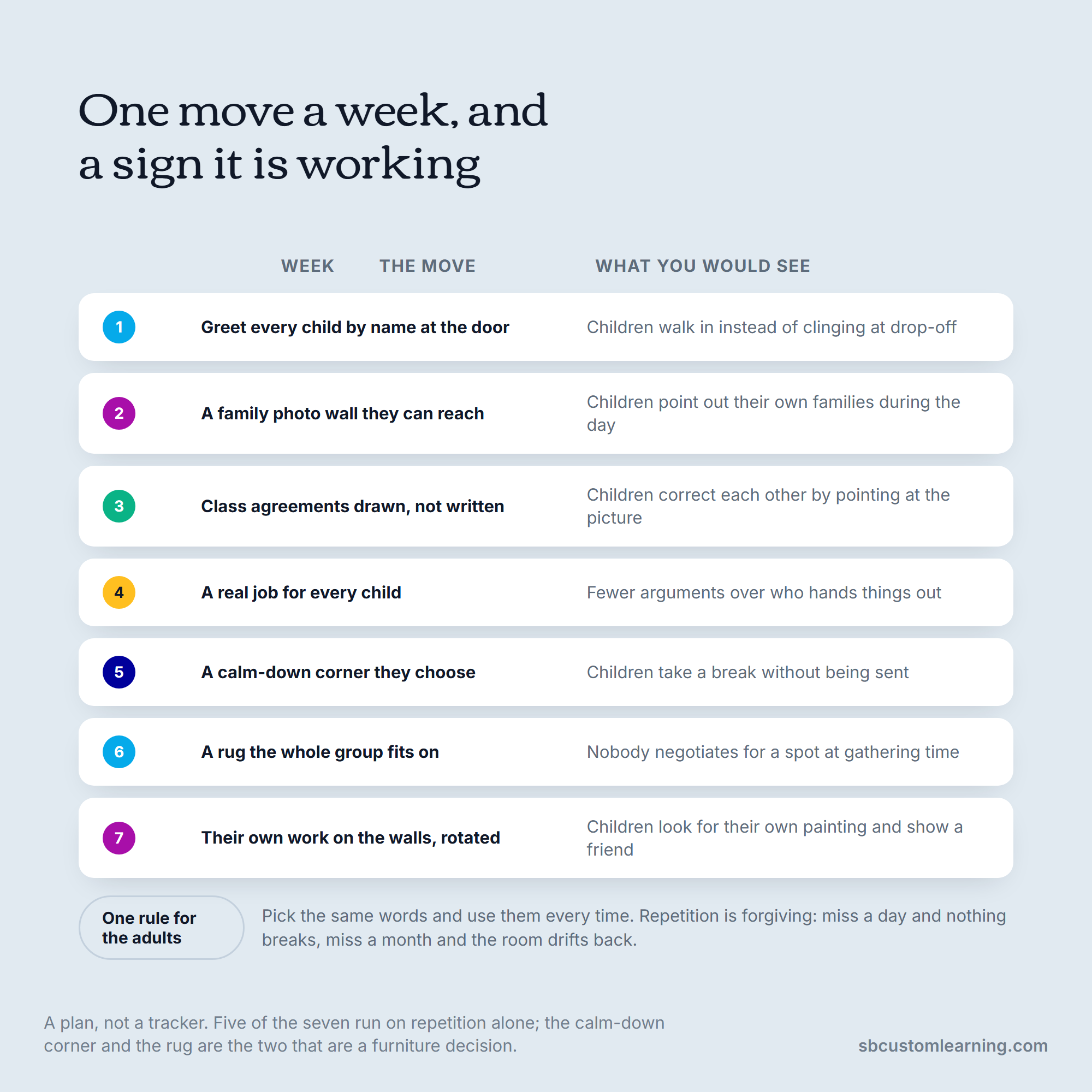
New habits fail when you try to install all of them on a Monday. Give each move its own week so it has time to become a routine, and watch for the small signs that tell you it is working.
| Week | Focus | What you would see |
|---|---|---|
| 1 | Doorway greeting by name | Children walk in instead of clinging at drop-off |
| 2 | Family photo wall at child height | Children point out their own families during the day |
| 3 | Drawn class agreements | Children correct each other by pointing at the picture |
| 4 | Classroom jobs | Fewer arguments over who hands things out |
| 5 | Calm-down corner by choice | Children take a break without being sent |
| 6 | A rug the whole group fits on | Nobody negotiates for a spot at gathering time |
| 7 | Work on the walls, rotated | Children look for their own painting and show a friend |
Along the way, keep one rule for the adults: pick the same words and use them every time. Culture is built by repetition, and repetition is forgiving. Miss a day and nothing breaks. Miss a month and the room drifts back.
You can see how this plays out in finished rooms, including lofts, cubbies and reading corners, in our completed projects. The patterns repeat across ages, because belonging works the same way at 18 months and at 5 years.
So why teach culture in the classroom rather than simply manage behavior? Because a room that repeats these habits spends far less of the day correcting, in every age band it serves.
Start With the Door and the Wall
You do not have to rebuild a room to change its culture. You have to change what happens first, and what happens every day after that. Start at the door with a name, then move to the wall at the child's height. Those two moves alone tell children that the room was built with them in mind.
If a room needs more than habits to get there, and the layout itself is working against the group, that is the work we do. We plan the space, buy furniture from many makers rather than one, and have a single piece built to measure when nothing on a shelf fits.
Planning, sourcing and installation all sit with us, for centers across the Midwest and the states we are moving into next. Pricing is built per project rather than per catalog line, and a director can ask for samples and judge a fabric in their own light before a class set is ordered.
From there, the pieces do their job. A room that fits the group, with dividers that move and a rug that seats everyone, gives the culture a place to grow.
The team at SB Custom Learning has furnished early learning rooms for more than 20 years, including the custom play lofts we built for Educare Chicago. When you are ready to plan the space around the children who use it, you can schedule a consultation and start with the room you already have.
FAQs
What is classroom culture in simple terms?
Classroom culture is the set of habits a room repeats until children trust them: the greeting at the door, the words you use, what hangs on the walls, and how the room handles big feelings. It is what a child feels before anyone explains a rule.
How do you build classroom culture with young children?
Build it through repetition, not rules. Greet every child by name, post drawn agreements at their height, give real jobs, and let children choose a calm-down corner. Do the same small things every day until they become the room's default.
What makes a classroom culturally responsive?
A culturally responsive classroom learns each child and family, then adapts the room to what it learns. That means asking families what works at home, reflecting their words and pictures at child eye level, and trusting each family to know their child best.
How do you promote cultural awareness in the classroom?
Put children's own lives on display. Share family words, songs and celebrations, hang art made at home beside art made at school, and invite families to add to the room. Knowing how to incorporate culture in the classroom is really about what children see every day, not a single lesson.
Do you need a big budget to build a classroom culture?
Not for most of it. A greeting, a laminated photo wall, drawn agreements, jobs and children's work on the walls cost next to nothing. Two of the seven are furniture decisions, the calm-down corner and a rug that seats the whole group, and both are worth sizing to the room rather than guessing. That work is quoted per project rather than priced from a list.