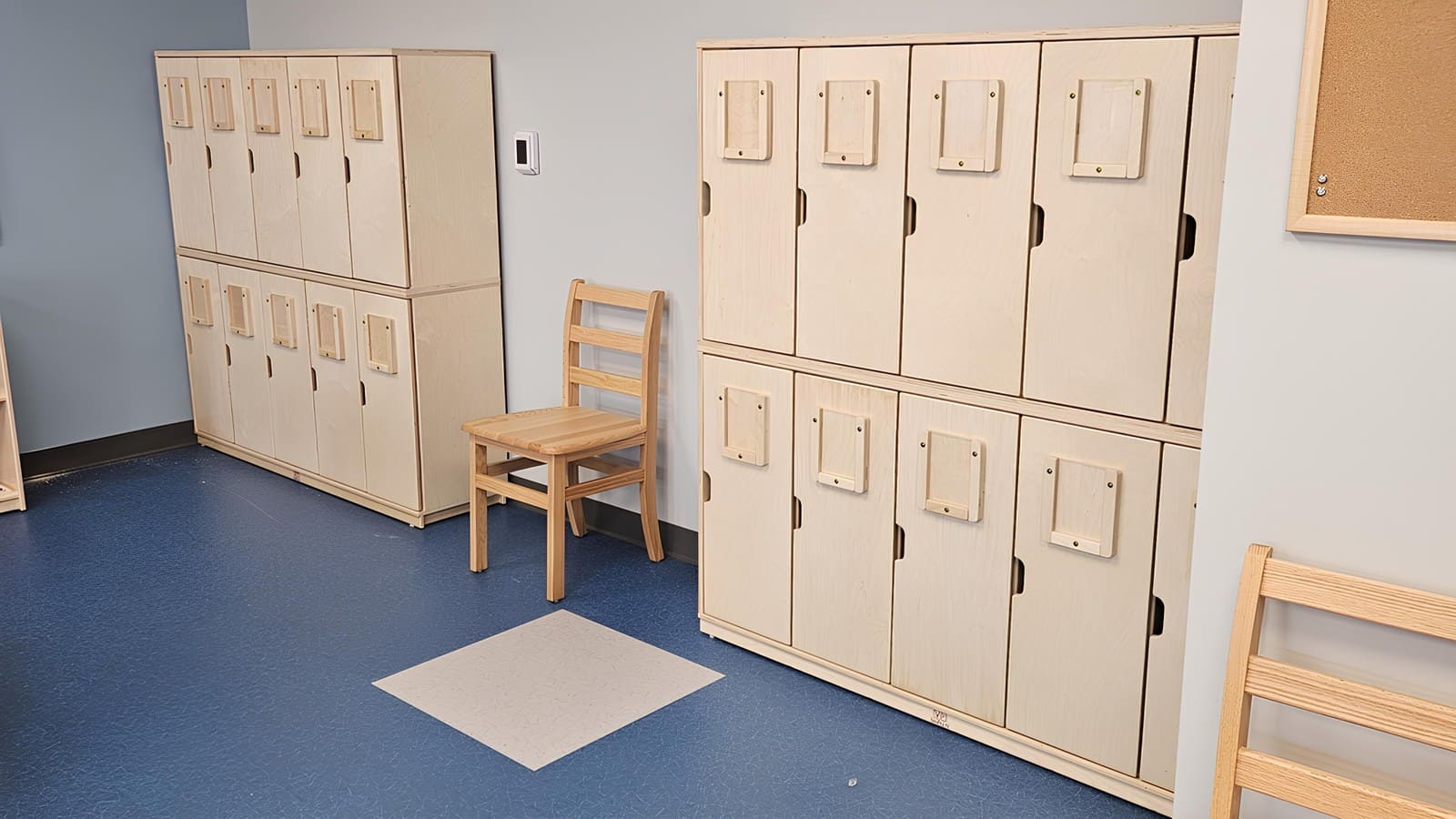
Classroom Cubbies: Sizing, Heights and Labeling That Holds
Key takeaways:
- Size each opening for the bulkiest day of the year. In a Midwest January, one child's winter gear plus a bag has to fit without touching the next child's things.
- Give every enrolled child a separate space. Caring for Our Children, the national child care health standards, asks for separate, labeled storage to slow lice, scabies and ringworm, and the Illinois licensing code makes individual storage a requirement.
- For threes and fours, hang hooks and photo labels no higher than 36 inches, the top of the U.S. Access Board's advisory reach range for that age, and give any cubby above that line to spare clothes.
- Label for the adult who has never been in the room: a name and a photo on the cubby, and one color repeated everywhere that child's things live.
At 8:15 on a January morning, the entry to a room of three- and four-year-olds in suburban Chicago holds 20 snowsuits, 40 boots and a parent kneeling on wet tile looking for one mitten.
Classroom cubbies decide whether that scene takes five minutes or fifteen. They're the part of classroom storage that has to work fast, with wet gear, for children who can't read yet, and they're easy to pick from a catalog photo instead of a tape measure.
At SB Custom Learning we plan, source and install classroom cubbies for childcare rooms. Where a number below is our own planning figure, we say so.
What Classroom Cubbies Have to Hold on a January Morning
Start with the heaviest day of the year. A cubby that swallows a September backpack looks generous until the first snow, when the same child arrives in snow pants, boots, a hat, mittens and a puffy coat, with the backpack still on top.
So build a pile before you shop. Borrow one child's full winter gear for each age group in your building, put it on the floor and measure it. That pile is your design load, and it's a better spec than any product photo.
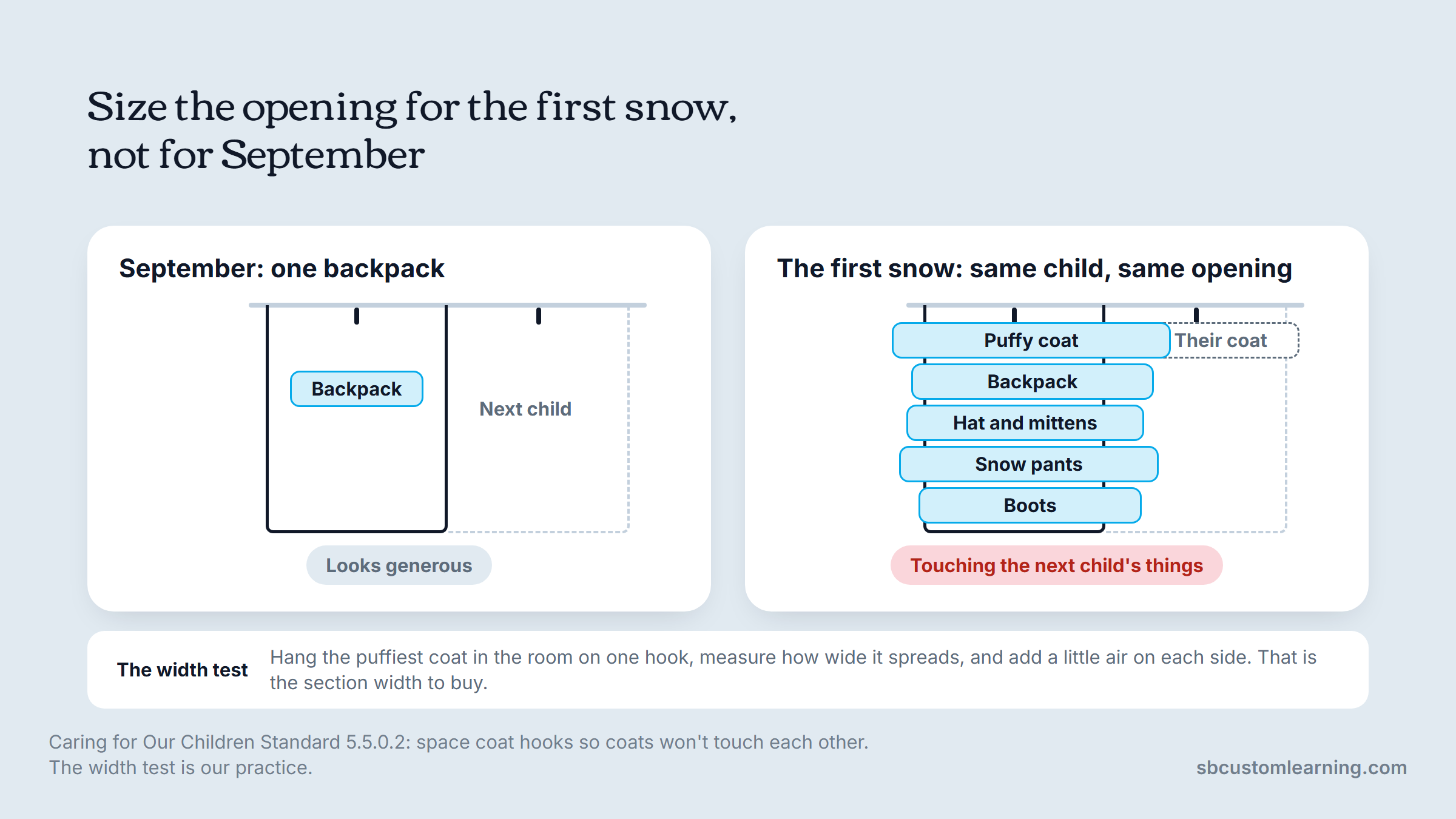
On the hooks, width is what matters. Caring for Our Children, the national child care health and safety standards that pediatric and public health bodies publish together, says in Standard 5.5.0.2 that coat hooks should be spaced so coats won't touch each other.
The alternative it gives is an individual cubicle or locker at the child's own height. On hooks, the spacing becomes a test you can run. Hang the puffiest coat in the room on one hook and measure how wide it spreads, then add a little air on each side. That's the section width to buy, whatever the catalog calls its unit.
The table below shows what typically arrives with one child in winter and the opening we plan for at each age. The last column is our own planning figure, not a published standard, so check it against a pile of your own families' gear.
| Age group | What arrives in January | What we plan for (our figure) |
|---|---|---|
| Infants | Diaper bag, snowsuit or bunting, spare clothes | An adult-height cubby or bin per baby, about 15 inches deep, since staff do all the handling |
| Toddlers and twos | Snowsuit, boots, hat, mittens, spare clothes, nap blanket | A hook section at least 12 inches wide, floor space for boots, a labeled bin for spares |
| Threes and fours | Coat, snow pants, boots, backpack, spare clothes, nap bedding | 12 to 15 inches wide and about 15 inches deep, a hook plus a cubby the bag lies flat in |
| Fives and kindergarten | Everything above, plus a lunch box and a take-home folder | About 15 inches wide, a hook, a cubby and a mail slot the child can reach |
| School-age | A full backpack, sports gear, a heavier coat | 15 inches or wider, locker-style, with a taller hook |
In our planning, a 10- to 12-inch-deep shelf holds a folder or a small bag, but a backpack lying flat for a three- or four-year-old needs closer to 15. If one child's pile can't fit without spilling into the next section, the section is too narrow for your winter. It's cheaper to learn that from a pile on the floor in August than from 20 coats on the floor in January.
Why Every Child Needs Separate Storage
Separation is a health rule before it's a tidiness rule. Caring for Our Children Standard 5.5.0.1 says a center should provide separate storage for each child's and staff member's personal articles and clothing, labeled with the child's name, with bedding stored so it isn't touching another child's things.
The standard's own rationale names the reason: lice, scabies and ringworm are common infectious diseases in child care, and storing personal items separately helps prevent their spread. Standard 3.3.0.4 adds that nap bedding should be kept separate, on the bed or in individually labeled bins, cubbies or bags.
Illinois writes the same idea into law. The Illinois Department of Early Childhood (IDEC) became the state's child care licensing agency on July 1, 2026, and its center rules are published as 23 Ill. Adm. Code Part 2008. Section 2008.380(e)(4) of those rules requires "individual lockers, cubicles or separate hooks and shelves for children's personal belongings."
Other states reach the same point in their own words. Indiana's child care center rules, 470 IAC 3-4.7-111(d), say "the center shall provide space for each child's personal belongings to keep them separate from other children's belongings." Outside those two states, check your own licensing agency for its wording.
The Centers for Disease Control and Prevention (CDC) says head lice mainly spread through head-to-head contact, and that spread through shared clothing such as hats, scarves and coats happens but is less common. Its prevention advice includes not sharing those items.

So classroom cubbies won't stop lice moving between children who play with their heads together. What they cut down is one of the less common routes the CDC names, shared clothing, which in a classroom looks like a pile of hats on one shared shelf or two coats pressed together on a crowded hook. Tucking each child's hat and mittens into a coat sleeve is a free way to narrow it further.
Our team works through your licensing requirements with you early, because the count, the spacing and the layout all follow from them.
How Many Cubbies Each Room Needs
Count classroom cubbies by enrolled children, not by the number in the room on a typical day. A group of 20 might enroll 24 part-time children across two schedules, and if a Monday child and a Tuesday child share an opening, anything left overnight ends up touching.
Adults count as well. Caring for Our Children's separate-storage standard covers staff members' personal articles, so every teacher on the floor needs a spot for a coat and bag, ideally above the children's reach band or in a staff area close by.
The table below starts from Illinois's maximum group sizes in 23 Ill. Adm. Code 2008.190, which cap the children present at one time, so treat each row as a minimum. It also works out the staff at a full group from the same section's ratios. Our own planning number sits in the final column: a full group plus two spares, for a mid-year enrollment or a child on a transition visit.
| Age group | Illinois maximum group | Minimum staff at a full group | Cubbies we plan for (our figure) |
|---|---|---|---|
| Infants (6 weeks through 14 months) | 12 | 3 | 14 |
| Toddlers (15 through 23 months) | 15 | 3 | 17 |
| Two-year-olds | 16 | 2 | 18 |
| Three- and four-year-olds | 20 | 2 | 22 |
| Five-year-olds | 20 | 1 | 22 |
| Kindergartners in a school-age group | 30 | 2 | 32 |
Raise any row to your real enrollment if part-time schedules push it higher, and add an adult spot for each person in the staff column. A mixed-age group follows the ratio and group size of its youngest child under the same section.
One exception changes the fives row: under 2008.190(b), a teacher with an assistant may supervise up to 30 children when every child is at least five, so a fives room run that way needs 32 cubbies, not 22.
Full counts take up more wall than people expect. At 12 to 15 inches a section, a run of 22 needs 22 to 27½ feet of wall, which is more than many entry walls offer in one straight line.

Wall length is why we count classroom cubbies at the same stage as chairs and cots, early in a room setup plan, before the entry wall is spoken for. The same count sets the number of mail slots, since every enrolled child needs one.
Reach Heights by Age, and the Top-Row Problem
Cubbies only build independence if a child can use them alone. The U.S. Access Board's guide to the 2010 ADA Standards gives non-mandatory reach ranges for children, so they're a target to build to, with no inspector measuring them.
Building to the shortest reach in the room is the heart of universal design for early learning, and the cubby run is where you see it work or fail every morning. Here's how we apply it by age.
Infants: Adult Height Is the Right Height
Babies don't hang coats or fetch bags, so an infant room's cubbies are staff storage. Put them where an adult can reach without bending, near the diapering area and the door, and keep them out of the floor-play space.
Toddlers and Twos: Below the Published Range
The Access Board publishes no range for children under three. For a twos room, we plan hook tops a few inches below the 36-inch top of the threes-and-fours band, then test with the children: if a two-year-old can't lift a coat loop over the hook without a step, it's too high.
That puts toddler hooks close to toddler eye level, and Caring for Our Children flags exactly this. Its comment on Standard 5.5.0.2 says hooks shouldn't sit at children's eye level where possible, because of the risk to eyes, and that safety hooks should be used instead. Safety hooks rounded over at the tip let you keep a hook low enough to reach without a point at eye height.
Threes and Older: The Three Published Bands
For three- and four-year-olds, the advisory range runs from 20 to 36 inches off the floor. For ages five to eight, it runs from 18 to 40 inches, and for nine to twelve, from 16 to 44. Keep the hook, the bag cubby and the photo label inside the band for the youngest child who'll use the run.
What Belongs on the Top Row
If your coat lockers have a cubby above the hooks, measure it. When it sits above that band, it's adult territory, so use it for the spare-clothes bag families send in, labeled with the same name and color, where teachers can reach it in one move during a change.
Classroom Cubby Labels a Substitute Can Read
A label has two readers: a child who may not read yet, and an adult who may never have seen the room. A good label works for both in the five seconds it takes to grab a coat.
A picture label is what lets a two-year-old run the morning arrival routine with no adult hands involved. These are the steps we use when we label a cubby run:
- Print the child's first name and last initial in large type, so two Emmas never share a label.
- Add a recent photo of the child at child eye level, for the children who can't read their name yet.
- Give each child one color or symbol and repeat it on the hook, the cubby, the nap bin, the cup and the mail slot.
- Put the adult-facing name on the top edge of the section, where it still shows when the cubby is full.
- Use clear sleeves or clips so a label moves in seconds on a transition day, instead of tape that peels.
- Keep allergy and medical notes off the cubby label, where every family at pickup can read them, and post each child's food allergies where staff can see them, with a copy in the substitute folder.
- Keep a one-page map of the run, name by position, in the substitute folder.
The map is the step that pays off on a sick day. A substitute who arrives at 7:00 can match every child to a section from one sheet, and the morning runs the way it does when the lead teacher is there.
Where to Put Cubbies: The Door, the Lane and the Bench
We start a cubby plan with the door, not the furniture, because where the cubbies sit decides whether the entry flows or jams. The work comes down to three choices.
Beside the Door, Out of the Lane
A cubby run belongs just inside the door, so coats and wet boots stop at the entry and stay off the carpet. Keep the run out of the door's swing and to one side of the main walking path, so a family hanging up a coat isn't standing in the route every other family uses.

Leave real floor in front of the run. A parent crouching beside a child takes more room than a child alone, and the U.S. Access Board's clear floor space for a wheelchair user is 30 by 48 inches. Plan for at least that much in front of some sections, so a parent with a wheelchair or a stroller can reach their child's cubby too.
The Bench Question
A bench lets a child sit to pull on boots, which is often the slowest part of a winter pickup. It also adds depth into the walkway and gives a climber a step up to the top row. In rooms for fours and up, a seated locker or a bench along the run usually earns its space.
For toddlers, we place a low, heavy seat a few feet from the hooks, so it helps with boots and sits too far away to climb from.
Sightlines Across the Entry
When a run stands out from the wall, a teacher still has to see every child from where they stand, so keep it low enough that a standing adult sees over it.
If your entry opens straight into the play space with no wall for a run, a purpose-made partition can give the entry the wall it's missing.
Mail and Mailbox Cubbies for Take-Home Paperwork
Paper dies in a belongings cubby. Daily sheets, art, newsletters and forms end up under wet boots, which is why each room is worth a set of mail cubbies with one slot per child.
Where they go depends on who collects the mail. Through the threes and fours, families usually collect it, so mail slots in the entry can sit at adult height, along the path families walk at pickup. In kindergarten and school-age rooms, children check their own slot, so it moves back inside the reach band. A slot that carries the child's cubby label and color takes no learning.

A system that runs both ways works best. Staff fill the outgoing slots during nap or the afternoon lull, and a single labeled tray takes signed forms coming back in. Some papers belong in the slot and some are better handed over in person:
- Daily sheets, newsletters and event flyers go in the slot.
- Dry art goes in the slot; wet art waits on the drying rack.
- Forms that need a signature go in the slot, with a matching return tray.
- Injury and incident reports are handed to the family in person.
- Anything with a child's health information is handed over in person or sent privately.
Checking every slot before closing shows what went home and what didn't. A slot that's still full on Friday tells you which family needs a direct conversation.
Wooden Cubbies and the Other Materials
Material decides how a cubby run looks in year eight. Solid wood and plywood cubbies are heavy, stable and repairable, and laminate, plastic and steel each suit particular rooms.
Winter is the hard test. Slush from boots sits on the bottom shelf, and exposed particleboard edges swell when they stay wet. A boot tray on the floor, or an open bottom with no shelf at all, keeps water off the furniture.
| Material | Strengths | What to watch | Where it fits |
|---|---|---|---|
| Solid wood or plywood | Heavy and stable, edges can be sanded and refinished | Higher price, weight makes it hard to move | Long-term runs in any age group |
| Laminate over particleboard | Lower price, many colors, wipes clean | Chipped edges expose board that swells when wet | Dry rooms, or paired with a boot tray |
| Molded plastic | Light, washable, rounded edges | Light units slide or tip unless anchored | Toddler rooms, mobile carts, outdoor gear |
| Steel | Durable, lockable, slim profile | Dents, noise, cold to the touch | School-age rooms and staff lockers |
One example from our storefront shows what plywood construction looks like on paper. This 12-shelf big cubby unit is 100% plywood, fully assembled, 49 inches high, 48 inches wide and 15 inches deep.
At 49 inches, its top sits 13 inches above the 36-inch top of the three-and-four reach band, so in a room for that age, check how much of its top row a child can really reach before you assign it.
Many of the coat lockers and cubby units in our furniture category list their dimensions, so you can check them against your winter pile before ordering, and some coat lockers are priced on request. If you'd like to see a laminate color against your own floor first, we can share a finish sample.
Freestanding, Wall-Mounted, Mobile or Custom
Format is the last decision, and the entry itself usually makes it. Freestanding classroom cubbies are the most flexible, but tall units need anchoring to the wall. Wall-mounted hooks over a row of shelves free up floor and make mopping under them easy, which matters in a slushy entry.
Mobile cubbies on locking casters can roll to the wall at nap time and back to the door for pickup, which suits a room that doubles as a gross-motor space. They trade some stability for that, so lock the casters whenever the unit is in use.
Custom pieces earn their cost in the entries no catalog fits: a radiator under the only free wall, a column in the middle of the run, or a slanted ceiling. Little Angels Learning Center went custom for a new school: "We are beyond thrilled with the beautiful custom children's lockers, shelves, sensory tables, art easels, room partitions, and cabinets built for our new school!"
Pieces like those come from the way we work. We buy from many established manufacturers, commission a piece when a room needs something none of them makes, and have our installation crews put it in. You can see finished cubby runs from rooms we've furnished.
Keeping Cubbies Working Through the Year
Cubbies that work in August drift by February unless someone resets them. These checks take a few minutes a week and keep the run honest:
- Empty every cubby on Friday and send home anything that isn't needed on Monday.
- Swap spare clothes to the next size and the next season each quarter.
- Update labels the same day a child transitions or a new child starts.
- Wipe down shelves and hooks on the room's cleaning schedule, and after a lice notice, bag the child's hats, scarves and spare clothes from the cubby to go home for washing.
- Check hooks, anchors and casters for looseness once a term.
Illinois's Section 2008.380(g) requires that equipment and classroom surfaces stay "in sound, clean conditions at all times," and the Friday empty-out is what makes that achievable on a cubby run. It also finds the forgotten winter boot before it lands in the lost-and-found bin.
Planning a Cubby Run That Lasts
Good classroom cubbies come down to four numbers: the width of a winter pile, the count of enrolled children plus spares, the reach of the youngest child, and the floor left in front for a kneeling parent. Get those right and labels, mail slots and materials fall into place around them.
At SB Custom Learning, we deliver and install across the Midwest, and our delivery map keeps growing into new regions. We quote each run once we know the room and its enrollment. If you're planning a new room or replacing a run that fills up every January, book a consultation and bring the measurements of your entry wall.
FAQs
What size should classroom cubbies be?
Size them for the bulkiest day of the year, not for a backpack in September. For three- and four-year-olds we plan each section 12 to 15 inches across and roughly 15 inches deep, then test it with one child's full winter gear. If the pile spills into the next section, it's too narrow. Those are our planning figures, so measure your own families' coats.
How high should coat hooks be in classroom cubbies?
For three- and four-year-olds, keep hooks no higher than 36 inches, where the Access Board's advisory range for that age tops out. For ages five to eight, the range runs to 40 inches. No range is published under age three, so we set twos-room hooks a little lower and use rounded safety hooks, since those low hooks sit near a child's eye level.
Can two children share one cubby?
The national standard, Caring for Our Children 5.5.0.1, asks for separate storage for each child's belongings, and in Illinois, Section 2008.380 of the licensing code makes individual storage for every child a requirement. Part-time children who share an opening on different days still leave things behind, so plan one per enrolled child, not one per child present on a given day.
What are good ideas for cubbies in classroom entries with little space?
Wall-mounted hooks over a shallow shelf take the least floor, and a run that wraps a corner fits more sections than one straight wall. In a room that doubles as a nap or gross-motor space, mobile cubbies can roll aside when not in use. Odd entries with radiators or columns are where a custom run pays off.
Are wooden cubbies for classrooms better than plastic?
Wooden cubbies, solid wood or plywood, are heavier, more stable and easier to repair, which suits a run you'll keep for years. Molded plastic is lighter and fully washable, which helps in toddler rooms, but it needs anchoring. In a slushy entry, keep particleboard edges off the floor or add a boot tray, whatever you choose.