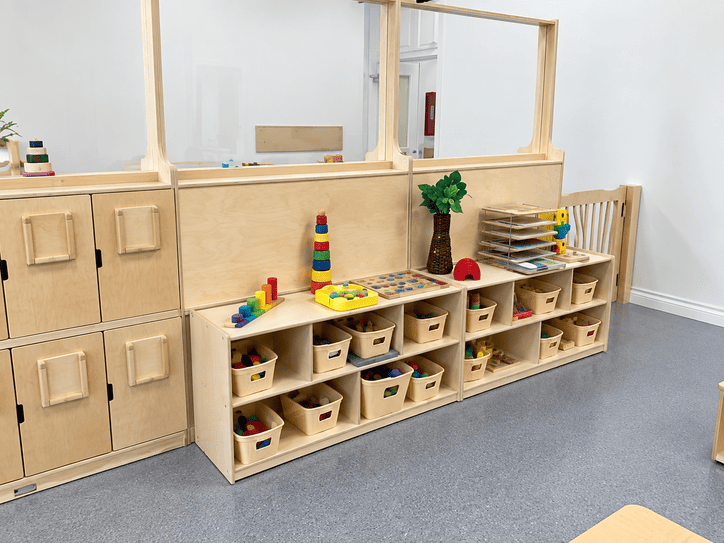
Classroom Storage Ideas for Early Learning Rooms
Key takeaways:
- Anchor everything tall. The Consumer Product Safety Commission counts roughly 1,000 emergency-room visits a year from children and shelving, bookcases or shelving units tipping over.
- Storage height decides whether children can work independently. Anything they self-serve belongs between roughly 20 and 36 inches from the floor.
- Centers need three separate storage systems: children's, teacher's, and out-of-room. Rooms missing the third quietly hand their reachable shelves over to whatever is out of season.
- Vary the depth. Deep bins everywhere get stuffed and become unfindable, which is the most common storage failure in early learning rooms.
Every classroom storage guide on the internet is a list of hacks. Repurposed shoe organizers, gallon bags for puzzle pieces, crates with cushions on top, and a photograph of a room that has never had twenty three-year-olds in it.
Some of those hacks are genuinely good. What none of them address is the part that decides whether a room works: how high the storage sits, how deep it is, whether it is anchored, and whether there is somewhere else in the building for the things that are not in use this month.
This guide covers the classroom storage hacks worth keeping and the specifications underneath them. It is written for the person who signs the purchase order rather than the person improvising at 7am, though both problems are real and the second one is usually caused by the first.
Height Is What Makes Storage Work
Storage that a child cannot reach is adult storage, whatever it says on the label.
The clearest published numbers for this are advisory rather than mandatory, and they sit inside the 2010 ADA Standards. Three- and four-year-olds get a usable band of 20 to 36 inches off the floor. Five- to eight-year-olds widen to 18 to 40 inches.
Whatever a child fetches and returns unaided has to live inside that band. Anything above it is teacher storage by definition, and it may as well be labeled that way rather than pretending otherwise.
Measure your existing units against that and the pattern is consistent: the top shelf of nearly every unit is dead space for children, and the bottom shelf is doing most of the work. That is not a reason to buy shorter units. It is a reason to decide deliberately what goes in the top third, and to stop putting materials there that children are then asked to request.
Open shelving beats closed cabinets for anything in rotation. A child can see what is available, choose, and put it back without a conversation, which is the whole basis of how a Montessori-inspired classroom runs.
Anchor It, and Know Why
This is the section every other classroom storage article skips, and it is the one with the actual stakes.
The Consumer Product Safety Commission's annual tip-over report estimates roughly 14,500 emergency-department-treated injuries a year from furniture tip-overs. Of the roughly 6,400 of those injuries that happen to children, about 1,000 a year, or 16%, involve shelving, a shelving unit or a bookcase. Of reported tip-over fatalities, 155, or 71%, were children under 18, and half were crushed and remained under the product.
One honest caveat, and it matters. That data is overwhelmingly residential: only about 8% of treated injuries happened in public settings, so these numbers do not measure classroom risk. The physics is identical, though, and a childcare room contains more climbing children per square foot than any home.
The practical implications are short and non-negotiable. Anchor every unit taller than it is wide to a stud or with an approved wall fixing. Load heavy items low, since a unit with the weight at the top is the one that goes over. Never leave an open drawer or shelf that reads as a step, because a two-year-old will treat it as one.
Three rules, and none of them is a judgement call.
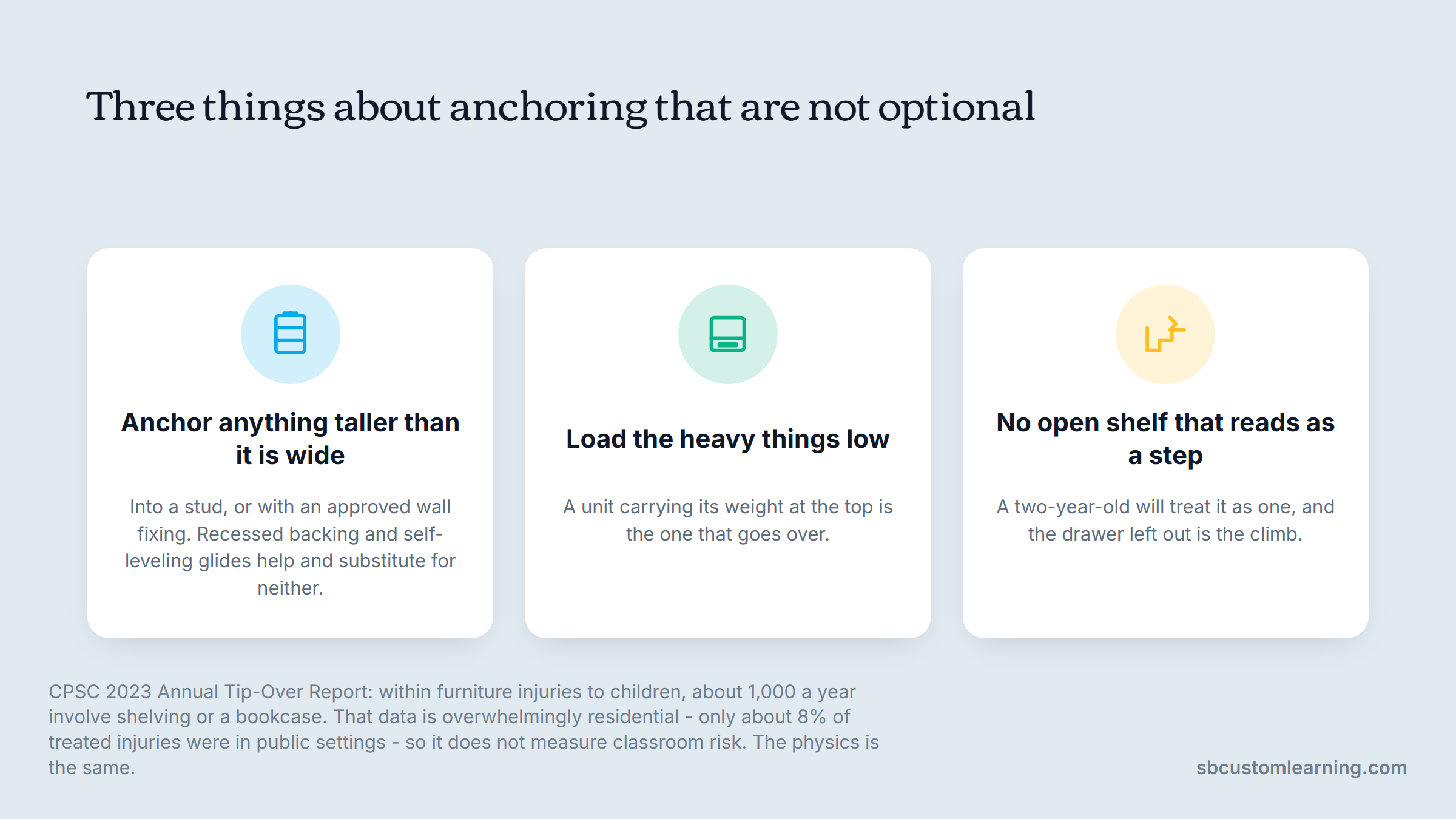
Recessed backing and self-leveling glides both help, and neither substitutes for a wall fixing.
The Depth Nobody Thinks About
Depth is the variable that decides whether a storage system survives contact with a real classroom.
Directors who have opened a center tend to say the same thing once they have lived with the result: storage cannot all be deep and big, because deep storage gets stuffed and stops being usable. It matches every overloaded supply closet we have been asked to reorganize.
Deep bins hide their contents. Anything at the back is functionally gone, and the bin becomes an archive nobody audits. Shallow storage does the opposite, because everything is visible at a glance and putting something back correctly takes no more effort than putting it back wrongly.
Aim for a mix rather than a standard. Shallow trays and shelves for materials in daily use, medium bins for sets and collections, and deep storage reserved for bulk consumables that genuinely are stock rather than working material.
| Storage type | Best depth | What it holds | Failure mode |
|---|---|---|---|
| Open tray shelving | 3 to 6 inches | Manipulatives, single activities, puzzles | Overfilled, becomes a bin |
| Shallow cubbies | 10 to 12 inches | Personal belongings, folders, small bags | Used as a lost property pile |
| Standard classroom bins | 12 to 15 inches | Sets of blocks, dramatic play props | Unlabeled, contents unknown |
| Deep cabinet or closet | 18 to 24 inches | Bulk paper, seasonal materials, spares | Becomes the archive nobody audits |
| Vertical or wall storage | 4 to 8 inches | Anchor charts, paper, flat items | Mounted above child reach |
Match the depth to the contents and the labeling problem mostly solves itself, because a shallow shelf shows you what is missing.
Three Storage Systems, Not One
The most consequential storage decision in a center is made at the floor plan stage and has nothing to do with furniture.
Children's storage sits in the reach band and holds what is in use this week. Teacher storage sits above it, in the room, and holds materials in rotation plus the things that need adult control. Center storage sits outside the classroom entirely and holds everything not currently in play.
Two of the three live in the room, and the third is the one centers skip.
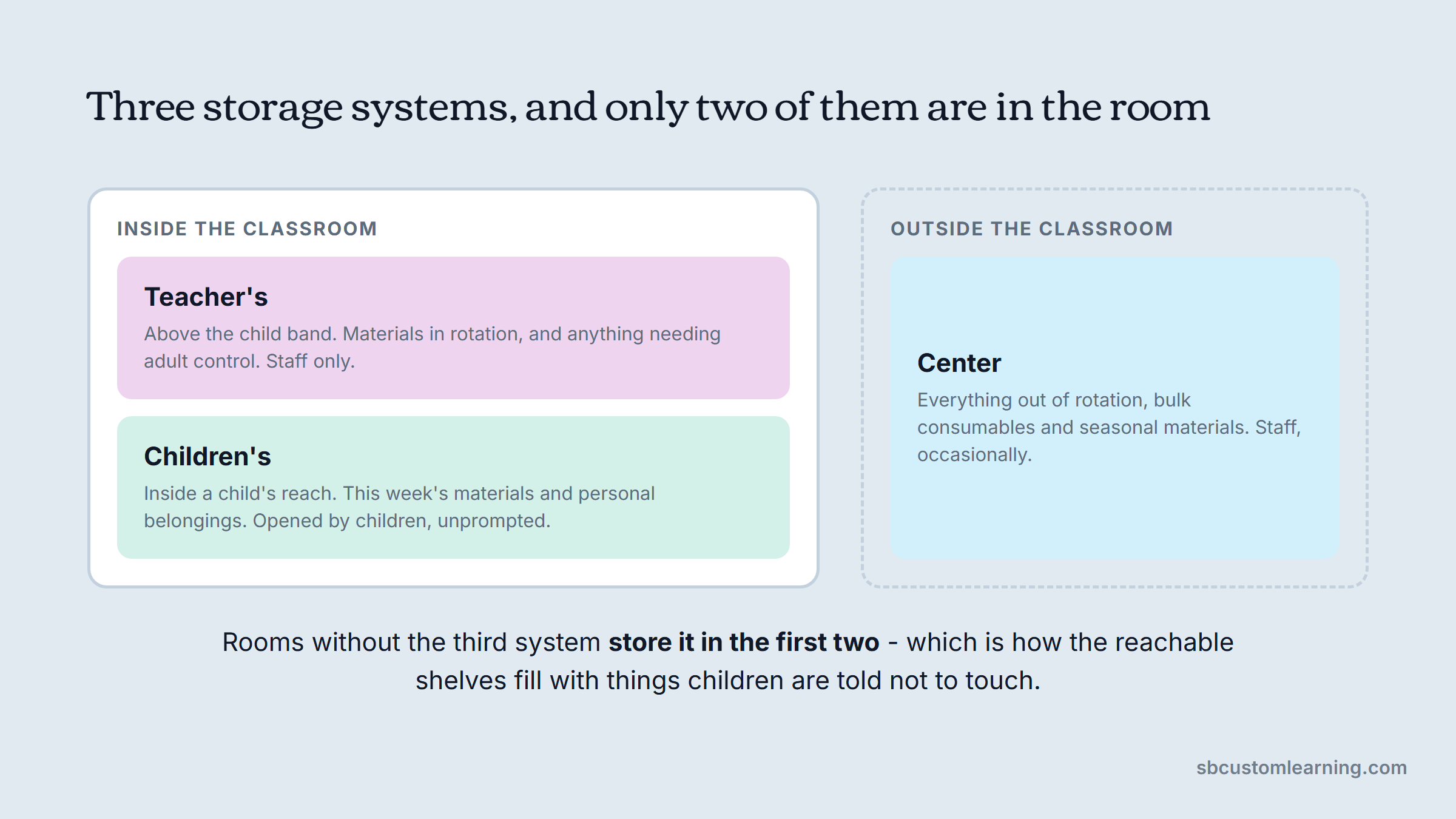
Rooms without the third system store it in the first two. That is how a preschool room ends up with a quarter of its shelving occupied by holiday materials in February, and why the reachable shelves fill with things children are told not to touch.
| System | Where it lives | What it holds | Who opens it |
|---|---|---|---|
| Children's | In the room, 20 to 36 inches from the floor | This week's materials, personal belongings | Children, unprompted |
| Teacher's | In the room, above the child band | Materials in rotation, anything needing adult control | Staff only |
| Center | Outside the classroom entirely | Everything out of rotation, bulk consumables, seasonal | Staff, occasionally |
Smart storage was one of the clearest themes at NeoCon this year, and almost everything shown assumed a building with somewhere to put the overflow. Products cannot solve a missing third system.
If you are planning or renovating a building, put a dedicated storage room in the plan early. It is far cheaper as square footage on a drawing than as permanently lost classroom capacity, and it is the single change most directors say they would make again.
Labeling That Works Before Children Can Read
Labels are the cheapest classroom organization ideas on this page, and they do more work than most of the furniture.
Use a photograph of the actual contents rather than clip art, because a three-year-old matching a real image to a real object is doing something clip art cannot support. Add the printed word next to it, which serves emerging readers and gives adults an unambiguous reference.
Label the shelf as well as the bin. A bin without a home ends up wherever it is dropped, and the shelf label is what makes putting it back a one-step decision rather than a search.
Photograph each area when it is correct and post the photograph there. That image is how a substitute, a parent volunteer or a new hire resets the area without asking anyone, and it converts a system in one person's head into a system the room owns.
Storage for the Things That Do Not Fit Anything
Some materials defeat every standard product, and puzzles are the canonical case.
A TK teacher posted on Reddit asking how to store wooden puzzles, and the replies are a catalog of workarounds: Velcro dots holding pieces to the board, gallon bags on a wire rack, mesh zipper pouches a two-year-old can open, pizza-style boxes, trays with a letter written on the back of every piece so sets can be reunited.
Nobody had a clean answer, and that is the honest finding. Wooden puzzles are irregular, they need to stay flat, they lose pieces, and there is no mass-produced classroom unit designed around them.
The same problem shows up with anchor charts, large paper, dress-up clothes, ride-on toys and cots. Every center improvises, every improvisation half-works, and the improvisation becomes permanent.
This is exactly the gap custom pieces exist to fill. We build storage to what a room actually holds rather than to a catalog size, and Little Angels Learning Center described the result as custom lockers, shelves, sensory tables, art easels, room partitions and cabinets built for their new school. Those pieces exist because standard units did not fit what they had. The finished examples across cubbies and cabinets sit in our work gallery.
Cubbies Are the Highest-Traffic Furniture You Own
Cubbies get treated as a commodity and they are the most heavily used piece in the building.
Every child uses theirs at least twice a day, and so does every adult dropping off and collecting. That is thousands of interactions a year per unit, most of them at speed, many of them by someone carrying a bag and a child.
Three specifications decide whether they hold up. The hook height has to sit inside the child's reach band, or every coat becomes an adult task. The construction has to survive being leaned on and climbed, which rules out most flat-pack. And the depth has to fit a real bag, not a photograph of a bag, because a cubby too shallow for a backpack means coats on the floor from October.
Hook height, construction and depth are the three that decide it.
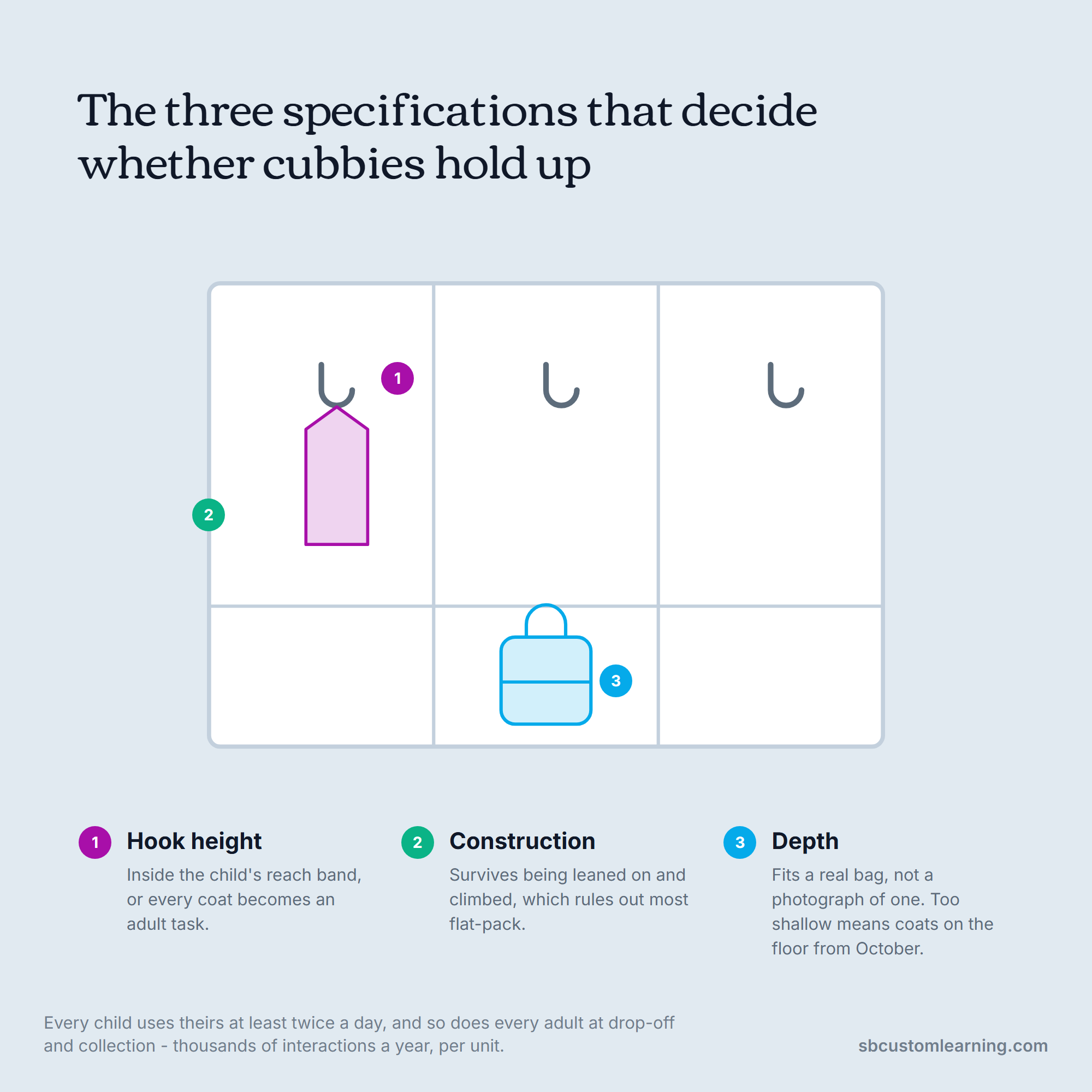
Cubbies also carry a supervision job that nobody specifies. They usually sit near the entry, which is exactly where sightlines matter most, so a tall cubby run can wall off the room's most important view.
Where a run has to double as a boundary, a proprietary wall system is the better tool, because it is designed to divide at a height that keeps the room visible.
Vertical, Mobile and Under-Used Space
Floor area is the scarcest thing in an early learning room, and storage is the main thing competing for it.
Wall-mounted storage is the obvious answer and is underused. Rails, pockets, shallow shelving and magnetic surfaces all hold real volume without taking any floor, and mounting them just above the child reach band keeps the wall useful for adults without cluttering the child's field of view.
Mobile carts are the other underused option, and their value is not mobility. It is that a cart is a defined, finite volume that visibly fills up, which is the only natural check on accumulation most classrooms have.
Under a loft is usually the best storage real estate in a room, since it is enclosed on two or three sides and out of the traffic pattern. The Educare Chicago play loft works this way, with the structure doing double duty overhead and underneath.
What the Research Says About Order
There is a real evidence base for why any of this matters, and it is broader than storage.
The HEAD Project at the University of Salford assessed 153 classrooms in 27 schools against the academic progress of 3,766 pupils, and found that physical classroom design accounted for 16% of the variation in pupils' academic progress over a year. The study is published in Building and Environment, and organizes its findings around naturalness, individualization and stimulation.
Read that figure carefully, because it is widely misquoted. It means design explained 16% of the differences in progress between pupils, not that good design produces a 16% improvement. It was also UK primary schools rather than US early learning centers.
The figure is worth keeping, and worth keeping straight.

What it supports is the general claim that the room is not neutral. Ownership and flexibility, which in practice means storage a child can operate and space that adapts, sit among the design parameters the study identifies as mattering.
Keeping a System Alive Past November
Most storage systems fail through entropy rather than design, and the fix is scheduled rather than clever.
Most classroom organization ideas fail because nobody scheduled them, so build three habits into the year. Reset areas to their photographs at the end of each day, which takes children four minutes and adults none. Audit one storage zone a month rather than the whole room annually, since a monthly rotation covers everything without ever being a project. And enforce a one-in-one-out rule on donated materials, which is where most accumulation actually comes from.
The annual purge should happen in June rather than August, because deciding what to keep is much easier when you remember using it. A June purge also means the August setup starts from a room that is already sorted.
Our classroom supply list separates durable purchases from consumables for the same reason, since the two need different replacement cycles and different budget lines.
What to Buy, and What to Improvise
Not everything needs to be purchased, and the split is fairly predictable.
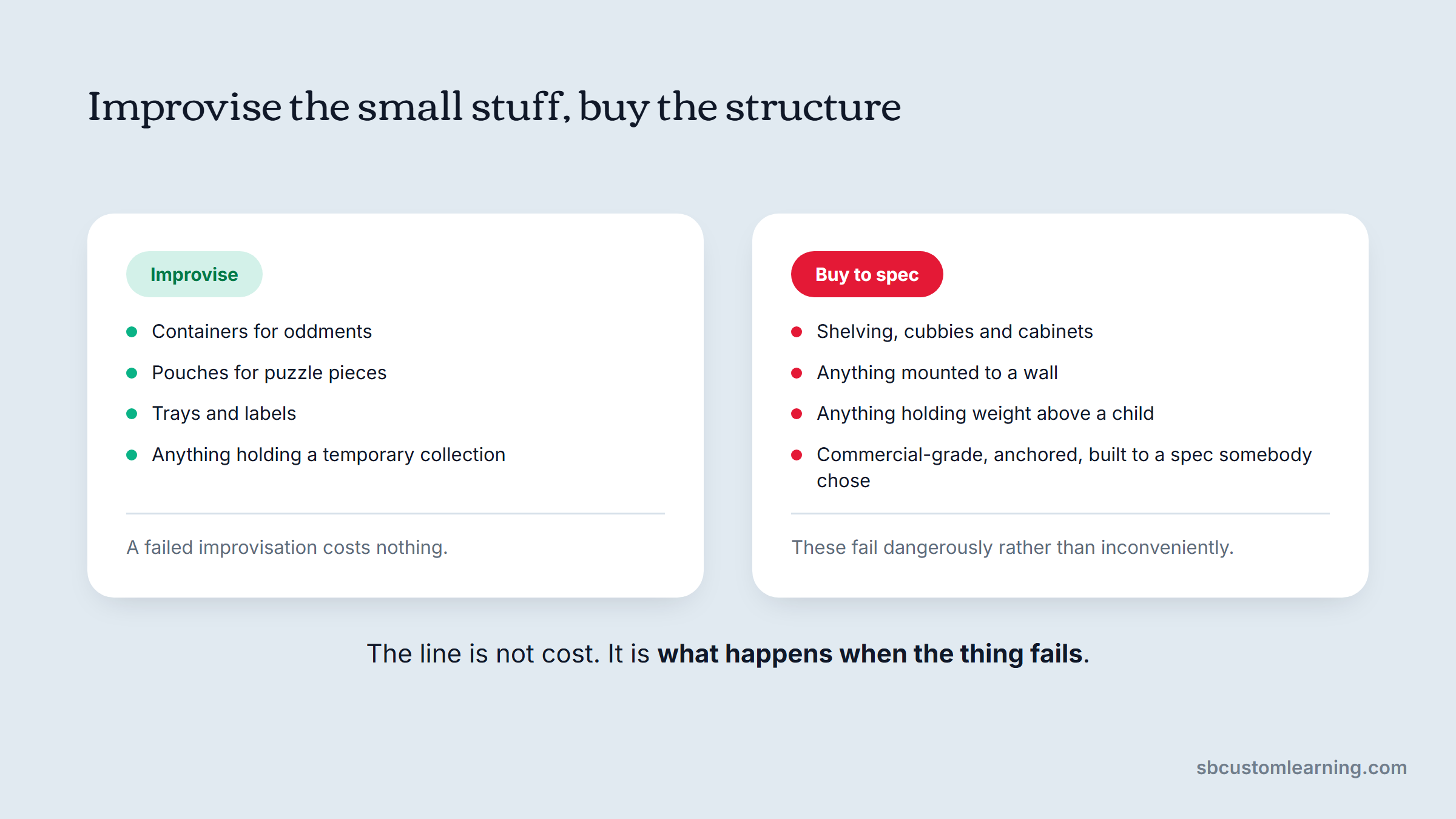
Improvise the small stuff. Containers for oddments, pouches for puzzle pieces, trays, labels and anything holding a temporary collection are all fine as low-cost classroom storage, and a failed improvisation costs nothing.
Buy the structure. Shelving, cubbies, cabinets and anything mounted to a wall or holding weight above a child needs to be commercial-grade, correctly anchored and built to a spec somebody chose. These are the pieces that fail dangerously rather than inconveniently.
The split falls along one line, and it is not the price.
We do not make furniture. We specify it, source it and put it in, and we commission one-off pieces when a room needs something nobody manufactures.
Individual products carry a listed price on our storefront. Anything involving a drawing, a crew or a measurement gets priced against that specific job, since a cubby wall for an odd-shaped entry has no catalog equivalent. Our design consultation starts from the room itself.
One practical limit worth stating plainly: we deliver throughout the Midwest and are expanding from there, so we are not a nationwide supplier and will say so rather than quote you a shipping estimate we cannot stand behind.
Getting Storage Right Before the Year Starts
Staying organized has very little to do with owning more storage. It comes down to whether somebody decided what each system was for, put children's materials inside a child's reach, varied the depth, anchored anything tall, and gave the out-of-rotation material a home outside the classroom.
Start with a tape measure and the reach band. Anchor everything tall this week, whatever else you do. Vary depth deliberately, label the shelf as well as the bin, and photograph each area when it is right.
If you want storage sized to a room rather than to a catalog, get in touch. We have been furnishing early learning rooms for more than twenty years, and most of that work has come down to rooms needing something the catalog did not have.
FAQs
How high should classroom storage be for preschoolers?
Anything children are expected to fetch and return themselves should sit between roughly 20 and 36 inches from the floor, which is the advisory ADA children's reach range for ages 3 to 4. For ages 5 to 8, the band is 18 to 40 inches.
Use everything above that as deliberate teacher storage rather than leaving it as shelving children are told not to touch. Those reach ranges are advisory guidance rather than an enforceable code, so treat them as a well-researched target.
Does classroom furniture really need to be anchored to the wall?
Yes, for anything taller than it is wide. The Consumer Product Safety Commission attributes roughly 1,000 emergency-department visits a year to children and tipping shelving, shelving units or bookcases, and 71% of reported tip-over fatalities involve children under 18.
That data is largely residential, so it does not measure classroom risk directly. The physics does not change with the building, and a childcare room has more climbing children per square foot than a home.
What are the best classroom storage ideas for a small room?
Go vertical and go shallow. Wall-mounted rails, pockets and shallow shelving hold real volume without taking floor, and shallow storage keeps contents visible so materials are actually used rather than buried.
Then look at what is competing for floor. A loft creates enclosed storage underneath while adding an area above, and storage units used as room dividers give you a boundary and capacity from a single footprint.
How do you organize classroom storage so it stays organized?
Label the shelf as well as the bin, use a photograph of the real contents plus the printed word, and post a photograph of each area in its correct state so anyone can reset it.
Then schedule the maintenance rather than relying on willpower: a daily four-minute reset with the children, one storage zone audited per month, a one-in-one-out rule on donations, and a full purge in June while you still remember what you used.
Should we buy classroom storage or make it ourselves?
Improvise the containers and buy the structure. Trays, pouches, labels and holders for oddments are fine as cheap solutions, and a failed improvisation costs almost nothing.
Shelving, cubbies, cabinets and anything mounted or bearing weight above a child should be commercial-grade and properly installed. Those are the pieces that fail dangerously rather than inconveniently, and they are also the ones handled thousands of times a year.