Classroom Routines for Toddler and Early Learning Rooms
Key takeaways:
- Routines are taught, not announced. Name the steps of each one, model them, let the children practice, and reinforce the same way every day.
- The day is one long routine built from small ones: arrival, handwashing, a short morning meeting, center time, snack, outdoor play, lunch, rest, and pickup.
- Transitions break more routines than anything else. A five-minute warning, a visual timer, a song, and a first/then card turn a hard switch into something children can run themselves.
- The room does half the work. Cubbies by the door, a sink near the messy zone, and clear sightlines make a routine easy to follow or impossible to keep.
Every early learning room has a tipping point. It lands somewhere between the end of center time and the walk to the sink, when one child wants to keep building, another is hungry, and a third has decided today is the day to test the coat rack. A room with solid routines absorbs that moment. A room without them spends the next twenty minutes recovering.
The difference is rarely the children or the teacher's patience. It is whether the routines were designed and taught, or simply assumed. New teachers often inherit a schedule, are told to follow it, and then spend the year wondering why it keeps falling apart in the same two places.
This guide walks the routine itself: why predictability matters more with our youngest children, what teaching a routine explicitly looks like, a sample day hour by hour, the transitions that hold it together, and how to lay out the room so the routine has somewhere to happen.
Why Classroom Routines Matter More with Young Children
The case for routines is not a taste for tidiness. It is how young children learn to manage a day.
The Texas Education Agency describes an organized room with an orderly routine as the condition for children to work independently, expand their attention span, and build self-control and personal responsibility. The same guidance connects that structure to self-regulation and a child's readiness to learn. A predictable day frees a toddler from having to guess what comes next, and guessing is expensive when you are two.
This is why routines in an early learning room carry more weight than the same schedule would in an older grade. A nine-year-old can hold the day in their head and check the clock. A two-year-old cannot, so the room has to hold it for them.

A room that feels chaotic is rarely a discipline problem. A room where some days begin outside and some inside, and where rest is handled differently each afternoon, is a room in which the children and the staff are both guessing.
When a room is struggling, a consistent order with as few transitions as possible is the first thing to try, ahead of any new chart or reward system.
Predictability protects the adults too. When everyone shares one script, a substitute can step in, a new assistant can find the rhythm, and a float teacher can cover a break without a long handoff.
That shared script is what classroom organization systems put on paper, and it is why the daily routine doubles as the classroom management routines that do the heaviest lifting. Most behavior trouble starts at the seams between activities, not inside them.
Teach a Routine Explicitly, Then Hand It Over
A routine that lives only in the teacher's head is a routine the children cannot learn. The one that works is taught the way you would teach anything else in the room.
Start by naming it. "This is how we wash hands" works better than "go wash your hands," because the first version tells a child a routine exists and the second only issues an order. Then break the routine into steps small enough to hold, model them, and let the children take over.

The sequence below is worth repeating for every routine in the room, from lining up to cleaning up. This is what establishing classroom routines and procedures actually looks like in practice.
- Name the routine and say why it matters.
- Break it into three or four steps a child can remember.
- Model the whole routine once, slowly, without narrating every motion.
- Let one child practice while the rest watch.
- Run the whole group through it together.
- Point to the posted picture card as the reminder instead of repeating yourself.
The last step is the easiest one to let go of, and it is the one that pays off. Put the steps where the routine happens, not on a single chart by the door. The handwashing steps belong above the sink, the entry routine belongs at child height just outside the door, and the cleanup steps belong where the bins are.
A visual procedure card gives a non-reader somewhere to look, so the direction stops coming from your voice on every pass. Teachers who make the switch describe children using the cards as their own checklists and working through the steps alone. The work is heavier in the first weeks and lighter for the rest of the year.
The Day, Hour by Hour: a Sample Early Learning Schedule
No two centers run the same clock, but a toddler room almost always moves through the same handful of blocks in the same order. The table below shows sample classroom procedures and routines for a room of 2- and 3-year-olds. Treat the times as a shape, not a contract, and adjust each block to your own opening hours and meal times.
| Time | Block | What the routine looks like |
|---|---|---|
| 7:30 to 9:00 | Arrival and breakfast | Greet each child at the door, hang up the bag, eat at the table |
| 9:00 to 9:20 | Morning meeting | Hello song, day of the week, one book |
| 9:20 to 10:00 | Center time | Choose a center, play, clean up on the signal |
| 10:00 to 10:15 | Handwashing and snack | Wash hands at the sink, sit, eat a short snack |
| 10:15 to 11:00 | Outdoor play | Shoes and coat, outside, back in on the song |
| 11:00 to 11:30 | Lunch | Wash hands, help set the table, eat together |
| 11:30 to 12:00 | Wind-down | Quiet books, cots come out |
| 12:00 to 2:00 | Rest time | Lie down; quiet activities for early risers |
| 2:00 to 2:30 | Snack | Wash hands, sit, eat |
| 2:30 to 3:30 | Centers and outdoor | Choice time, then outside again |
| 3:30 to 5:30 | Pickup | Gather belongings, quiet play until a grown-up arrives |
The sections below take each block in turn and show where the routine can carry itself.
Arrival and Drop-Off
The day is decided in the first ten minutes. A predictable arrival gives a child somewhere to put their body and their things before the hard part of saying goodbye, which is why the routine is worth teaching as carefully as any lesson.
Stand in the same place, say the same greeting, and point a child to the same first task: hang up the bag, then choose a table toy. When the sequence never changes, a child who arrives upset has a script to fall back on, and the goodbye takes less out of everyone.
Handwashing and Self-Care
Handwashing gets repeated more often than any other routine in the room, and taught less often than most. A three-step card posted at the sink does more than a reminder, because a child can run the whole thing without an adult standing over them.
Set the expectation that hands are washed before eating, after the bathroom and after outdoor play, then let the picture card hold the line. The same approach covers the small self-care routines that stack up during the day, from wiping a nose to finding a coat on a hook.
Morning Meeting
A morning meeting that runs long is a morning meeting that ends in tears. Keep it short, keep it predictable, and keep sitting optional.
Sing the same hello song, name the day, read one book, and move on. For 2-year-olds the shape that holds is five to ten minutes at most, several short gatherings across the day rather than one long one, and no child required to sit.
Splitting the meeting in two keeps the group from having to hold still for long. A short meeting children can trust beats a long one they endure.
Center Time
Centers are where choice meets routine, and they need both. The free part is which center a child picks. The routine is how a child gets there, how long they stay, and what happens at the end.
Teach the sequence in this order: choose a center, carry a card or marker to claim it, play until the signal, then return the materials before choosing again. Cleanup is a routine of its own, and it works best when every bin has a home at child height and a picture on the front.
The centers in a learning space only stay calm when the room is zoned so a noisy block corner and a quiet book corner are not fighting for the same three feet.
Snack and Meals
Meals run on the same trust as the rest of the day. Children who know that snack comes after handwashing and that lunch follows outdoor play are not asking when the food arrives, because they already know.
Set the table in the same order every time, let children take a turn carrying cups or wiping the table, and keep the conversation in the same low key. A helper chart taped at child height turns a chore into a routine children ask to join.
Outdoor Play
The walk outside is a routine hiding in plain sight. Shoes, coat, line up, out the same door, and back in on the same song. When the sequence is fixed, the transition takes a fraction of the time and the outdoor block keeps its full value for movement and fresh air.
Plan the return as carefully as the exit. A five-minute warning, a countdown, and the same goodbye to the playground turn a hard stop into a predictable one.
Rest Time
Rest is the routine that tends to grow by habit rather than by design, and the one where predictability matters most. Children settle faster when the sequence never changes: bathroom, cot, comfort item, quiet music, lights down.
A child who does not sleep still needs a routine. Offer the same handful of quiet choices every day, such as books or a soft puzzle, so a non-sleeper has somewhere to go that is not a battle. The goal is a calm room, not a full one.
Pickup
Pickup is where the day overlaps with families, and it is easier when it looks the same each afternoon. Gather belongings from the cubby, find the bag, and play quietly near the door until a grown-up arrives.
Keep the handoff short and specific. One sentence about what the child did that day gives a parent something to carry home and reinforces that the room runs on a routine everyone can see.
Transitions: Songs, Visual Timers, and First/Then Cards
If routines are where a day succeeds, transitions are where it is won or lost. Ask any toddler teacher which part of the day produces the most tears and the answer is almost never the activity itself. It is the space between two activities.
Edutopia describes the mechanics well: transition times strengthen executive function, resilience and independence when they are planned, because the skills a child needs to stop one thing and start another have to be practiced rather than assumed. The same article notes that uncertainty releases stress hormones that interfere with impulse control, which is the plain reason an unannounced switch can turn a calm room loud in a minute.
The table below lists the tools that do most of the work, and how to use each one.
| Tool | How to use it | Best for |
|---|---|---|
| Five-minute warning | Name the ending in advance, then count down | Any switch a child resists |
| Visual timer | Set it and let the child watch the time run out | Center time and cleanup |
| Transition song | Use the same song for the same move, every day | Cleanup, lining up, coming inside |
| First/then card | Show the required task, then the preferred one | The hardest moves of the day |
| Transition toy | Carry one comfort object to the next spot | Children who struggle with change |
| Staggered groups | Send two children at a time, not the whole room | Handwashing and the sink line |
A first/then card is the single most useful tool on that list, and it costs nothing. Show a picture of the required task, then a picture of what comes next: first shoes, then outside. The child is not being told no. They are being told the order, which is a much easier thing to accept.

Pair the tools with a stagger wherever a line would form. A sink that fits two children at once will never survive a room of sixteen arriving together, so send them two at a time while the rest keep playing. Waiting is where routines go to die.
Design the Room Around the Routine
A routine can only run as smoothly as the room allows. If the coat hooks sit across from the door and the sink sits across from the bins, every child crosses the room twice before snack, and no amount of teaching will fix the traffic.
Design the room so the routine has a place to happen. At SB Custom Learning, we plan the layout before anything is bought, because the order in which a child moves through a space decides whether the routine feels obvious or feels like work. The space planning sequence we use starts with the fixed points, usually the sink and the door, and builds the zones around them.
Cubbies and Hooks by the Door
The entry routine needs a home, and it should be the first thing a child meets. Put cubbies and hooks right inside the door at child height, with a picture and a name on each one.
When a child can hang up their own bag without an adult reaching down, the arrival routine ends before it starts and the room stays clear. Mixed-up coats and lost water bottles almost always trace back to storage that lives nowhere near where it is used.
Put the Sink Where the Mess Is
Place the sink within sight of the messy zones, not down a hall. Art, sensory play and meals all end in washing, so a short path from the table to the water keeps children in view and keeps the water where it belongs.
If the room has one sink, treat it as the anchor and build the eating and art zones around it. A handwashing routine that requires a long walk will always need an adult to run it.
Keep Every Child in Sight
Sightlines are a safety feature and a routine feature at the same time. A teacher who can see every child from one spot runs a smoother room, because a glance is enough to catch the child drifting off task before it becomes a problem.
Keep tall shelving below shoulder height in open areas, arrange centers so no corner hides behind a wall, and leave the main paths clear. If you would have to walk to check on a corner, the corner is the problem.
Building Your Classroom Routines and Procedures Checklist
A room does not need a routine for every minute, but it does need one for every repeatable moment. Build a checklist you can hand a new hire on day one, then post the parts children run themselves. The list below is sample classroom procedures and routines to adapt to your own opening hours and age group.
Add the ones your licensing visit or your own schedule demands, and cut the ones that never actually happen.
- Arrival and goodbye
- Handwashing, nose wiping and bathroom
- Morning meeting and sitting options
- Choosing a center and cleaning it up
- Snack, lunch and table manners
- Outdoor shoes, coats and the walk outside
- Rest time and quiet choices
- Putting materials away and closing a center
- Lining up and moving as a group
- Pickup and the handoff to families
The checklist is only half of it. A routine also needs materials chosen with the routine in mind.
We source from a wide network of established makers, and when a room needs a piece no catalog sells, we commission it. That is how a cubby or a shelf gets built to the exact height a room calls for, and it is how the one-off pieces happen, like the custom play lofts we installed at Educare Chicago for a space with no obvious corner for one.
We design, source and install rather than manufacture, and we are not tied to one maker, so the piece can fit the routine rather than the routine bending around the piece. The storage pieces that support routines go in at reach height, because a bin a child cannot reach is a bin an adult has to manage.
Where Routines Break Down
Even a well-built routine fails somewhere, and the failure usually points at a specific fix. Read the symptom, then check the cause before you add another reward chart.
| What you see | Likely cause | First fix |
|---|---|---|
| The same direction repeated every day | The routine lives in your head, not the room | Post a picture card where the routine happens |
| Chaos at cleanup | Materials have no home at child height | Label every bin and lower the shelves |
| Tears at every switch | Transitions are unannounced and abrupt | Add a warning, a song and a first/then card |
| One corner keeps drifting off task | Bad sightlines or a zone next to a noisy one | Rezone the room and lower tall shelving |
| Children asking what comes next | The schedule is not visible or never changes | Post a picture schedule and keep it current |
Read the table as a checklist, not a verdict. A routine that fails at cleanup is usually a room problem: too few bins within reach, or a cubby with no home for the coat. Rebuilding the setup order fixes more of these than a new chart, because the routine follows the room and not the other way around.
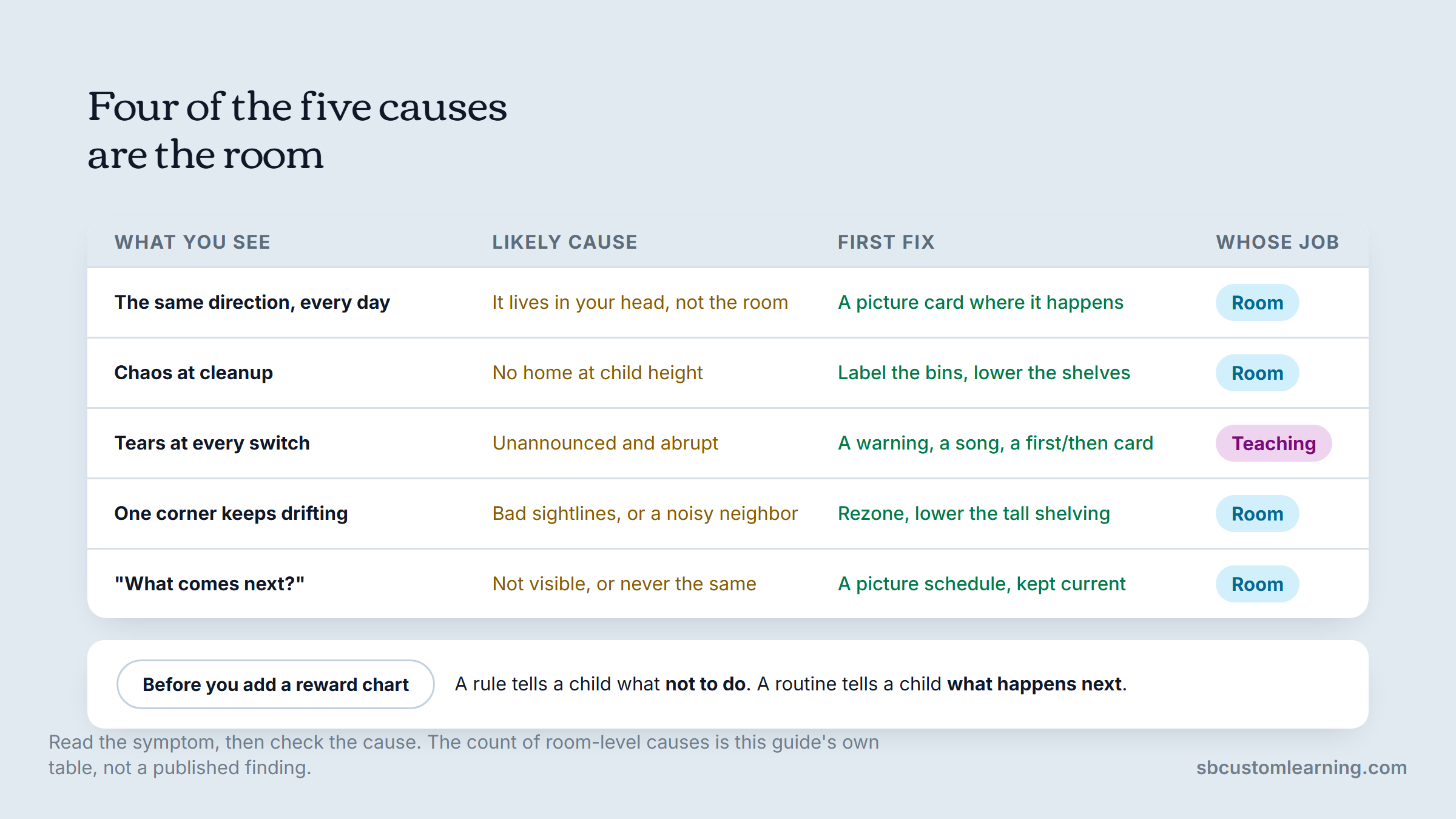
Rules and routines in the classroom are often treated as the same thing, and they are not. A rule tells a child what not to do. A routine tells a child what happens next.
Why are routines important in the classroom? The answer shows up in the ten minutes after a transition. Rooms that lean on rules alone spend that time correcting, while rooms built on rituals and routines in the classroom spend it teaching.
The routines that hold a room together are the classroom management routines a teacher leans on all day, and they are worth building before the year starts rather than in the middle of a hard week.
Do These Routines Change with Age?
Classroom routines keep the same bones from the toddler room through the oldest group a center serves. What changes is how much an adult narrates and how long each block runs.

A kindergarten classroom routine leans on the same moves with fewer handwashing trips and more independent transitions, so a teacher can post the schedule once and trust it. The steps get shorter as children take on more of the sequence themselves, and the posted card shifts from a prompt into a reference a child checks alone.
Rituals and routines in the classroom are what carry across, not the instructions. A hello song, the same goodbye to the playground and a helper chart make the day feel like the room's own, and they outlast the point where a child still needs the steps read aloud.
The rules and routines in the classroom stay posted whatever the age band. The older the group, the less an adult has to say them out loud, and the more the posted card does on its own.
We design rooms across age bands, and the layouts in our finished rooms follow the same handful of moves whichever ages a center serves: storage by the door, work zones that stay in view, and paths that make the routine obvious.
Start with One Routine This Week
You do not have to rebuild the whole day at once. Pick the single routine that fails most often, most likely the transition before lunch or the walk back inside, and teach it explicitly this week. Name the steps, model them, post them where they happen, then run the children through it until it holds.
Once one routine carries itself, the next one is easier, because the children already know how learning a routine works. The room stops being a place where a teacher manages behavior and becomes a place where the day runs on rails children can see.
If the routine keeps breaking at the same physical spot, that is a design problem, and it is worth fixing before the next school year instead of patching it all year. Our design and space planning service starts with the rooms you already have, so the fix is sized to your space and your age groups rather than to a catalog.
We plan early learning rooms across the Midwest and are expanding. Shopping is fully online with samples on request. Schedule a consultation and we will build the plan around the rooms you have, the ages you serve and the budget you are working within.
FAQs
Why are routines important in the classroom?
Routines make a day predictable, and predictability is what lets young children relax, pay attention and manage themselves. When a child knows what comes next, they are not spending energy on uncertainty. That frees a toddler to stay with an activity longer, and it frees a teacher to teach instead of repeating the same direction.
How long does it take to teach a routine?
Most early learning routines take weeks of modeling and practice, not days, before a group runs them without reminders, and some children need longer. Teach the routine the first week, keep modeling it, and point to the posted card when it slips. After a long break, expect to reteach the ones that matter most.
What is an example of a classroom routine?
A handwashing routine is a good example: turn on the water, add soap, scrub to a song, rinse, dry hands, return to the table. Each step is small, visible and repeatable, and the posted card lets a child run it without an adult standing beside the sink.
How do you teach a routine to a two-year-old?
Name the routine, break it into three or four steps, model it slowly, and let the child practice with you. Then post a picture card where the routine happens so the child has something to check without a verbal reminder. Keep the same order every time, and praise the steps rather than the finished result.
What do you do when a routine keeps falling apart?
Look for the point where it breaks rather than adding a new rule. Most failures trace to a transition that was never warned, a material a child cannot reach, or a schedule that is not posted. Fix the room and the transition, then reteach the routine once, and it usually holds.