Classroom Organization Systems That Survive the Year
Key takeaways:
- In a study of 36 toddlers, four toys out instead of sixteen produced longer play with each toy and more varied ways of using it.
- Classroom organization fails on maintenance, not on setup. The system that collapses is almost always the one that required a full swap of everything.
- Teachers name the same three blockers on rotation: no time, nowhere to store the off-duty materials, and relabeling.
- Organize across rooms rather than within one. Most centers own far more than any single classroom needs and cannot find it.
Every classroom is organized in August. The interesting question is what it looks like in February.
By then the labels no longer match the bins, three centers have quietly merged into a general area, and the cupboard that was going to hold the rotation stock is holding whatever did not fit anywhere else. Nobody decided any of that. It accumulated.
This guide is about the systems that stop it accumulating: how much to have out, how often to change it, who owns the job, and how to make the whole thing survive a substitute, a staff change and a February when everyone is tired. It assumes the room is already set up and the shelves are already chosen, so it deals with what happens next.
Why Classroom Organization Decays by November
Organization decays for a structural reason rather than a motivational one: the amount of maintenance a system needs is decided when you design it, and most systems are designed with no maintenance budget at all.
A room stocked to capacity in August has nowhere to put anything new, so new materials go on top of old ones. A labeling scheme that requires printing and laminating gets abandoned the first time something needs relabeling in a hurry. A rotation plan owned by "the team" is owned by nobody.
None of those are failures of effort. They are design faults you can see in advance if you ask one question of every system: what does this cost to keep true, every week, in minutes?
Anything that costs more than a few minutes a week will stop happening, and it will stop happening in the busiest month rather than the quietest one.
Some of this is decided before the room opens. A layout with nowhere to keep rotation stock will decay whatever the routines say, which is one more argument for treating thoughtful classroom design as the first decision rather than the last.
What Happens When You Put Out Fewer Materials
The instinct in a well-funded room is to put everything out, and there is reasonable evidence that it backfires.
Dauch, Imwalle, Ocasio and Metz at the University of Toledo ran 36 toddlers through individual free play under two conditions, one with four toys available and one with sixteen. The results, published in Infant Behavior and Development in 2018, were consistent: with fewer toys, children had fewer separate episodes of toy play, played for longer with each one, and used the toys in a greater variety of ways.
The authors read that as better focus. With less competing for attention, a child explores one object more deeply instead of sampling many shallowly.
Two caveats keep this honest. It is 36 toddlers in individual play sessions, not a group classroom, and a room of fifteen children needs duplicates for reasons that have nothing to do with focus. The direction is still useful, and it argues for depth over breadth on the shelf at any one time.
The two conditions were four toys and sixteen, and the difference was not subtle.
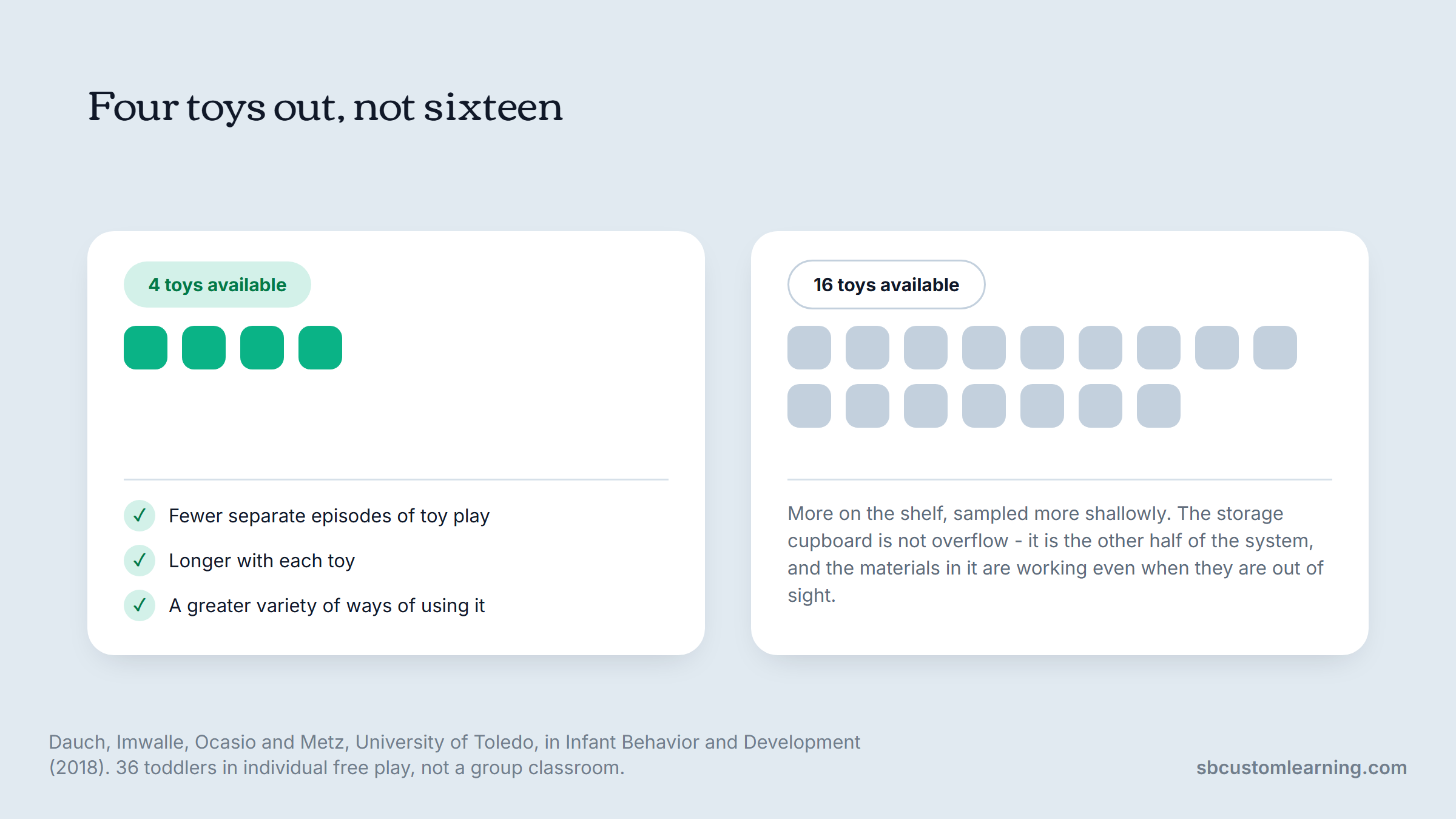
The practical translation is that your storage cupboard is not overflow. It is the other half of the system, and the materials in it are working even when they are out of sight.
Restraint on the shelf is also the organizing idea behind a Montessori-inspired classroom, where what is left out matters as much as what is put out.
What Teachers Say About Choice Overload
Practitioners reach the same conclusion from a different direction, and they explain it better.
In a Reddit thread asking how many toys should be out for two-year-olds, the most upvoted answer made the point plainly: when a child has twenty-five things to choose from it is hard to pick one, and when they have six it is much easier. Another teacher noted that with too many options children forget which materials are even available, and that fewer options on rotation improves both engagement and focus.
A third pointed out something that matters for licensing: state requirements set expectations about the materials a room provides, so reducing what is out is a decision about display rather than about what you own.
That is a discussion thread rather than research, so treat it as corroboration rather than proof. It happens to line up neatly with the Toledo findings.
Building a Rotation That Survives Term Time
Rotation is the core classroom organization system, and the version that works is smaller than the version people plan.
The failure mode is treating rotation as a full changeover. Swapping every center at once takes a full day, needs a place to stage everything, and means relabeling the room, so it happens in September, maybe in January, and then never again.
Almost everything a child relies on should still be there in March.
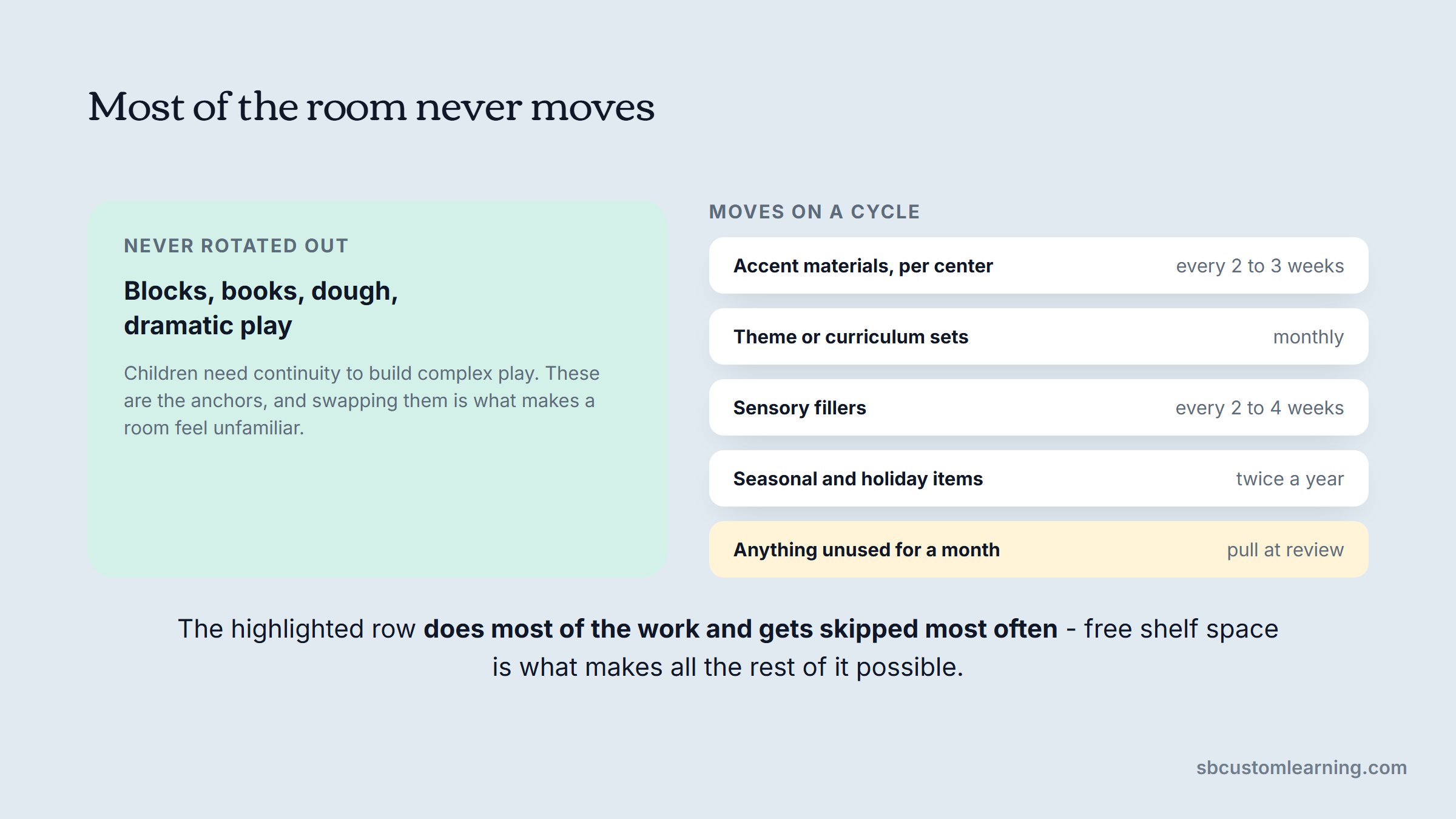
The version that survives keeps most of the room fixed and moves a small proportion on a predictable cycle.
| Material type | Cadence | Why | Who owns it |
|---|---|---|---|
| Anchors: blocks, books, dough, dramatic play | Never rotated out | Children need continuity to build complex play | Lead teacher |
| Accent materials in each center | Every 2 to 3 weeks | Refreshes interest without resetting the room | Lead teacher |
| Theme or curriculum materials | Monthly | Follows planning, arrives and leaves as a set | Whoever plans curriculum |
| Sensory fillers | Every 2 to 4 weeks | Hygiene as much as interest | Assistant |
| Seasonal and holiday items | Twice a year | Bulky, and only relevant briefly | Director or admin |
| Anything unused for a month | Pull at review | Free shelf space is what makes rotation possible | Lead teacher |
The last row does most of the work and gets skipped most often. A monthly walk through the room pulling anything untouched buys you the shelf space that makes everything else possible.
Mobile and modular units make the swap physically easier, which is why the classroom furniture trends worth paying attention to are mostly about pieces that move.
The Real Cost of Rotation, and How to Cut It
Rotation advice usually ignores what it costs, and teachers are specific about that.
In a Reddit thread on rotating toys, one teacher described their center asking for a swap every two weeks while nobody had the time to do it properly, because it meant switching out labels and photos, there was nowhere to store the spare materials, and in some rooms there was not enough to rotate with in the first place.
That is one center's experience, but the three blockers it names are the three we hear most: time, storage and relabeling. Each has a design answer.
Time comes down by rotating per center rather than per room, so the job is fifteen minutes rather than a day. Storage comes down by grouping the off-duty materials by center rather than by material type, so a swap means fetching one labeled tub instead of assembling a set. Relabeling stops being a blocker when the labels are designed to be swapped in the first place.
Where a room genuinely has nowhere to put the off-duty materials, the answer is usually vertical. Building upward recovers storage without taking floor area, which is what a custom play loft does at the same time as adding play space.
That teacher named a fourth problem, and it is the least comfortable one: if a room does not have enough materials to rotate with, the answer is a purchase, not a system. No amount of scheduling fixes an under-resourced room.
Keeping Labels True After the First Swap
Labels are usually treated as a setup task, and they are actually the maintenance surface where the whole system fails.
The moment a label stops matching what is in the bin, it teaches everyone to ignore labels. One wrong label is worse than none, because it converts a reliable system into one that has to be double-checked.
The fix is to choose a labeling format you can change in seconds. Velcro-backed or magnetic labels can be moved when materials rotate; a printed and laminated label glued to a bin cannot, so it gets covered with tape and eventually ignored. Write for the audience too, which in an early years room means a photograph as well as a word, since a pre-reader needs the picture and a substitute needs both.
The difference between the two formats is measured in seconds, and it decides everything.
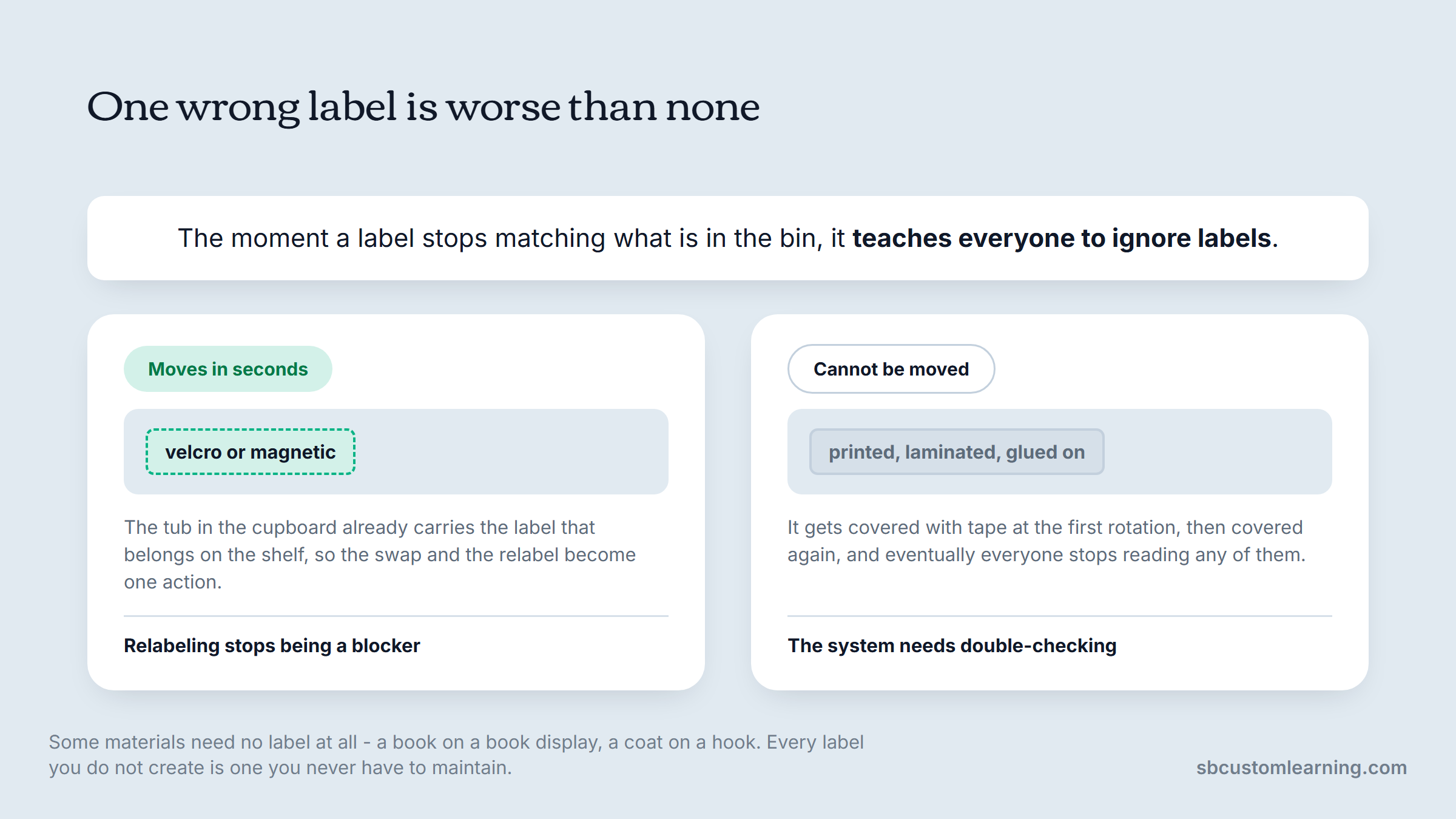
Build the relabeling into the rotation rather than treating it as a separate job. If the tub in the cupboard already carries the label that belongs on the shelf, the swap and the relabel become one action.
Some materials do not need labeling at all, which is a saving worth taking. Anything with an obvious home, a book on a book display, a coat on a hook, needs no label, and every label you do not create is one you never have to maintain.
The Closing Routine Is the Whole System
Almost all classroom organization rests on a five-minute routine when the room closes, and on whether that routine is real.
A closing routine works when it is specific, short, and owned. Vague instructions to tidy up produce a room that looks fine and is not reset, with materials in roughly the right area rather than in the right container. That difference is invisible in the evening and expensive the next morning.
What makes it specific is a reference for what "correct" looks like. A photograph of each center in its set-up state, taped inside the nearest cupboard door, settles arguments and orients anyone new. It is the cheapest documentation in the building and the only kind that stays accurate when you rearrange.
Children should do most of this, and in an early years room the tidying is curriculum rather than chores. Sorting materials back into labeled containers is classification practice, which is one reason the labels are worth keeping true.
The routine also needs a defined end. A closing checklist that finishes with a specific state, every container on its shelf, floor clear, tomorrow's materials out, gives staff a point where they are done rather than an open-ended obligation.
Sub-Proofing a Room
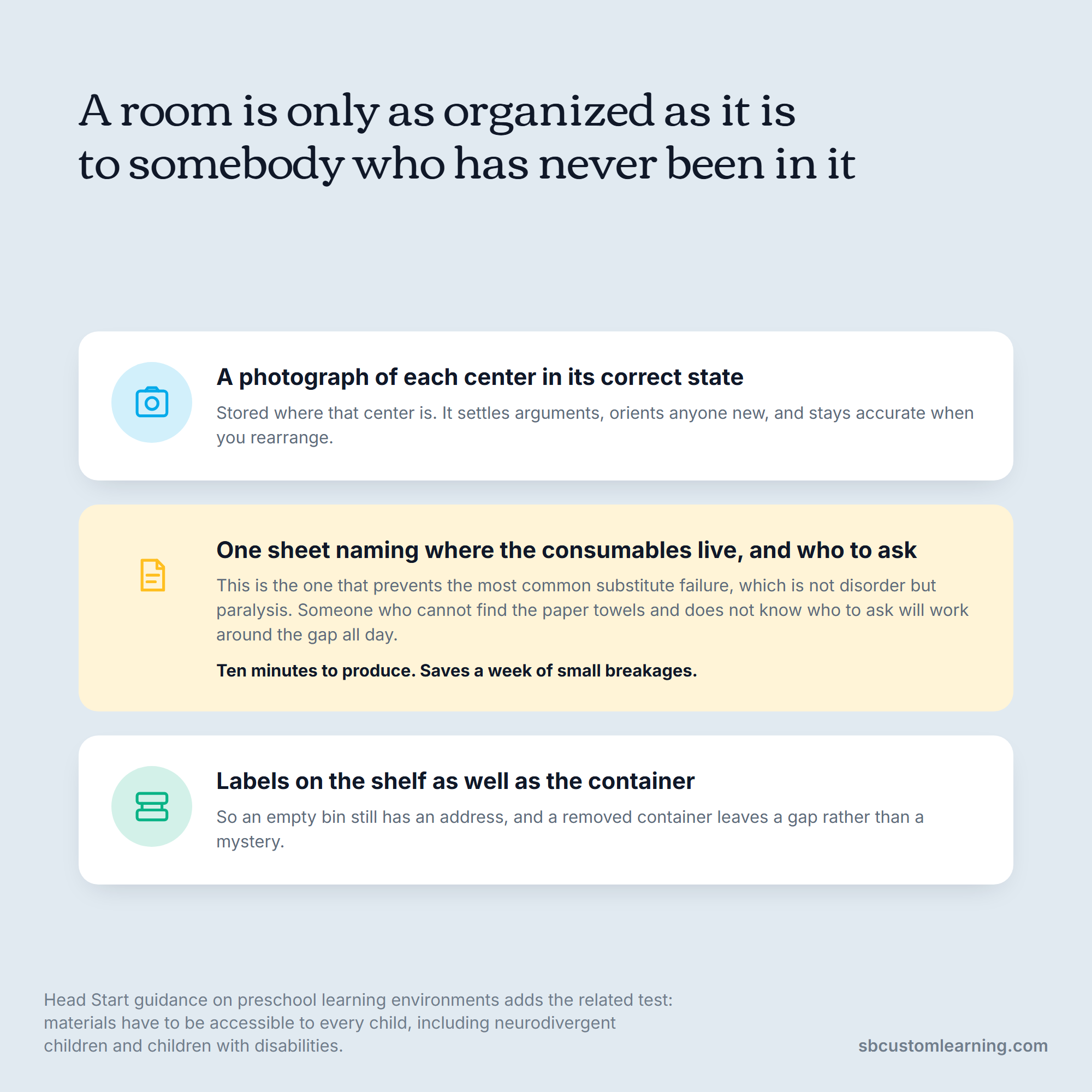
A room is only as organized as it is to somebody who has never been in it, and every center will test that within a month.
Head Start's guidance on preschool learning environments makes the related point that materials must be accessible to every child, including neurodivergent children and children with disabilities, and that the organization has to suit the developmental level of the group. A room organized around one teacher's memory fails both tests, because none of that logic is visible to anyone else.
Three artifacts make a room legible to an outsider, and none takes long to produce.
- A photograph of each center in its correct state, stored where that center is.
- A single sheet naming where the consumables live and who to ask when they run out.
- Labels on the shelf as well as the container, so an empty bin still has an address.
The second one prevents the most common substitute failure, which is not disorder but paralysis: someone who cannot find the paper towels and does not know who to ask will simply work around the gap all day. Ten minutes producing that sheet saves a week of small breakages.
Three artifacts, and the middle one is the one that gets skipped.
Keeping the consumables to a short, stable set helps here, which is what our list of essential classroom supplies is built to be.
Organize Across Rooms, Not Just Within One
The biggest organizational win in most centers is not inside any classroom. It is the fact that nobody knows what the building already owns.
Multi-room centers accumulate duplicates in one room and shortages in another, buy things they already have in a cupboard down the hall, and lose track of seasonal and specialist equipment entirely. Teachers solve this informally by swapping with the rooms on either side, which works and does not scale.
A shared stock system does not need software. A named location for shared materials, a list on the door of what is in it, and a rule that things return there rather than to whichever room used them last will cover most of it.
Setting it up is genuinely worth a morning. It is common to find enough unused material to fill the rotation gap that was about to become a purchase order, and it makes the next order smaller and better targeted.
What the audit cannot tell you is whether a gap can be filled at all, which is a sourcing question rather than an inventory one. Our FAQs page covers how we handle products outside the standard range.
Reordering Without Chaos
Organization eventually runs into procurement, and a system that works in the room can still fail at the purchase order.
Consumables are the usual problem. Paper, paint, glue and sensory fillers run out unpredictably, and the reorder happens when a teacher notices, which is generally after it has run out. A minimum-stock line on the shared store, with one named person checking it monthly, fixes almost all of it.
The Version That Is Still Working in March
Classroom organization is not a weekend project, and the rooms that stay organized are rarely the ones that started tidiest. They are the ones where every system was designed to cost almost nothing to maintain.
Put less out than you own. Rotate a little, per center, on a schedule somebody owns by name. Use labels you can move in seconds and keep them true. Photograph what correct looks like. Close the day to a defined state rather than to a general tidiness. And find out what the building already has before you buy more of it.
We design and furnish these rooms. We source from a range of established manufacturers and commission custom pieces when a room needs something no catalog makes. We are not tied to one manufacturer, which is why we can mix and match to fit the room rather than fit the room to one catalog.
If storage capacity is what is blocking your rotation, that is a design problem worth solving properly. Book a consultation and we will look at what the room has to hold before recommending anything to put in it.
FAQs
How do you keep a classroom organized all year?
Design every system for low maintenance rather than for a good first week. Keep most of the room fixed and rotate a small proportion per center every two to three weeks, use labels that can be moved in seconds, photograph each center in its correct state, and close the day to a defined end state rather than a general tidy-up. Anything costing more than a few minutes a week will stop happening in the busiest month.
How many toys should be out in a preschool classroom at once?
Fewer than most rooms put out. Research on toddlers found that four toys instead of sixteen produced longer play with each one and more varied use, and teachers consistently report that too much choice reduces engagement. Group settings need duplicates of popular items, so the principle is depth on the shelf rather than a strict count, with the rest held in rotation storage.
What are the best classroom organization ideas for teachers?
The ones with the lowest maintenance cost: swappable velcro or magnetic labels, photographs of each center taped inside a cupboard door, off-duty materials stored grouped by center rather than by type, a monthly pull of anything untouched, and a shared store between rooms so the building stops buying what it already owns.
How often should classroom materials be rotated?
Accent materials every two to three weeks, curriculum or theme sets monthly, sensory fillers every two to four weeks for hygiene, and seasonal items twice a year. Anchor materials such as blocks, books and dramatic play props should not rotate at all, because children need continuity to build complex play on top of them.
Who should own classroom organization in a multi-room center?
Name a person per system rather than assigning it to a team. The lead teacher usually owns accent rotation and the monthly pull, the assistant owns sensory fillers, and a director or administrator owns seasonal storage and the shared store between rooms. Systems owned by everybody are the ones that quietly stop happening.