
Classroom Furniture in 2026: A Buyer's Guide by Age Band
Key takeaways:
- Buy by age band. In Illinois, an infant room starts with one crib per licensed infant slot, each certified to the federal crib standard, plus open floor. Child-size tables start in the toddler room; for infants, the state asks for infant seats and seating with backs matched to what each baby can do.
- In Illinois, 23 Ill. Adm. Code 2008.380 asks for durable, safe furnishings sized for each age group: chairs and benches, tables for groups of 10 or fewer, low open shelves and individual storage.
- LISC's furnishings guide says to buy the costlier pieces (cubbies, shelves, changing tables, tables and chairs) to last 10 to 15 years, so check edges, corners and hardware before you check color.
- Under federal grant rules, a piece counts as "equipment" only at $10,000 or more per unit (or your own lower capitalization level), so on a federal award most classroom furniture counts as a supply, and the funder's quote rules decide how you buy it.
Furnishing a room for young children usually starts with a deadline: a licensing visit on the calendar, a grant with a spending date, or a new wing that opens in the fall. The list of pieces is long, and the order you buy them in matters as much as what's on it.
At SB Custom Learning, we plan classroom furniture from the age of the children in the room, then the licensing list, then how long each piece has to last, and the money and the paperwork come after that.
One idea runs through every section: furniture works when it's chosen for the actual room and the children who use it, the core argument of custom classroom design. A crib, a chair and a cubby do different jobs, and each one has to fit the age band it serves.
Classroom Furniture in Buying Order: Start with the Room
Before anything is ordered, measure the room and count the children who will use it at once. Licensed capacity sets most of the counts. For three- to five-year-olds, Illinois asks for one chair with a back per child, no folding chairs, and a foot of low open shelving per child, in Appendix B of Part 2008.
With those numbers in hand, we plan purchases in four rounds. The first round covers what children sleep on and staff sit on: cribs in an infant room, cots for children who stay five hours or more, and adult seating for staff.
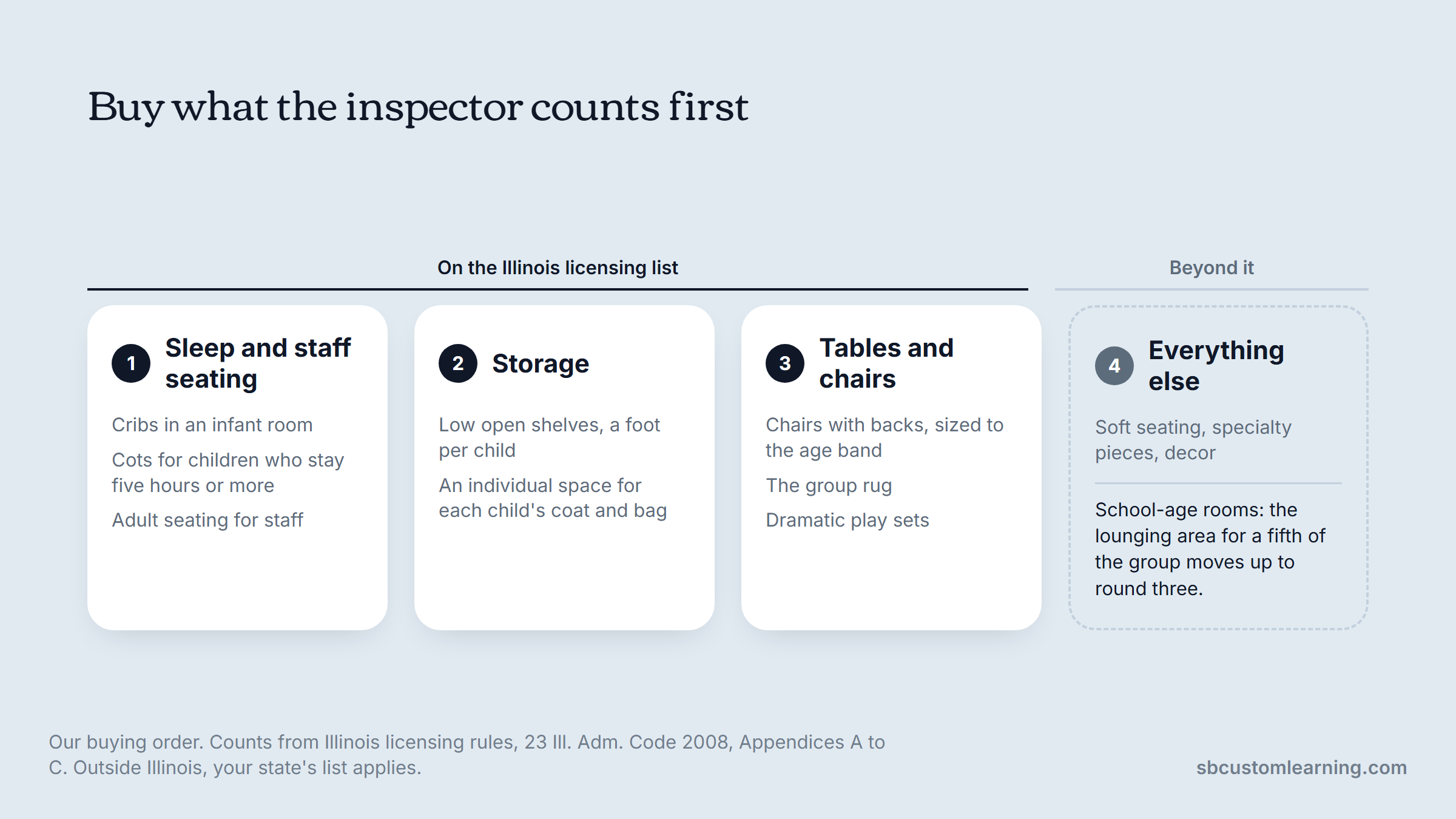
The second round is storage, planned alongside everything else in the room. Appendix A asks for the same foot of shelving per child in infant and toddler rooms, so where the shelves stand decides where everything else can go.
Low open shelves hold the materials children choose for themselves, and individual spaces hold coats and bags. A room with nowhere to put things ends up with them on the floor, and a working organization system depends on every bin having a shelf.
Tables and chairs with backs, sized to the age band, come third, along with the group rug (counted from the infant room up) and the dramatic play sets (counted from the toddler room up).
Soft seating, specialty pieces and decor usually come last. The exception is a school-age room, where Appendix C counts a cushioned lounging area big enough for a fifth of the group, so buy that with round three. That order keeps the first dollars on the pieces an inspector will look at.
What Each Age Band Needs, From Infants to Elementary
Age bands change what a room needs more than its size or budget does. The table below shows the first purchases for each band, drawn from the Illinois equipment lists in Part 2008 and the crib rules in Section 2008.350. The last column is our own planning judgment, the pieces we'd leave for a later round or for an older room.
| Age band | Buy first | What we'd hold off on |
|---|---|---|
| Infants (6 weeks to 14 months) | One certified crib per licensed infant slot, a changing table, low shelves, adult chairs with backs including a rocking chair | Child-size tables; keep the floor open for crawling |
| Toddlers (15 to 23 months) | Stacking cots or full-size cribs, a changing table, small-group tables, sturdy child seats with backs, low shelves, space for outer clothing | Tall shelving |
| Twos and threes | Tables and chairs sized for the group, a cot per child for long days, low open shelves | Desks and adult-height work surfaces |
| Fours and fives | A chair with a back for every child, tables for 10 or fewer, dramatic play sets and blocks | Chairs in a single height for a mixed-age room |
| Kindergarten and elementary | Group tables or individual work spots, seating at every table, personal storage | Furniture sized for the 4s room |
The rows overlap at the edges, because children move up during the year. A room that starts in September with young threes may need a second seat height by spring, so we plan the larger size into the order from the start.
Infant Rooms: Cribs and Open Floor
An infant room is furnished for babies who are held, fed, changed and laid down to sleep, and most of them aren't walking yet.
Illinois is specific about the first purchase: infants sleep in cribs, there's a crib for each licensed infant slot, and each crib needs certification that it meets the federal standard at 16 CFR 1219 or 1220 (or proof it was made on or after June 28, 2011), available for the licensing representative to inspect, under Section 2008.350.
Floor space is planned in two allowances. Section 2008.370 asks for 25 square feet of play space per infant plus 30 square feet of sleeping space, with 2 feet between cribs, so the cribs can't take floor from the play space.
Around the cribs, the Illinois infant list in Appendix A adds a diaper-changing table with a nonporous surface, low open shelves, an area rug, infant seats, and adult chairs with backs, including at least one rocking chair.
Toddlers, Twos and Threes
Toddlers are where tables and full-size child chairs start. Section 2008.350 lets toddlers sleep on stacking cots or in full-size cribs, and a cot or bed is required for each toddler, and each older child not yet in kindergarten, who stays five or more consecutive hours.
Chairs for this band need backs and a seat low enough that feet rest flat on the floor. Tables should seat a small group rather than the whole room. A washable rug marks the gathering spot, and each child gets a cubby or hook for outer clothing.
Fours and Fives
By four and five, children work at tables for longer stretches, so seat and table height get more of our attention. For children from about 3½ to 5½, we plan around a 12-inch seat and a 20-inch table, and older fives move up a size.
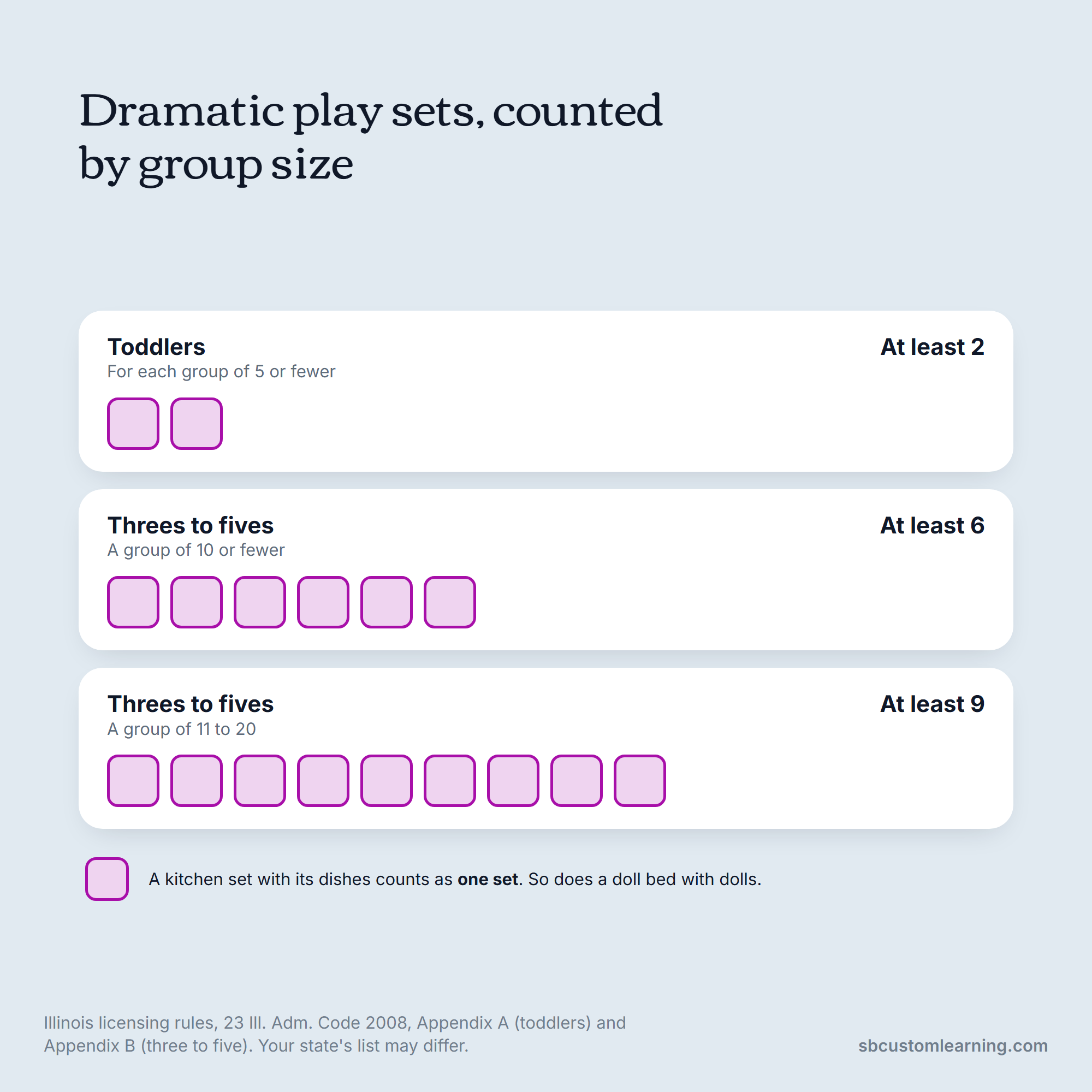
Dramatic play grows into a furniture line of its own here. Toddler rooms already need at least two sets for each group of five or fewer under Appendix A. For older children, Appendix B asks for at least 6 sets for a group of 10 or fewer and at least 9 for a group of 11 to 20, and a kitchen set with its dishes or a doll bed with dolls counts as one set.
Kindergarten and School-Age Groups
By kindergarten, the furniture shifts toward group tables and individual work spots. For school-age groups, Appendix C of Part 2008 asks for seating at tables for every child and staff member, matched to the type of program, plus an individual space for each child's belongings. A before- and after-school group needs pieces sized for older, taller children, so we plan furniture for elementary classrooms as a separate list.
The same age split carries outside, where every piece also has to survive a Midwest winter, which shapes how we choose outdoor classroom furniture.
What a Licensing Visit Actually Looks At
Illinois child care licensing has belonged to the Illinois Department of Early Childhood (IDEC) since the agency opened on July 1, 2026, and centers are licensed under 23 Ill. Adm. Code Part 2008. IDEC representatives make annual unannounced visits to every licensed program, so the room has to be ready on an ordinary Tuesday.
The furniture rules live mostly in Section 2008.380, which asks for "durable, safe and appropriately sized furnishings and equipment." It names chairs and benches sized for each age group, tables for 10 or fewer children, low open shelves within easy reach, and individual lockers, cubicles or hooks for belongings. If your center is in another state, read your state's licensing agency's equipment rules line by line before you order, since each state writes its own.
Here's what we walk a room for before a visit, each item traced to a Part 2008 section:
- Each crib has its certification on hand for inspection, slats no more than 2⅜ inches apart, a mattress gap of ½ inch or less, and nothing soft inside it (2008.350).
- Chairs and benches fit each age group, and any upholstered or padded seat meets the Illinois Furniture Fire Safety Act (2008.380).
- Furniture and equipment are adapted where an individual child needs it (2008.380).
- Play materials are free of sharp or rough edges and toxic paint, and no toxic or lead finish sits on furnishings within a child's reach (2008.380 and 2008.370).
- Nothing smaller than 1¼ inches across, and no removable part that size, sits where infants and toddlers play or sleep (2008.380).
- Where one room holds more than one group of children up to age 5, the dividers or program equipment between them stand at least 3 feet 6 inches tall (2008.370).
- Cribs and cots aren't used for storage, pillows and blankets included, though cots may be stacked between uses (2008.370).
- Table tops, equipment and classroom surfaces are in sound, clean condition (2008.380).
One more check comes from the design side rather than the code: anchor every tall shelf and storage unit to the wall, as LISC advises for cubbies.
Build Quality That Pays You Back
Furniture in a room of young children gets sat on, stood on, dragged and wiped down every day, so the purchase price is only the start of its cost. LISC's equipment and furnishings guide sets a useful bar: furniture should last 5 years or more with daily use, and the more expensive pieces (cubbies, shelves, changing tables, tables and chairs) should be bought to last 10 to 15 years.
Hardwood, Plywood or Laminate
Materials decide most of a piece's lifespan. The first two columns below follow LISC's materials appendix, and the last column adds what to know and what we check on a sample.
| Material | Where it shows up | What to know and check |
|---|---|---|
| Solid hardwood (beech, birch, maple, oak) | Tables, chairs, shelves, cubbies, lofts | Highest cost, and it can be refinished, so a scratched top comes back |
| Furniture-grade plywood | Lofts, platforms, curved pieces | Look at an exposed edge for many thin, even layers |
| Veneer over particle board | Tabletops, storage, play furniture | Cheaper versions can separate when wet, so confirm what's under the face |
| Plastic laminate | Tabletops, cubbies, counters, changing tables | Wipes clean but is hard to repair; look for rounded corners and protective edging |
| Molded plastic | Chairs, play furniture, dividers | Easy to sanitize, usually can't be repaired; skip light chairs that tip or slide |
For most rooms, the pairing we'd suggest is a laminate top, which wipes clean after paint and snack, on a hardwood or plywood frame that can take years of dragging.
LISC adds a practical caution: if a cubby or shelf in laminate will be fixed to a wall, check first that it can be anchored without damaging the surface. Ask and we'll share a sample, so a laminate color gets judged under your own lights before a whole room is ordered.
Edges, Hardware and Fit
Edges are where cheap furniture shows its age first. For anything built into a children's space, the General Services Administration's child care design guide asks for rounded outside corners with a radius of at least 13 mm, about half an inch. On laminate, in our experience, a lifted strip of edge banding at a corner is where chips start, so run a hand along every edge of a sample.
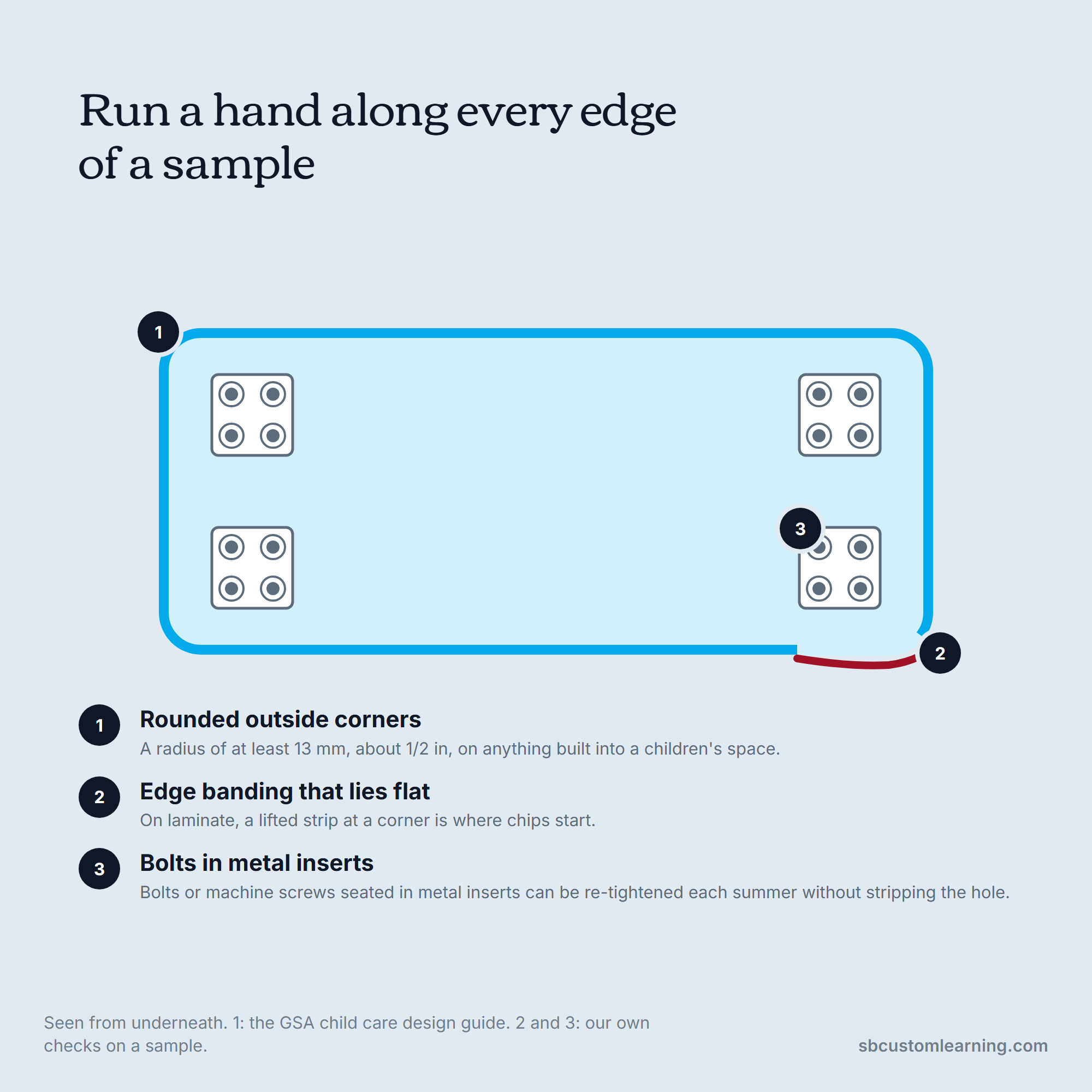
Hardware decides whether a piece can be kept tight. For metal furniture, LISC tells buyers to examine welded joints, machine screws and bolts, and to watch for loose connections. Our own advice goes a step further: ask whether a piece uses bolts or machine screws that seat in metal inserts, since a custodian can re-tighten those each summer without stripping the hole. Our maintenance guidance for custom lofts includes checking hardware tightness for the same reason.
Fit comes first in ergonomic classroom furniture. LISC's rule for children is that every child's feet should reach the floor when seated and a table should sit about at the waist, which in practice puts the top near elbow height once the child sits down. For adults, it calls for real adult chairs in several places around the room, so teachers aren't perched on child-size seats all day.
Ordering and Lead Times
Stock pieces and custom pieces run on different clocks. Our published timeline for custom furniture gives typical figures, which vary with each project: about 2 to 4 weeks for design consultation and approval, 6 to 10 weeks to make the pieces, and 1 to 3 days to install. Added together, that's 8 to 14 weeks before installation begins.
Catalog pieces usually move faster, and their lead times vary by line, so confirm each one on the quote. An order that mixes stock and made-to-order pieces is ready only when its slowest line is, so plan the room around the longest lead time on it.
Working Back From Your Opening Date
The safest plan starts at the date the room must be ready and counts backward. These are the steps we use:
- Fix the ready date: opening day, a licensing visit, or a grant's spending deadline.
- Count back 1 to 3 days for installation, plus a buffer for a delivery that slips.
- Count back 6 to 10 weeks for any custom piece to be made.
- Count back 2 to 4 weeks for design and approval.
- Confirm every stock lead time on the quote, and order the slowest items first.
- Book the install for an evening, weekend or program break if children will be in the building.
Run that sequence early and the date drives the order, which beats discovering a 10-week piece two weeks out. If you're pricing stock pieces first, our online furniture store lets you filter by grade level, including Infant and Toddler, so the list you build already matches the room.
Flat-Pack or Assembled
Flat-pack ships in boxes and can cost less to ship, but someone has to build it. Assembled pieces arrive ready to use, as long as they fit through your doors, hallways and stairs.
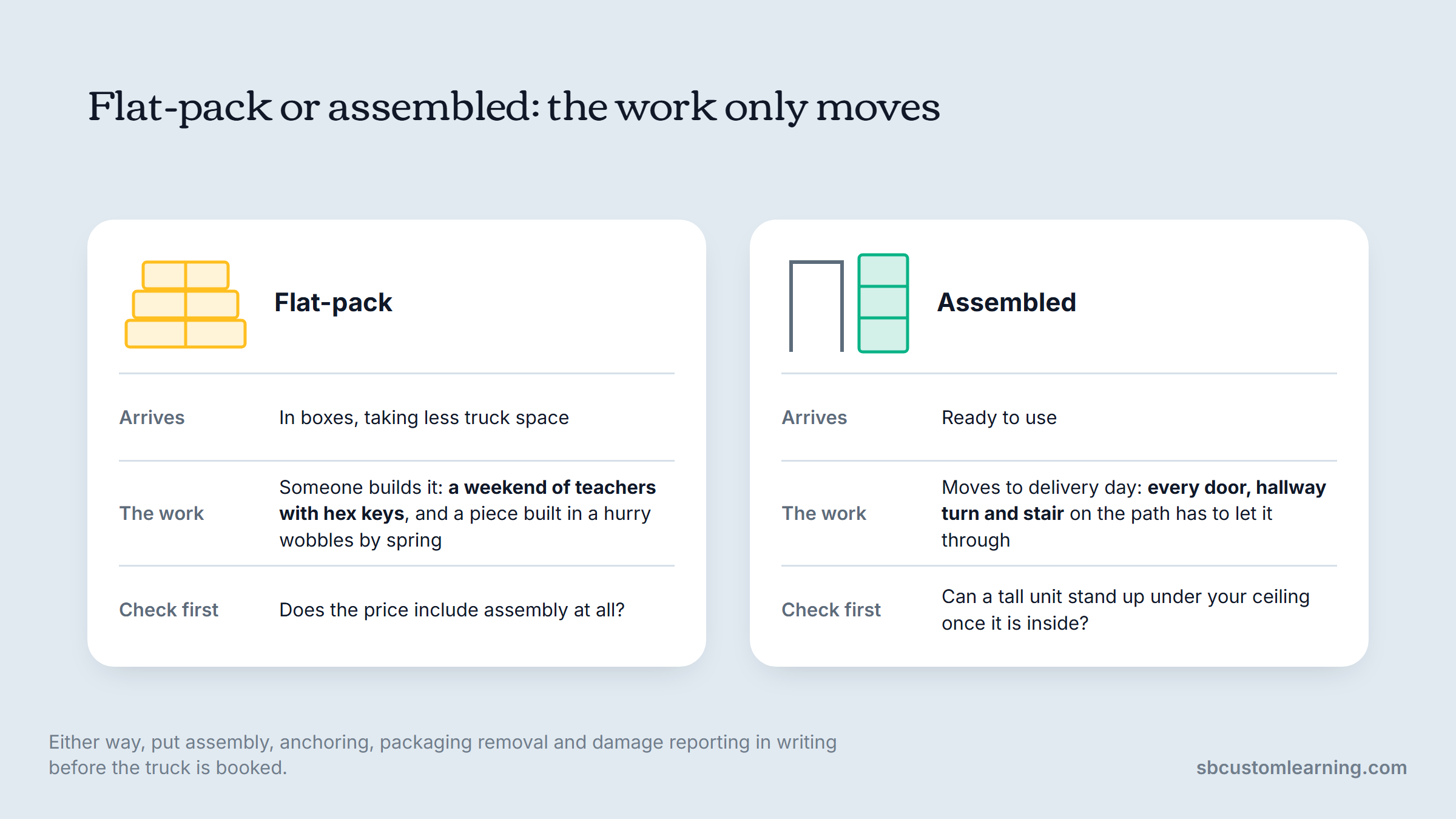
The hidden cost of flat-pack is labor: a room of shelves and cubbies can turn into a weekend of teachers with hex keys, so check whether a price includes assembly. For assembled pieces, measure every door and turn on the path to the room first. On our full-service projects, the scope runs from floor plans and color schemes through delivery and assembly, so the boxes never become your weekend.
Delivery and What Installation Covers
Any installation quote should spell out four things: who assembles, whether tall units get anchored, who takes away the packaging, and how damage gets reported. Get those in writing before the truck is booked.
Here's how we handle it. Our delivery area covers the Midwest and is widening into other regions, and experienced crews do the installation. On a custom project, a site visit to measure the space comes first where one is possible, our lofts go in with secure anchoring against tipping, the install is scheduled around your program (evenings, weekends or a program break), and maintenance guidelines come with it.
A little preparation makes delivery day shorter. Clear the room to the walls, keep the path from the door open, and have one person on site who knows the plan and can answer placement questions. If a piece arrives damaged, note it while the crew is still there, so it's on record from the start.
The Educare Chicago Play Lofts
Custom pieces earn their longer lead time in rooms that no catalog piece fits, and the custom play lofts we designed and installed at Educare Chicago are a good example. The lofts have distinctive red roofs, stairs with non-slip treads, upper play areas with railings that keep sightlines open for supervision, and archway entrances to the play space underneath.
We worked the design through with our vendor in an iterative process, covering weight capacity, stability, traffic flow and visibility for supervision. We also designed and installed custom cabinets with locking doors, matched to the lofts, so cleaning supplies and teaching materials can be kept out of children's reach.
A loft of this kind is designed for one age range, anywhere from toddlers of 18 months up to school-age children, with step height and railing spacing set to match. Infants fall outside that span.
Buying Classroom Furniture on a Fixed Budget
Over its life, the most affordable classroom furniture is the piece you don't have to buy twice. LISC puts it plainly: weigh the lifetime cost against the first price, invest in the pieces that get constant hard use, and economize on the ones used less often. A low-cost piece still has a place, as long as it's the occasional one rather than the chair every child sits on every day.

When the budget is fixed, this is the order we'd spend it in:
- Everything the licensing list counts for each age band, including cribs or cots, chairs, tables, low shelving, a group rug, adult seating, dramatic play sets and storage for surplus toys and supplies.
- Within that list, quality money for the hard-use pieces, such as tables, chairs, changing tables, cubbies and shelving.
- Soft seating, extra rugs and specialty pieces beyond the minimum counts, with decor added as the budget allows.
If the money won't stretch to every room at once, finish one room completely before starting the next, so at least one room is fully ready for its children and its licensing visit. Keep consumables on their own budget line too, since classroom supplies restock every year while a good chair doesn't.
Grants and Quotes Formatted for Funders
Grant money comes with rules about what it can buy and the paperwork that goes with each purchase. For federal awards, 2 CFR 200.1 defines equipment as property with a useful life of more than one year and a per-unit cost of at least $10,000, or your own capitalization level if that's lower. Everything else counts as a supply. That line took effect on October 1, 2024, so an older award may still use the earlier $5,000 threshold.
Most single classroom pieces fall below that line, so they're usually bought and tracked as supplies, unless your program sets a lower capitalization level. The same definitions let delivery and installation sit inside a piece's acquisition cost, depending on your accounting practices, so ask your finance lead which line they belong on before the quote is built.
Quotes matter too. Under Section 200.320, a purchase between the micro-purchase threshold and the simplified acquisition threshold needs price or rate quotations from an adequate number of qualified sources, and larger purchases move to sealed bids or proposals. State programs and private funders often add rules of their own, and federal money passed through a state still carries the federal ones, so ask for the funder's format before you request pricing.
That's where we spend time with directors. We put together grant-friendly product lists and format quotes to match funder requirements, and Illinois Action for Children counts us as an approved vendor.
Where to Start with Your Room
Start with the age band, then the licensing list, then the pieces that take the hardest use. Get the cribs, cots, chairs and shelving right, buy the high-use pieces to last a decade or more, and let decor wait for a later round.
At SB Custom Learning, our work covers the whole path: a room plan by age band, pieces sourced from established manufacturers, one-off pieces made to order where a room needs them, and the installation itself. Each quote is built around one center's rooms, its age groups and its deadline.
If you have a room to furnish, talk to our team about the space, the ages it serves and the date it has to be ready, and we'll build the plan from there.
FAQs
What furniture does an infant classroom need?
Cribs come first. Illinois requires one for every licensed infant slot, and each needs certification that it meets 16 CFR 1219 or 1220. Around them go a diaper-changing table, low shelving, a rug, infant seats and a rocking chair for staff. Children's tables can wait for the toddler room, which leaves the floor free for crawling; infant seating should have a back and match what each baby can safely do.
How long should classroom furniture last?
Plan on at least five years of daily use for anything you buy, according to LISC's resource guide, and 10 to 15 years for the costlier pieces, such as cubbies, shelves, changing tables, tables and chairs. Solid hardwood and furniture-grade plywood can be refinished, so a worn top can be restored.
Is laminate or hardwood better for kids classroom furniture?
Each wins in a different place. Laminate is the easier surface to wipe after paint and snack, though it's hard to repair once it chips. Hardwood costs more, stands up to daily dragging and can be refinished. A pairing that suits many rooms is a laminate top with rounded, edged corners over a hardwood or plywood frame.
How far ahead should I order classroom furniture for kindergarten or a new room?
Check stock lead times line by line on your quote, since they differ. Custom work takes longer: our typical figures are 2 to 4 weeks to design and approve, 6 to 10 weeks to make and 1 to 3 days for installation. For a custom piece, start the design conversation 8 to 14 weeks before installation, then add the 1 to 3 install days and a buffer before the date the room must be ready.
Can grant money pay for classroom furniture?
Often, yes. Federal awards call a piece equipment when it costs $10,000 or more per unit, or passes a lower threshold your program sets, so most chairs, tables and shelves are bought as supplies. On a federal award, bigger orders need competing quotes or bids under 2 CFR 200.320. State and private funders often add their own rules, so get their quote format first.