
Teacher Development in Childcare Centers: 10 Types That Work
Key takeaways:
- Teacher development in a childcare center is the coaching, training and credentials that happen all year, not one in-service day in August.
- Ten types fit a small budget, and most cost staff time rather than money: coaching, peer observation, mentoring new hires, room walk-throughs, reflective supervision, peer groups, conferences, online modules, credential pathways and book studies.
- Teachers move through four stages (survival, consolidation, renewal and maturity), and each stage needs different support from a director.
- Illinois requires 15 clock hours of in-service training a year for each staff member, and the room itself is one of the cheapest development tools you own.
September usually shows how a center spent August. A room with a rearranged layout and a teacher who can explain why it changed had a plan behind it. A room where the furniture sat still and the in-service binder stayed on the shelf more often had a summer that got away from everyone.
Teacher development is what separates the two, and it is not a day on the calendar. It is the steady work of helping adults get better at a job that is physically hard, emotionally demanding and often underpaid.
This guide is for the director or owner running a small center on a thin budget. It covers what teacher development actually means, ten types that fit real money, the four stages every teacher moves through, the Illinois licensing requirements you already have to meet, and a plain way to plan the year.
The room itself is part of that program, which is why our planning and consultation service starts with the people who work in it rather than with a catalog.
What Teacher Development Means in a Childcare Center
The short answer is that teacher development is ongoing coaching, training and credentials, not one in-service day. It is the sum of everything a center does on purpose to build its teachers' skill: a mentor walking a new hire through the nap routine, a peer watching another teacher run a morning meeting, a director sitting down once a month to talk through one specific goal.
The field draws the line in the same place. NAEYC's professional development glossary calls it a continuum of learning and support activities that improves knowledge, skills, practices and dispositions, and sorts that continuum into three kinds: training, technical assistance and education. Coaching, mentoring and peer learning communities all sit under technical assistance. A single workshop is one item on the list, and usually the weakest one.
That distinction matters for a small center because the strongest items are also the cheapest. Coaching, observation and structured reflection cost time you can schedule, while conferences and tuition cost money you may not have.
A director who sees the difference can build a real program from the budget already in front of them, deciding what the staff can absorb this year rather than designing one nobody has the hours to run.
The other half of the definition is that development belongs to the adult, not the room. A teacher who feels stuck with no path forward starts looking for one somewhere else, and pay is part of why. An early childhood development teacher salary rarely stretches far, so the path a center can offer counts for more than it would in a better-paid field. Building that path is a retention strategy as much as a training one.
Why a Single In-Service Day Rarely Changes a Room
The one-day model is popular because it is easy to schedule, not because it works. Everyone gathers, someone presents, and by the next week the room looks the same. The format fails for a simple reason: a skill practiced once, without follow-up, does not survive contact with a Tuesday.
The research on coaching makes the gap plain. In a meta-analysis of 60 studies with causal research designs, Kraft, Blazar and Hogan found that teacher coaching raised instructional practice by 0.49 standard deviations and student achievement by 0.18 standard deviations.
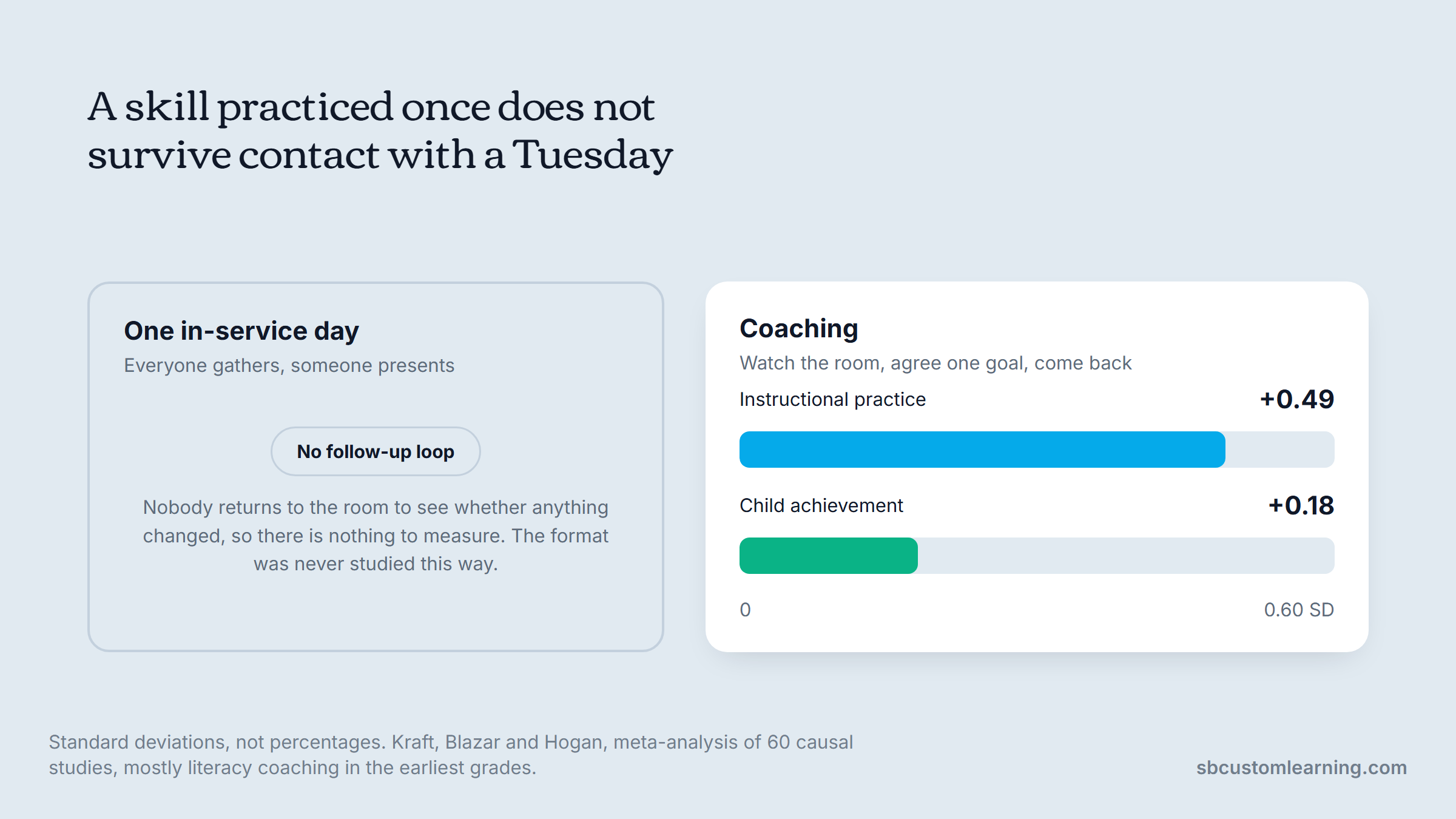
Those are large effects by education research standards, and the studies were mostly literacy coaching for the youngest children and the early elementary grades, which maps closely onto a childcare room.
The reason coaching outperforms a workshop is baked into what it is. A coach watches the actual room, names one thing to change, and comes back to see whether it changed. That loop is what a teacher professional development workshop cannot supply on its own, however good the speaker is.
The same test is worth applying to a training calendar. A session that teaches something a teacher can use the next morning earns its hour, while one that will not be touched until next term rarely survives the week.
A room gets judged the same way. In the rooms we have planned, the layout, the storage and the sightlines were worked out with the teachers who use them, which is why those decisions hold up once the term starts.
The 10 Types of Teacher Development That Fit a Small Budget
Ten formats work in a small center, and none of them requires you to hire a consultant. The teacher staff development ideas below share one trait: they expand what the staff can already do, using time the center controls.
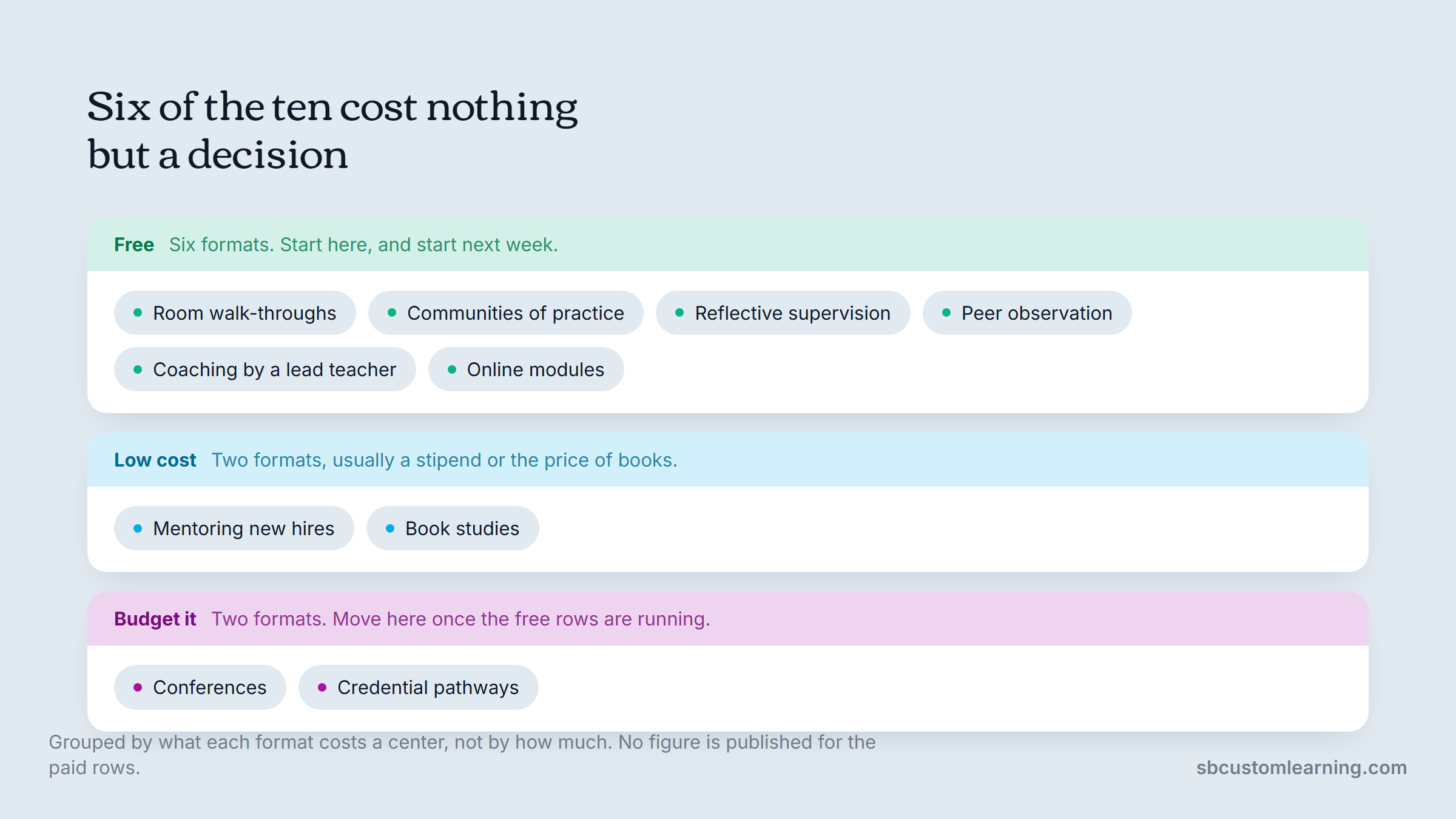
Six of the ten cost nothing but a decision, because the only thing they spend is time the center already pays for: coaching by a lead teacher, peer observation, room walk-throughs, reflective supervision, communities of practice and the free online modules. The table lays out what each one looks like in practice, how much time it takes and what it costs a center that counts every hour.
| Type | What it looks like | Time it takes | What it costs |
|---|---|---|---|
| Coaching | A trained peer or director watches a lesson, agrees on one goal, and returns to check it | 30 to 45 minutes every two weeks | Staff time, unless you hire an outside coach |
| Peer observation | One teacher watches another and both debrief afterward | 30 minutes per visit, plus coverage | Coverage time |
| Mentoring new hires | A veteran is paired with a new teacher for the first 90 days | Weekly check-ins for 12 weeks | A small stipend or release time |
| Room walk-throughs | Director and teacher walk the room together and name one change | 20 minutes | None |
| Reflective supervision | A scheduled one-to-one on practice and how the work feels | 45 minutes monthly | Director time |
| Communities of practice | Teachers from different rooms meet around one shared problem | 60 minutes monthly | None |
| Conferences | A state or regional early childhood conference | One or two days | Registration, travel and coverage |
| Online modules | Self-paced, state-approved courses taken on a break | One to three hours each | Free courses exist, others are low cost |
| Credential pathways | A CDA, a Gateways credential, or college coursework | Months to years | Tuition, often grant-eligible |
| Book studies | The staff reads one title and discusses it together | 30 to 60 minutes monthly | The cost of the books |
Start with those six rows. Room walk-throughs, communities of practice and reflective supervision can begin next week, and each one produces material a paid training would otherwise supply. The teacher-approved supplies list makes a good first book study, because the discussion stays grounded in the room instead of drifting into theory.
Move down the table only when the cheap rows are running well. A conference is worth the money when the teacher who attends brings back one idea the whole staff can use, and worthless when it is a solo trip with no debrief.
State conferences work better for a small center when two staff attend together, so each one has someone to plan the debrief with. The professional development opportunities for teachers that pay off fastest are the ones paired with a free format, because the expensive row then has somewhere to land.
Notice what the table does not include. There is no line for a motivational speaker, a new curriculum binder or a subscription nobody logs into. Those are the rows that pad a training budget while leaving the room unchanged, and dropping them is the simplest way to fund the rows that matter.
The Four Stages of Teacher Development
Teachers do not grow in a straight line, and a first-year hire does not need what a fifth-year teacher needs. Lilian Katz described four stages that early childhood teachers move through, and her framing is still the most useful map a director has.
| Stage | What it looks like | What helps most |
|---|---|---|
| Survival | The first year, when the teacher is focused on getting through the day | On-site support, a mentor, help with routines and reassurance |
| Consolidation | Roughly the second year, when routines are in place and the focus shifts to children | Coaching on instruction, observation feedback, behavior strategies |
| Renewal | Around the third or fourth year, when the same day starts to feel stale | New ideas, peer groups, conferences, a fresh challenge |
| Maturity | The fifth year and beyond, when the teacher asks deeper questions about purpose | Leadership roles, mentoring others, credentials, reflective supervision |
The insight that makes Katz worth reading today is that experience by itself is not enough.
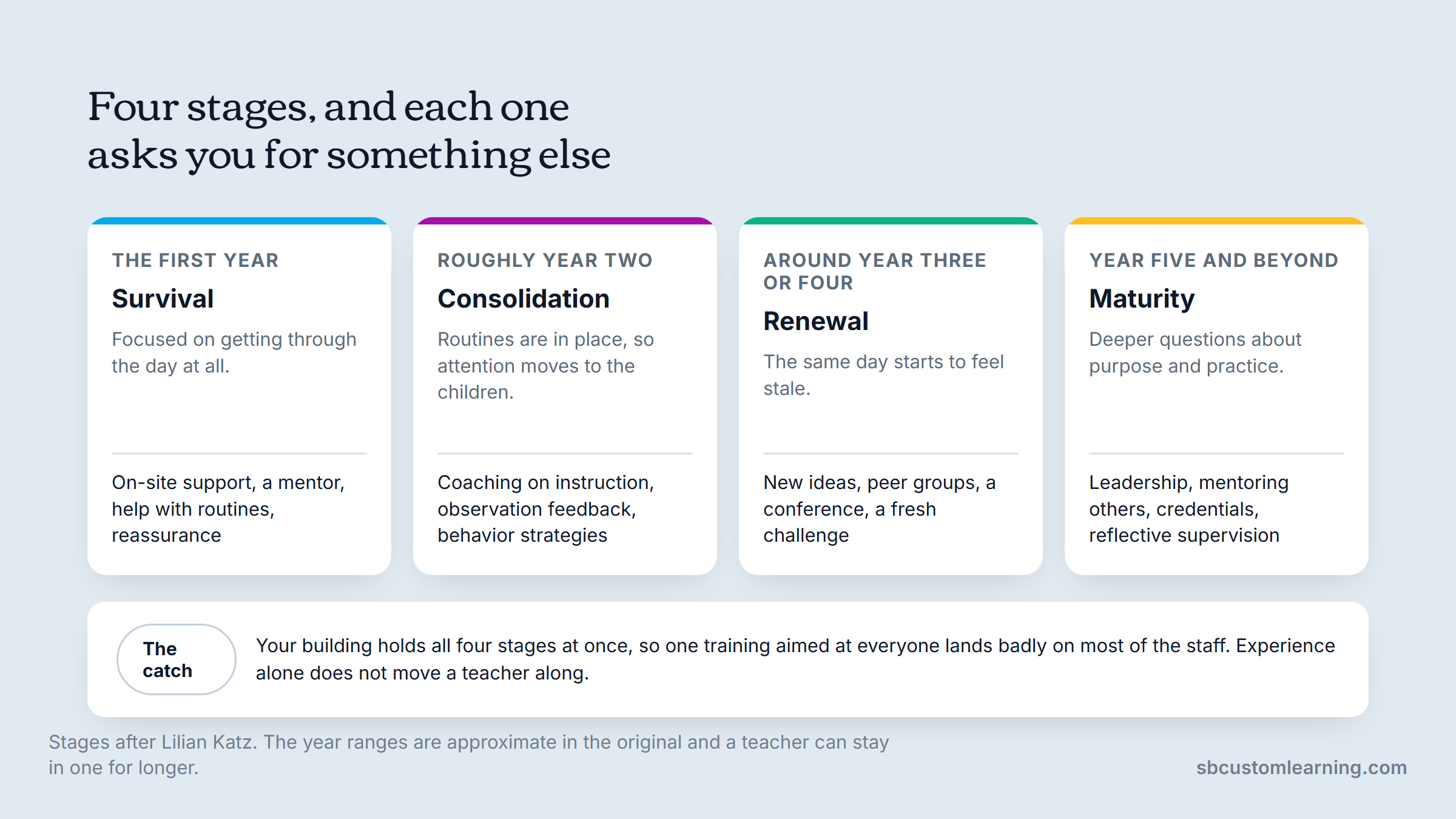
As her paper puts it, experience alone seems insufficient to direct a teacher's growth and learning, so someone has to help the teacher interpret what happened and decide what to do next. Years in the room are worth a great deal, and on their own they are not a training plan.
What Each Stage Needs From You
A single training program aimed at everyone will land badly on most of the staff, because the room holds four different stages at once. The fix is to aim your one-to-one time at the stage each teacher is actually in, which costs nothing extra and changes what the conversation is about.
Most directors already have more ideas for teacher professional development than hours to spend on them. Four questions do more work than the catalog does.
Use the four questions below in a monthly check-in, matched to where the teacher sits. They surface the real problem faster than an open-ended chat, and the answers tell you which row of the training table to spend on next.
- For a first-year teacher: which part of the day still feels like it is running away from you?
- For a teacher in consolidation: what did you try this month that you want a second opinion on?
- For a renewing teacher: what is one thing you have stopped being curious about?
- For a mature teacher: who on this staff could learn from what you already know?
The questions only work if the room gives the teacher somewhere to stand, literally and otherwise. A survival-stage teacher needs a layout that works without constant rescue, which is the case classroom design ideas are built around. A mature teacher needs room to lead, whether that is mentoring a new hire or running the staff meeting on a problem they care about.
The Illinois Side: Credentials and Required Training Hours
If you run a licensed center in Illinois, you are already doing teacher development whether you call it that or not, because the state requires it.
Childcare licensing in Illinois moved to the Illinois Department of Early Childhood (IDEC) on July 1, 2026, taking over from the Illinois Department of Children and Family Services (DCFS), which had licensed Illinois centers for decades. The rules were recodified from 89 Illinois Administrative Code 407 to 23 Illinois Administrative Code 2008, and the childcare center standards now sit in Part 2008.
The training requirement survived the move. Under 23 Illinois Administrative Code 2008.100, the director and each childcare staff member must complete 15 clock hours of in-service training per year.

In the first year of employment, the training must cover how to recognize and report suspected child abuse or neglect, how to make that report, the rules for operating the facility, and the legal protection given to people who report licensing violations.
The rule is generous about how you earn the hours. On-site training counts, along with documented attendance at seminars, workshops, conferences and early childhood classes, and approved self-study. A staff meeting counts only when a planned in-service program is presented, which is a useful test to apply to your own calendar. Records of the training have to be kept at the site.
There is a second Illinois thread running alongside the hour count. Staff who serve children must join the Gateways to Opportunity Registry within 30 days of hire under the same section, with their education and credentials entered and verified.
That registry is where a consistent path shows up. A teacher can build toward a Gateways credential, a CDA or a degree, and the center can point to something concrete when it talks about a career ladder.
Development That Uses the Room Itself
The cheapest development tool in the building is the room, and most centers never use it. A room that works teaches the teacher something every day: where the traffic snags, where a child disappears from view, where the supplies run out by ten in the morning. Learning to read those signals is a skill, and you can teach it the same way you teach anything else.
The formal version is an environment rating scale walk-through. The ECERS-3 for rooms serving children 2.5 to 5 and the ITERS-3 for infants and toddlers both turn a room into a list of concrete, scorable items, from the condition of the furnishings to how much of the day children spend in whole-group instruction.
You do not need a certification to borrow the method. Walk the room with the teacher and score it together, then pick one item to change.
Even a plain walk-through, done as a team exercise, builds the eye. Use this sequence the next time a room needs a reset, and let the teacher drive the last step.
- Walk the room from the door the way a child would, at a child's height.
- Stand where the teacher has to stand and check what leaves the sightline.
- Find the spot where two activities collide, usually near the sink or the block area.
- Name one change that would fix the worst collision, not all of them at once.
- Move the furniture together, then leave it for a week before judging it.
That last step matters more than it sounds. A change the teachers made with their own hands is one they will defend and refine, and refining it is where the learning happens. It is also why we treat a room as a working draft, which is the case we make for a custom layout over a one-size-fits-all setup.
One honest limit applies here. Rearranging movable furniture and shelving does not touch the licensing rules on space per child, so check the current figures for your age group before you plan a reset. We buy to the Illinois code on every order, and that is a detail worth keeping in the plan rather than discovering at the monitoring visit.
A Year-Long PD Calendar for a Small Center
A training plan that lives only in a director's head becomes a scramble every August. Spreading the work across the year solves the scheduling problem and the money problem at once, because the free formats can carry the months when nobody has budget for anything else.
The calendar below is written for a small center with a handful of staff and no dedicated training coordinator. It assumes the 15 required hours have to be earned by each employee across the year, and it uses the formats from the table earlier.
| Season | Focus | Main format | Cost to plan for |
|---|---|---|---|
| Fall | Routines and the first 90 days for new hires | Mentoring, walk-throughs | Release time for mentors |
| Winter | One instructional goal, chosen by the staff | Coaching, peer observation | Staff time |
| Spring | A room reset and the supply audit | Walk-through, book study | Small material budget |
| Summer | Credential and conference season | Conferences, online modules | Registration, tuition |
The winter row is where the year is won. Pick one instructional goal, say helping toddlers through transitions or asking open-ended questions at the art table, and point coaching and peer observation at that single goal for three months.
Changing one real practice a year adds up faster than it sounds. When the material budget opens in spring, spend it against what the coaching surfaced rather than against a catalog, which is the discipline behind designing on a fixed budget.
Keep the required hours in view the whole time. Fifteen clock hours sounds like a lot until you count the ones the calendar already produces: an on-site session, a conference day, a documented online module and a planned staff meeting each contribute, and a well-run year clears the requirement as a byproduct of work you wanted to do anyway.
Turning the Calendar Into Professional Development Plans
A calendar is not a plan, and a plan is what keeps development from dissolving in a busy month. The practical unit is a single page per teacher, written in September and reviewed each quarter.
Write it in two parts. The professional development goals for teachers come first, stated so they can be watched in the room. Under each goal sit the professional development objectives for teachers, phrased as the specific change you want to see by the next review.
The second half of the page is the training that will get the teacher there, drawing on the required Illinois hours and any conferences worth the trip. Free online professional development for teachers keeps the cost at zero for a teacher who wants to work an hour in the evening.
A teacher chasing a CDA, a Gateways credential or a degree can list the coursework on the same page, which keeps the licensing hours and the career path in one place.
Gateways to Opportunity, the state's professional development system, publishes a professional development plan form with the goal, barrier and timeline sections already laid out. Sample teacher professional development plans built from that form beat a blank sheet, because the headings tell a director what to ask.
The page pays for itself at review time. When a funder or a grant asks what the money will change, the answer is already written down, and the plan becomes the record that shows it happened.
Coaching Without Hiring a Coach
The word coaching scares off small centers because it sounds like a salary line. It does not have to be. The core of coaching is one adult watching another and giving specific feedback, and an experienced lead teacher can do that for a colleague with a little training and a clear structure.
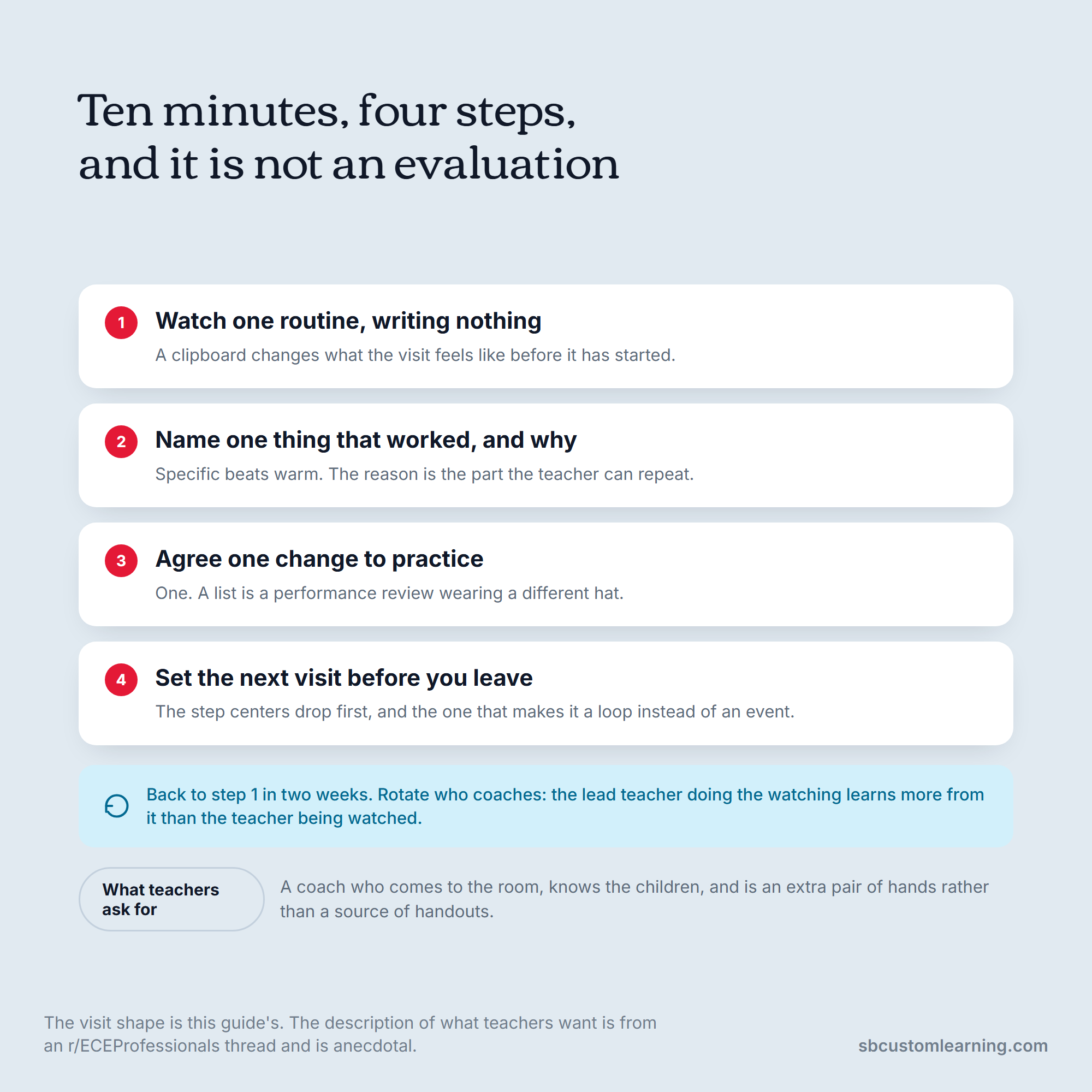
The useful version of a coach is modest and specific: someone who comes to the room, knows the children, and is there often enough to notice when something changes. That is a colleague rather than a consultant, and it is a realistic thing to build with the staff you already have.
A good ten-minute coaching visit is short, specific and repeatable. Keep it to this shape so it does not balloon into an evaluation.
- Watch one routine without writing anything down.
- Name one thing that worked and exactly why it worked.
- Agree on one change to practice before the next visit.
- Set the next visit before you leave the room.
Rotate the role rather than fixing it to one person. A lead teacher who coaches a peer learns more from the exercise than the peer does, and that is the point. Coaching also sharpens the eye for the room itself, including whether the adults have furniture that fits them, which is half the argument for flexible seating.
A Program You Can Actually Run
Teacher development fails in small centers for boring reasons: nobody schedules it, the money shows up all at once, and the person responsible is the same person running the building.
Every fix in this guide is aimed at that reality. Use the free formats first, match each check-in to where that teacher actually is, let the room do some of the teaching, and keep the Illinois hours in view so the required training doubles as the program you wanted.
None of it asks you to become a training department. It asks you to decide, once a year, what the staff is going to get better at, then point the time and the money at that one thing. A center that does that for three years looks nothing like the one next door, and the teachers know which building they are standing in.
When you are ready to make the rooms part of the plan, schedule a consultation and we will walk each space with your staff. We serve centers across the Midwest and beyond.
FAQs
What is teacher development in early childhood?
Teacher development is the ongoing work of building an educator's skill through coaching, peer observation, mentoring, reflective supervision and formal training, rather than a single in-service day. It covers the practices and knowledge a teacher needs to run a room well, and the credentials that open a path forward.
What are examples of professional development for teachers?
The everyday examples cost the least: a mentor walking a new hire through the routine, one teacher observing another, a monthly peer group, a book study, or a director's reflective supervision. Paid options include teacher professional development workshops, conferences and college coursework.
How many training hours does Illinois require?
Illinois requires the director and each childcare staff member to complete 15 clock hours of in-service training per year, under 23 Illinois Administrative Code 2008.100. Hours can be earned through on-site training, seminars, workshops, conferences, early childhood classes and approved self-study, and records must be kept at the site.
What are the four stages of teacher development?
Lilian Katz described four stages: survival, when a new teacher is focused on getting through the day; consolidation, when routines are set and the focus turns to children; renewal, when the routine starts to feel stale; and maturity, when the teacher asks deeper questions about purpose. Each stage calls for a different kind of support.
How can a small center afford professional development?
Lean on the formats that cost nothing but time, including walk-throughs, peer observation, communities of practice and reflective supervision. Then budget one paid row a year, such as a conference or a credential, and tie it to a debrief so the whole staff benefits. There is free online professional development for teachers, and the 15 required hours can be earned through work you already planned.