
Teacher Retention in Childcare: 8 Strategies That Work
Key takeaways:
- Pay is the first lever, not a last resort. Early educators earn a median wage of $13.07 an hour, and low pay is the most common reason they leave.
- Seven more levers sit behind pay. Six of them cost scheduling or attention rather than money, and only the credential-to-lead ladder needs a budget line of its own.
- The room is part of the argument. Adult-height counters, seating built for grown-ups, and changing tables children can step up to remove a daily load of lifting and kneeling.
- Audit the rooms you already have before you spend anything, then fund the fixes in order.
Your lead infant teacher just gave notice. The reason was not dramatic: a center eight minutes away pays two dollars an hour more and does not ask her to lift a 2-year-old thirty times before lunch.
Directors live this story every fall. Childcare runs on people, and when they leave, the whole building feels it. Children lose the teacher who knew their nap routine, the teachers who stay absorb the extra ratios, and you start a hiring cycle that eats the time you needed for everything else.
Retention usually gets framed as a pay problem, and pay is real. It is also not the only lever, and it is not the only thing you can move this quarter. This guide covers why early educators leave, eight teacher recruitment and retention strategies that hold them, and the part almost no budget line covers: the physical room they spend the day inside.
Why Childcare Teachers Leave
Start with pay, because every other lever works better once pay is settled. The 2024 Workforce Index from the Center for the Study of Child Care Employment puts the median early educator wage at $13.07 an hour.

Compare that with $31.80 for elementary and middle school teachers, or $22.92 across the whole U.S. workforce. In plain terms, 97 percent of other occupations pay better than early education does.
The same research found that 13.1 percent of early educators live below the federal poverty line, against 2.3 percent of elementary and middle school teachers. Another 43 percent of early educator families lean on public programs such as Medicaid or food assistance to get by.
Pay leads, but it does not work alone. The Learning Policy Institute examined why U.S. public school teachers move schools or leave the profession and tied turnover to salaries, the quality of leadership, and job satisfaction. Leadership mattered as much as money there: teachers who rated their leaders highly were half as likely to leave.
Workload is the next pressure. Staffing gaps push more children into one room, planning time disappears first, and breaks get covered by whoever is free, which is often nobody. Put that teacher in a room with no sightlines and no chair at adult height, and a hard job gets harder by noon.
The table below groups the research into pressures a director can actually see, with the first lever to reach for on each.
| Pressure | How it shows up | First lever you own |
|---|---|---|
| Pay and benefits | A nearby center offers more an hour; no health coverage | Adjust the wage scale, then add one benefit that matters |
| Workload and staffing | Ratios stretched, planning time cut, unpaid overtime | Protect planning time on the schedule and hire to ratio |
| Leadership and support | Teachers get no backup and unclear expectations | Reflective supervision and lead-teacher training |
| Job satisfaction | Teachers feel unheard and boxed in | Give them a real say in their own room |
| Physical working conditions | Lifting, kneeling, furniture built at child height | Raise surfaces, seating and storage to adult height |
| No path forward | Assistants see no next step | Build a credential-to-lead-teacher ladder |
Read the table as a control panel. Pay is the biggest dial, and the other five rows are cheaper to turn, which is why a center on a thin budget can still cut turnover this year. Thoughtful classroom design reaches two of those rows at once, because the room decides how hard the physical work feels.
What Teacher Retention Actually Means
Teacher retention is the share of teachers who stay, whether at your center or in the profession, from one period to the next. Turnover is the mirror image: the share who leave. A retention rate near 100 percent means almost nobody departed. A turnover rate of 30 percent means nearly a third of the staff did.
To define retention in a way you can use, keep two questions apart. Are teachers staying at your center, or staying in the field at all? Those need different fixes. A teacher who loves the work but leaves your building for a shorter commute is a center problem. A teacher who quits childcare entirely is a field problem.
The statistics on retention are easy to misread, so anchor them to one source. The Learning Policy Institute found that between 2020 and 2022, 15.1 percent of U.S. public school teachers moved schools or left teaching, splitting into 8.0 percent who moved and 7.1 percent who left the profession. Nearly three in four of those who moved or left did so voluntarily, before retirement.
Put another way, the national retention rate for public schools sat near 85 percent, meaning about one in seven teachers did not return to the same school. That turnover is roughly 27 percent higher than in the early 1990s, driven mostly by more teachers leaving the profession rather than switching buildings.
Retention rates by state swing wider than that national figure, because wages, licensing and public funding for early education are set locally. A national retention survey such as the National Teacher and Principal Survey is where most of these numbers start, and its message stays consistent: people rarely quit the children. They quit the conditions.
Where Retention Is Hardest
Turnover does not fall evenly across a staff, and knowing which roles leave first tells you where to spend your first hour.
- Teachers in their first one to three years
- Assistants with no funded next step
- Infant and toddler room staff
Most directors can name all three without opening a spreadsheet, and they have to, because the published rates do not cover them. Every national turnover figure in this guide comes from the Learning Policy Institute's work on U.S. public school teachers, and that is a different job in a different building. The direction it points is sound, but the numbers are not childcare numbers.
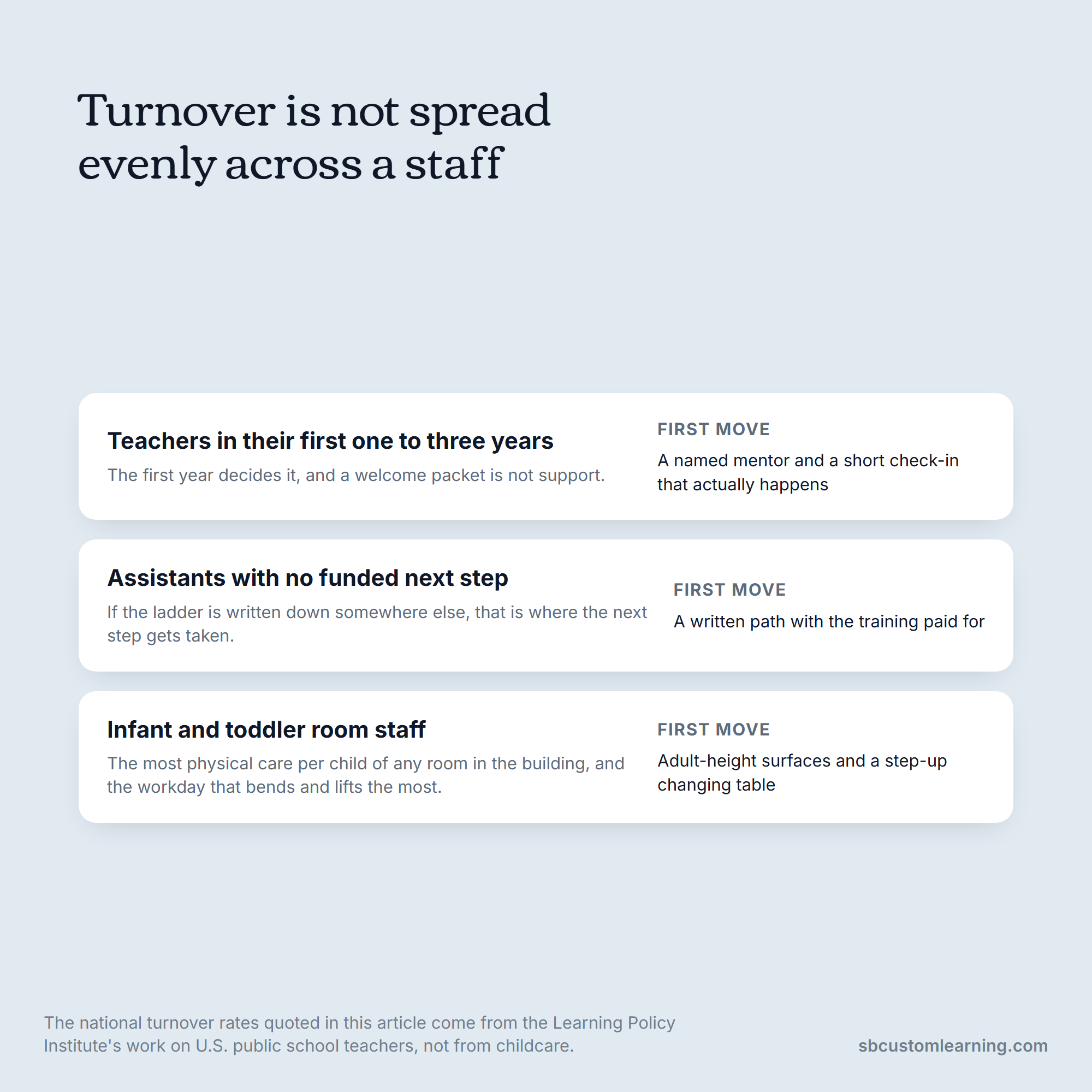
New teachers are the group the first year makes or loses. Support in those opening weeks, meaning a named mentor and a short check-in that actually happens, is what turns a hire into a second-year teacher. A welcome packet is not support.
Assistants are the group a center can most often keep. If the path from assistant to lead is written down somewhere else, with the training funded, that is where the next step gets taken.
Inside childcare, the youngest rooms are the hardest to keep staffed. Infant and toddler teachers handle the most physical care per child, and their workday bends and lifts more than any other room. Fix the room and you have done something for retention that a gift card cannot match.
Eight Strategies: Start with What You Pay For
Eight strategies carry most of the weight. The four below go first, because no recognition program survives a wage a teacher cannot live on.
Pay and Benefits
Raise the floor before you chase the ceiling. A center with a tight budget can still publish a wage scale so teachers can see the next step, fund the certifications it requires, and add one benefit that matters, whether that is health coverage, a retirement match or paid planning time.
In public schools, the Learning Policy Institute found that every $1,000 increase in salary lowered the odds of a teacher leaving. The step matters less than the direction, which is why a published scale with a visible next rung does work that a one-off bonus does not.
Protected Planning Time
Planning time is the perk teachers notice first and directors cancel first. Block 45 to 60 minutes per teacher per week, stagger it across the day, and give the floor a floater to cover it. Write it on the schedule and treat it like a licensing item. If it is not on the calendar, it does not exist.
Covered Breaks
A break is a floor, not a favor. Build a rotation that guarantees every teacher a real pause away from the children, and give the break room an adult-height chair and a door that closes. A teacher who cannot sit down until nap time is a teacher refreshing job listings at nap time.
First-90-Days Mentoring
The first 90 days decide whether a new hire becomes a veteran. Assign a named mentor, schedule a weekly 15-minute check-in, and have the mentor handle the logistics a new teacher does not know yet, from where the cots live to how the room closes. Teacher recruitment and retention strategies tend to over-invest in the hiring event and under-invest in the first two weeks after it.
Cover these four and you have slowed the bleed. Our services begin from the same premise: fix the working conditions before you spend on anything else. The last four strategies decide whether a teacher stays for a year or builds a career.
The Four Strategies That Build a Career
The remaining four are mostly habits, and only one of them, the ladder, needs a budget line. They are the difference between a center people tolerate and one they stay at.
Build a Credential-to-Lead-Teacher Ladder
Map the steps from assistant to lead in writing: what training each step needs, what pay each step earns, and how long it usually takes. Then pay for the credential the next step requires. A teacher who can see the third rung does not have to guess whether staying gets her anywhere. Teacher leadership and teacher retention are linked for the same reason: ownership is a reason to stay.
Practice Reflective Supervision
Reflective supervision replaces the yearly evaluation with a regular, short conversation about what is hard and what would help. Meet monthly for 20 minutes, ask what is draining and what is working, and commit to one change before the next meeting. In the public school data, the Learning Policy Institute found job and workplace satisfaction among the strongest predictors of staying, and supervision is where satisfaction is built or broken.
Make Recognition Land
A pizza thanks the room. Strong recognition names the thing one teacher did and who it helped. Try one of these each week:
- Name a specific teaching move in front of the team
- Give a lead teacher ownership of one training topic
- Cover a class so a teacher can observe another room
- Ask a veteran teacher to mentor a new hire, and pay her for it
- Hand a room-improvement decision to the teacher who lives in that room
Recognition works when it transfers trust, not when it transfers a gift card.
None of these habits lands in a room that fights the teacher, and our finished rooms show what happens when staff help plan the space they work in every day.
Give Them a Say in Their Own Room
The teachers who use a room all day see what a designer cannot: which shelf children ignore, where the traffic jams, and which corner needs a soft place to land. Ask them before you buy. A teacher who helped choose the layout has a reason to defend it. The Learning Policy Institute found that classroom autonomy raises job satisfaction, and that satisfaction is among the strongest predictors of who stays.
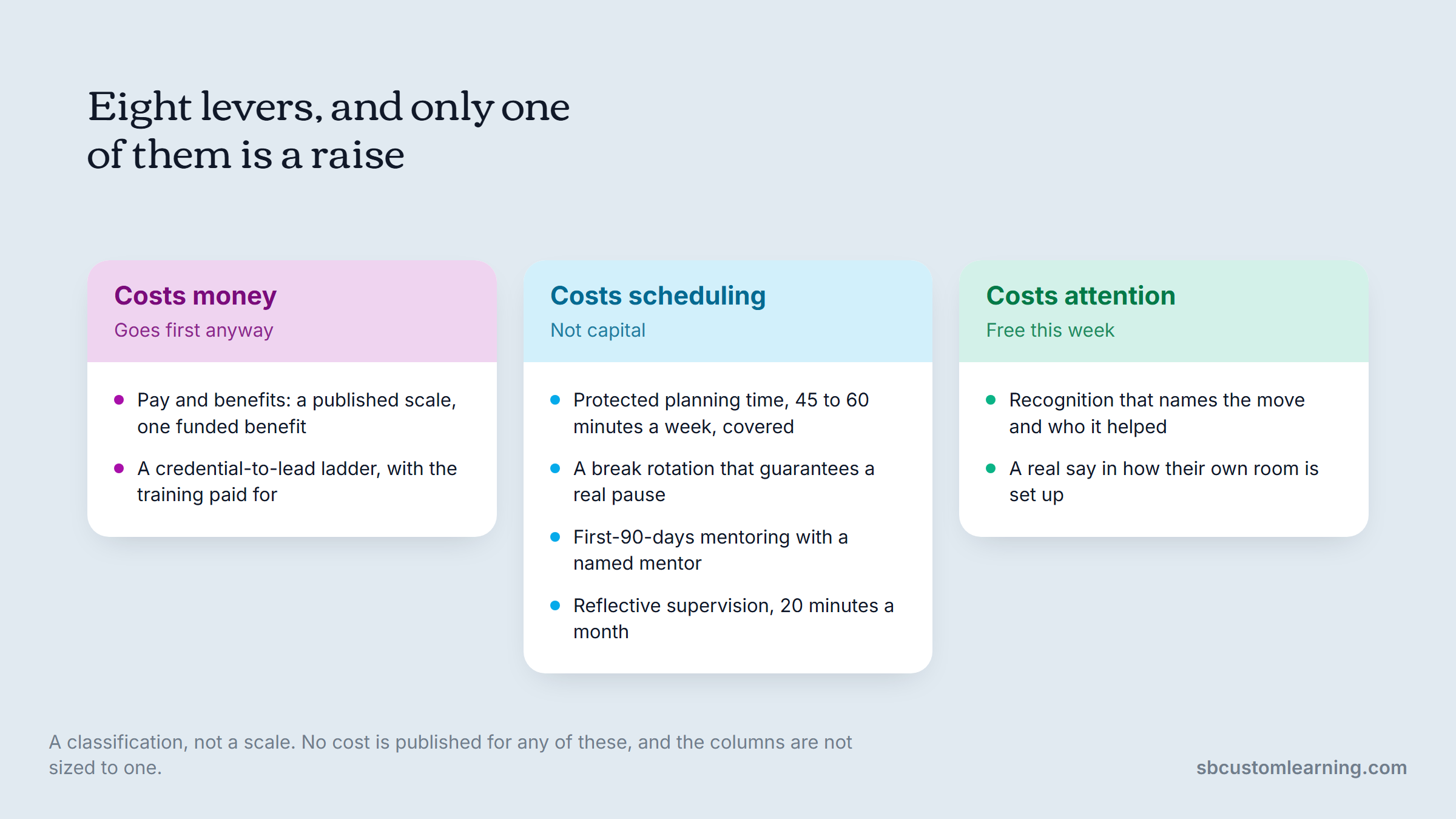
Set side by side, the eight sort into three costs: two need money, four need scheduling, and two need nothing but attention.
| Strategy | What it looks like in a normal week | Cost band |
|---|---|---|
| Pay and benefits | A published scale and one funded benefit | Money |
| Credential-to-lead ladder | A written path with the training paid for | Money |
| Protected planning time | 45 to 60 minutes on the schedule, covered | Scheduling |
| Covered breaks | A rotation that gives every teacher a pause | Scheduling |
| First-90-days mentoring | A named mentor and a weekly check-in | Scheduling |
| Reflective supervision | A monthly 20-minute conversation | Scheduling |
| Recognition that lands | One specific, named thank-you a week | Attention |
| A say in their own room | Teachers help choose the layout before you buy | Attention |
Eight small commitments, and not one of them asks a teacher to care more than you already do.
The Physical Job Nobody Budgets For
Retention plans tend to ignore the body. Childcare is a physically demanding job dressed up as a gentle one, and the strains show up in the payroll.
The Texas Department of Insurance, citing the U.S. Bureau of Labor Statistics, reports that 4,670 childcare employees sustained work-related injuries in 2020 that required time away from work, and that 460 of them needed 31 days or more off. Safety agencies target the same three moves first, because lifting, bending and kneeling are what a badly planned room forces all day.

The fixes are physical, and most are cheap. Safety and health agencies converge on the same short list: changing tables with steps so a child can climb up, adult-size seating so a grown-up is not folded into a child's chair, and work surfaces at adult height. The reach ranges and furniture heights that make a room fit every body are the same ones universal design for early learning puts first.
| Daily task | What it strains | Room-level fix |
|---|---|---|
| Lifting a toddler to a changing table | Low back and shoulders | A changing table with steps the child climbs |
| Kneeling on the floor all day | Knees and hips | Adult-height seating and a low bench |
| Working at child-height tables | Back and neck | An adult-height counter or standing table |
| Carrying diaper and trash bags | Shoulders and arms | A rolling cart kept near the work area |
| Scanning the room from a doorway | Neck | Open sightlines and low furniture |
None of this is a perk. It is the difference between a teacher who finishes a shift tired and one who finishes it sore. Sore teachers leave sooner, and they leave for a center that at least offers a chair at the right height.
The Room as a Retention Tool
Here is the thread that ties it together: working conditions are retention conditions. The Learning Policy Institute found that public school teachers with high job and workplace satisfaction were less than half as likely to leave as teachers with low satisfaction, 8.0 percent against 22.0 percent. A large part of that satisfaction is how the room treats the adults in it.
Sightlines That Let a Teacher Breathe
When a teacher can see every child from where she actually stands, she stops patrolling and starts teaching. Low shelving, open centers and a clear line from the sink to the art table do more for her shoulders than a poster about self-care. Dividing a room without construction lets a large, noisy space become two calmer ones while keeping every child in view.
Surfaces at Adult Height
Count how many times a teacher bends in an hour: to a child's table, to a low shelf, to a cot. Each one is small. A hundred a day is not. Raise the counters, the drying rack, the adult work table and the storage teachers reach most often.
A Place to Plan and a Place to Breathe
A room needs one corner that belongs to the adults: a desk with a lockable drawer, a chair, and enough quiet to think. It doubles as the spot where a teacher writes an observation or returns a parent call. Without it, planning happens in a hallway and paperwork happens at home for free.
This is the part we plan for at SB Custom Learning. When we design a childcare room, adult-height counters, seating built for grown-ups and storage that spares a teacher's back are as much a part of the plan as cubbies and centers.
For odd or undersized rooms, we commission custom pieces rather than force a standard unit into a space it does not fit. Our play-loft installation for Educare Chicago is one example of a room that no catalog piece could have solved.
Our work runs from the floor plan through to the finished install, using a range of established manufacturers and custom builders rather than a single catalog. Ordering happens online, and samples are sent out so a teacher can sit in a chair before you buy twelve of them. The service area is the Midwest and still growing, and a design fee is set against the rooms themselves once we have walked them.
How to Audit Your Rooms Before You Spend
You do not need a consultant to find the retention problems in a room. You need an hour and a critical eye. Choose the busiest part of the day, not the quiet one, and walk each space with this list.
- Stand where the teacher stands and check whether you can see every child from there.
- Count the lifts in ten minutes, from cots, changing tables and chairs.
- Sit in the teacher's chair and note what sits at eye level and what sits at knee level.
- Open the cabinets a teacher opens most and check the height of what she pulls out.
- Time the walk from the changing area to the sink with a child in your arms.
- Look for one surface at adult height that a teacher can use without bending.
- Find the quietest corner and ask whether a teacher could plan there.
- Note the single fix that would remove the most lifts, and start with that one.
Write down what you find before you write a shopping list. A room that scores badly on sightlines and adult surfaces will not be rescued by better toys, and a teacher will notice the difference within a week. Our space planning sequence starts with the same walk, because the layout decides most of what wears a teacher down.
Teacher Retention Programs: What to Fund First
A teacher retention program is not one purchase. It is a sequence, and the order matters more than the size of the budget. Fund the changes that remove daily strain first, because teachers feel those immediately. Teacher recruitment and retention share the same budget line, and the line that keeps people usually costs less than the line that replaces them.
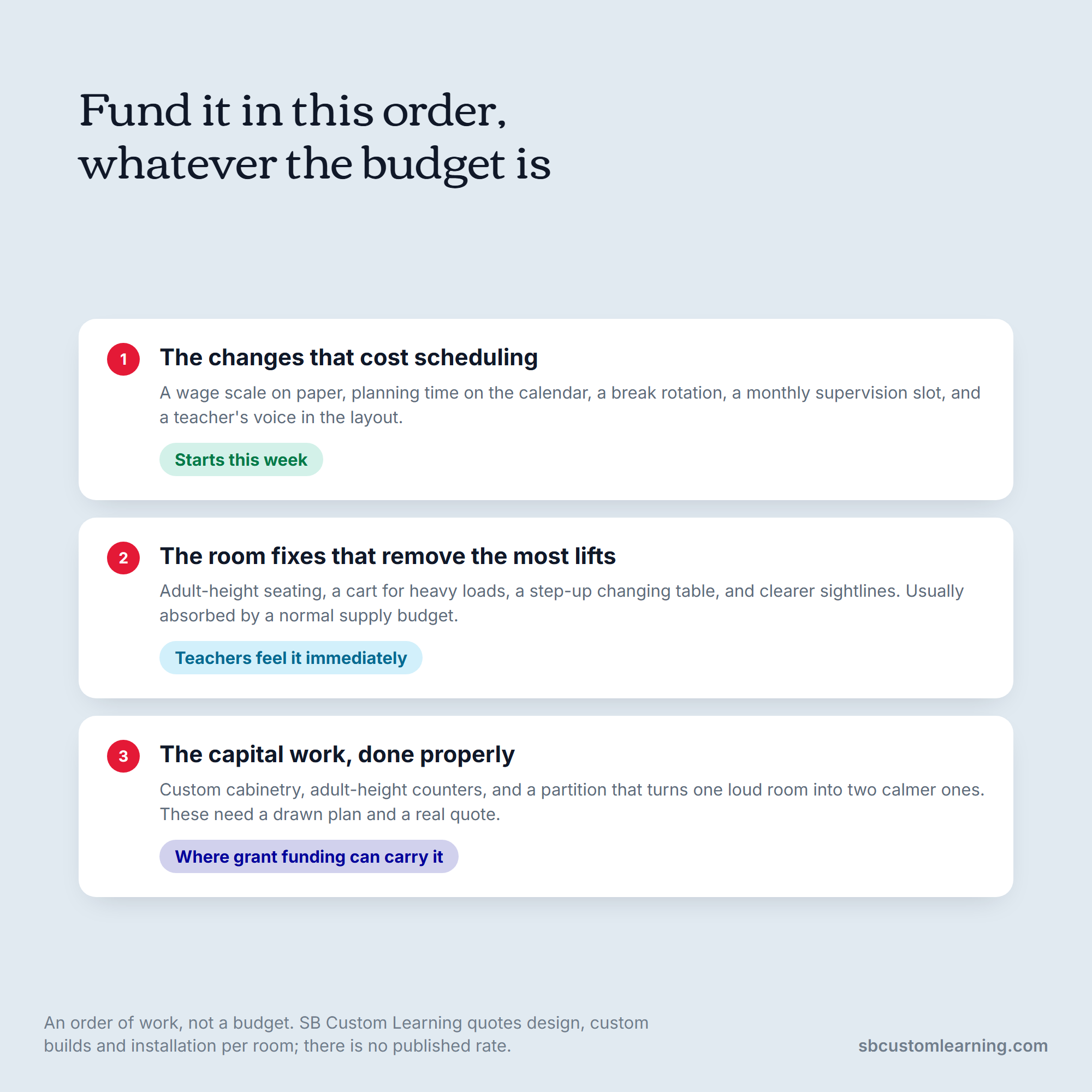
Start with the free changes: a wage scale on paper, planning time on the calendar, a break rotation, a monthly supervision slot and a teacher's voice in the layout. These cost scheduling, not capital.
Next, take the low-cost room fixes: adult-height seating, a cart for heavy loads, a step-up changing table, and clearer sightlines. A center can usually absorb these within a normal supply budget.
Save the capital projects for last, and do them properly: custom cabinetry, adult-height counters, and a partition that turns one loud room into two calmer ones. These are where a designed plan and a real quote matter, and where grant funding can carry the cost.
We format quotes and estimates for funding applications, including for Illinois Action for Children, because a grant that expires for want of the right paperwork is its own retention problem.
Most teacher retention problems and solutions come down to the same trade-off: spend on people, then spend on things, and put teachers in the room while you decide. Once the room is set up, the systems that keep it working matter just as much, which is where classroom organization systems pick up.
Start with the Room You Already Have
Retention is a pay problem first, and no design choice replaces a livable wage. But pay is not the only lever you control, and it is not the fastest one to move. The room is.
Make the three changes that remove the most strain from a teacher's day: a surface at adult height, a seat built for a grown-up, and a changing table a child can step up to. Fix the sightlines so a teacher can see the whole room without pacing. Then protect the planning time and the breaks you just made room for.
Most of these are not purchases. They are decisions about how a space treats the adults who spend their day inside it, and teachers notice the difference long before an exit interview. If you want a second set of eyes on your rooms, schedule a consultation and we will start from your space, your age groups and your budget.
FAQs
What is the definition of retention?
In plain terms, retention is the share of staff who stay in a role or in the field over a set period, usually a year. It is the inverse of turnover: if 15 percent of teachers leave, retention is 85 percent. A useful definition keeps staying at your center separate from staying in the field, because the two need different solutions.
Why do childcare teachers leave?
Low pay leads the list: the median early educator wage is $13.07 an hour, and 13.1 percent live below the federal poverty line. After pay come workload and staffing, weak leadership support, and physical working conditions that demand constant lifting and kneeling.
What is the national retention rate?
About one in seven U.S. public school teachers left or changed schools between 2020 and 2022, according to the Learning Policy Institute, which puts national retention near 85 percent. Rates differ sharply by state, because wages and licensing are set locally.
What are the most effective retention strategies?
Pay and benefits, protected planning time, covered breaks and first-90-days mentoring address the strongest drivers. A credential-to-lead-teacher ladder, reflective supervision, real recognition and a say in the classroom keep teachers once those basics are in place.
How does classroom design affect retention?
Design decides how much a teacher lifts, bends and scans in a day. Adult-height counters, seating built for grown-ups, storage at reach height and a step-up changing table remove daily strain. Job satisfaction, which the room shapes, is one of the strongest predictors of whether a teacher stays.