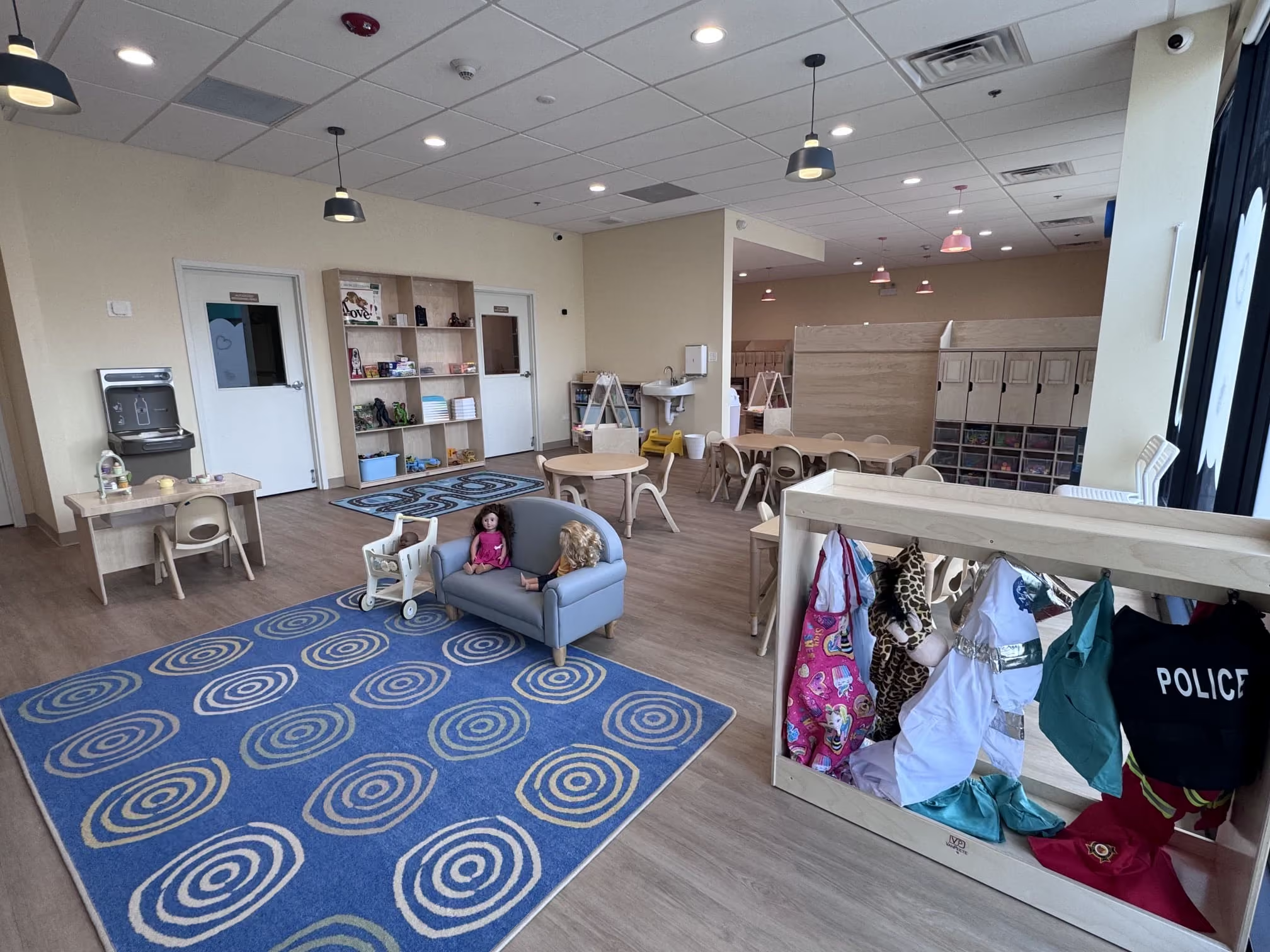
20 Dramatic Play Ideas for Toddler and Early Learning Rooms
Key takeaways:
- Dramatic play is the pretend work of taking on a role, and it gives language, turn-taking and self-regulation somewhere to be practiced.
- Twenty themes fit a toddler or early learning room, and most need nothing new but props and a corner.
- Toddlers play beside each other; children 3 to 5 run longer stories with assigned roles and rules.
- Plan the area like a real room, with a defined footprint, low open storage, and labels a child can read.
A director with a licensing visit in six weeks rarely has room to spare. Every corner is spoken for, and a pretend-play corner can look like the easiest thing to shrink. The opposite is true. The pretend corner is where children practice the talking, waiting and negotiating that the rest of the day runs on, and a cramped version teaches them less than the space it gives back.
The area does not need much to work. It needs a theme children recognize, props that invite a role, and a footprint that tells a child where the play begins.
This guide covers what the play is, twenty themes with the props each one needs, how the toddler version differs from the older version, and how to plan the size, placement and storage so the corner keeps working after the first week.
What Dramatic Play Is and Why It Earns Floor Space
Dramatic play is the pretend work children do when they take on a role and act it out. A child becomes the vet, the customer, the firefighter or the parent picking up a baby, and the objects around them turn into the tools of that job.
Ask what dramatic play is in early childhood and the kitchen corner is what most people picture first, which is a reasonable place to start. The fuller answer is that the area is a rehearsal space for the skills the room is already trying to teach.
Sociodramatic play is the version with other children in the scene. Two or more children agree on a story, hand out roles, and keep each other inside the rules they agreed on. The agreement is the hard part, and it is where the learning sits.
A child who wants to be the doctor has to wait for a turn, listen to a friend's idea, and stay in character when the story changes underneath them.
Why does the corner deserve floor space? NAEYC, the professional body that accredits early learning programs, defines developmentally appropriate practice as methods that "promote each child's optimal development and learning through a strengths-based, play-based approach to joyful, engaged learning." A pretend corner is not a break from learning. It is one of the rooms where the learning happens.
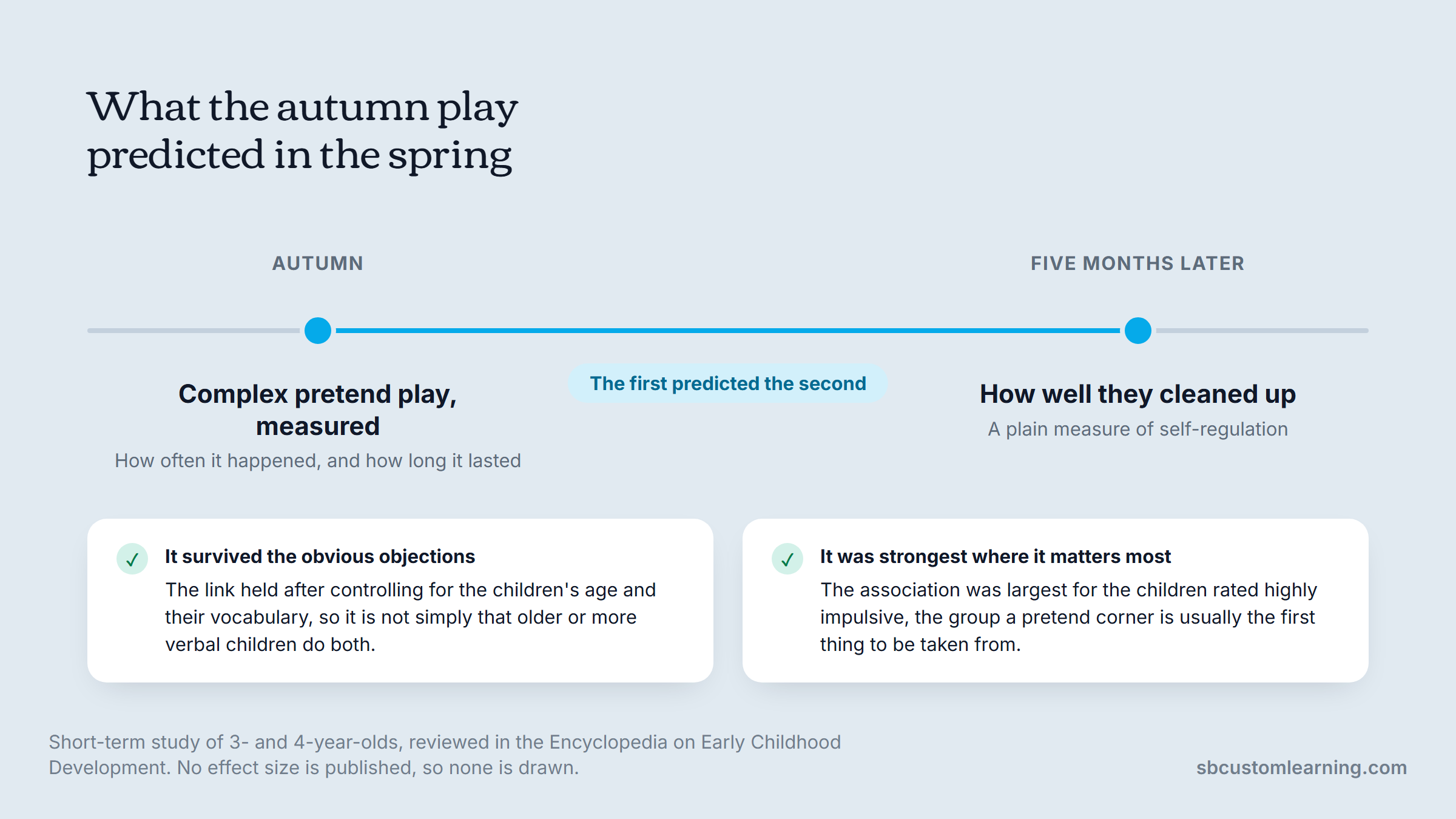
The self-regulation research points the same way. In a short-term study of 3- and 4-year-olds, the frequency and persistence of complex sociodramatic play in the fall predicted how well children cleaned up five months later. The link held after controlling for age and vocabulary, and it was strongest for the children rated highly impulsive, as reviewed in the Encyclopedia on Early Childhood Development.
Language, turn-taking and self-regulation all show up inside the same ten minutes of play. Children narrate what they are doing, negotiate who gets which role, and wait for the part they want. A room that keeps props and open-ended art within reach gets more of that talk than one that stores everything behind a closed cabinet, the same idea that shapes our interactive learning spaces.
What Changes Between Toddler and Older-Childcare Play
The same corner serves very different play depending on who is in the room. With dramatic play for toddlers, the props do most of the work and the adult does the modeling. A child under 18 months is not pretending to be a chef. They are dropping a spoon, hearing it clang, and looking up to see whether you saw it too.
A teacher who stirs an empty pot and offers the spoon turns that moment into the first version of a role. By the time children reach the 3-to-5 band, the play moves between them instead of through the adult. They assign roles, argue about the rules, and stretch one story across twenty minutes.

A room can hold both if the props are duplicated and the storage is low enough for the youngest child to reach. The table below lays out the shift.
| Age band | What the play looks like | What the area should offer |
|---|---|---|
| Under 18 months | Explores props, drops and dumps, mirrors sounds and faces | Soft props, puppets, a low mirror, a few safe real objects |
| 18 to 36 months | Plays beside others, copies routines, feeds and rocks a doll | One clear theme, duplicates of favorite props, print on the wall |
| 3 to 5 years | Assigns roles, follows rules, plans a longer story | More props per theme, costume pieces, menus and charts, floor room to negotiate |
Watch for the prop that gets fought over. If two children always want the same stethoscope, add a second one, and the negotiation has room to move past a standoff. Toddler rooms also need the props a little larger and a little fewer, because a child who cannot yet read a label relies on shape and color to find what they want.
20 Dramatic Play Themes, Their Props, and What They Require
A theme is a role plus the objects that role touches, and most of the twenty below fit a corner that already exists. The list runs from the kitchen corner almost every room starts with to the less common setups that hold attention when the usual themes go stale. The right-hand column answers the question directors ask first: does this require new furniture, or only props?
| Theme | Props to gather | Needs new furniture? |
|---|---|---|
| Home kitchen | Play pots and dishes, play food, an apron, a play phone | No |
| Grocery store | Baskets, play money, empty food boxes, a calculator, a low shelf | No |
| Doctor's office | Clipboards, bandages, a toy stethoscope, a cot or mat, patient charts | No |
| Veterinary clinic | Stuffed animals, a toy stethoscope, bandages, pet carriers, grooming tools | No |
| Post office | Envelopes, stickers for stamps, a scale, a mailbox, a mail bag | No |
| Restaurant | Menus, order pads, play food, an apron, a table and chairs | No, uses the existing table |
| Bakery | Felt or dough pastries, trays, an apron, a display shelf, price tags | No |
| Fire station | Helmets, jackets, a cardboard truck, walkie-talkies, cones | No |
| Camping site | A sheet tent, sleeping bags, flashlights, binoculars, a pretend fire | No |
| Car repair shop | Toy tools, a steering wheel, a creeper mat, a cardboard lift | No |
| Flower shop | Artificial flowers, vases, ribbons, a counter, printable price tags | No |
| Pumpkin patch | Pumpkins, a wagon, a scale, a crate for a hay bale | No |
| Airport | A row of chairs, tickets, a scanner, suitcases, a passport stamp | No, uses the existing chairs |
| Pizza parlor | Cardboard crusts, felt toppings, an oven box, order pads | No |
| Ice cream shop | Scoops, felt toppings, cones, a menu, an apron | No |
| Library | Books, library cards, a date stamp, a checkout scanner | No |
| Baby nursery | Dolls, blankets, bottles, a crib or basket, a changing mat | One basket or crib |
| Farmer's market | Play produce, baskets, a scale, price signs, a cash box | No |
| Construction site | Blocks, hard hats, vests, toy tools, a wheelbarrow | No |
| Laundromat | A hamper, sock pairs, an ironing board, a washer box, a drying rack | One low shelf |
The right-hand column is the useful one. Most of the dramatic play examples in this list need no new furniture at all. A grocery store dramatic play corner is empty boxes, a calculator and a low shelf the room already owns. A dramatic play flower shop is a vase, a ribbon and a set of printed signs.
A pumpkin patch dramatic play setup is a wagon and a scale, and it earns its place every October.

Only two themes on the list ask for a piece of furniture, and both are small: a basket or crib for the nursery and a low shelf for the laundromat. Everything else is a matter of gathering props and giving the corner a name.
The furniture question is still the wrong one to open with. What decides whether the corner holds is the room around it: where the area sits in the layout, what gives it an edge, and whether the storage beside it puts props back inside a child's reach. Those three are what we plan first, and they are why a corner built from props a center already owns can outlast one that arrived in a box.
How to Build a Themed Prop Box
The theme on the wall matters less than the box you pull out with it. A prop box keeps a theme's props together, so changing the corner takes minutes instead of an afternoon, and it is where the four layers below do their work. Build one for the theme you are running now, then build the next as the children lose interest in this one.
| Layer | What to include | Why it earns its place |
|---|---|---|
| The anchor | One theme sign and one costume piece per role | Signals the theme without an adult explaining it |
| The tools | Safe real versions of the objects the role handles | Real items carry the vocabulary a plastic toy misses |
| The print | Menus, order pads, charts, printable signs | Gives scribbling and early writing a real purpose |
| The flexible | Fabric, baskets, blocks, loose parts | Lets children rewrite the theme when they get bored |
Start with the props the children already know from home, then add the one unusual object that makes the role feel grown up. A telephone, a set of keys or a stack of old gift cards holds attention longer than a purpose-built toy, because children read them as the real thing.
We source props and pieces like these for centers across the Midwest. The design and sourcing service starts with the room, not the catalog, so the props fit the theme you actually plan to run.
Choosing a Spot for the Dramatic Play Area
Placement decides whether the area gets used or becomes a hallway. An area tucked into whatever space is left over is usually the one children walk past. A child needs to see the corner from where they enter the room, and a teacher needs to see into it from wherever she has to stand.
Work through these steps before you move a single shelf.
- Walk the room and mark where an adult already stands for supervision.
- Find a corner or a low divider that keeps the play out of the main traffic path.
- Check that the sightline from the adult station reaches every child in the area.
- Keep the pretend zone away from the quiet reading corner and the nap area.
- Put it near a block or art area so props and materials can travel between them.
- Confirm a child can enter and leave without crossing another group's play.
If the room has no spare corner, a low, movable partition can carve one out without touching a wall. We furnish these rooms with furniture and millwork rather than construction, so a partition or a low unit that defines the corner is a furnishing decision, not a renovation, the case we make in room divisions without construction.
How Much Room the Area Needs and What Has to Fit
The area needs enough floor for children to stand up inside the scene. A dramatic play center for young children works at a smaller footprint than most directors assume, but it still needs room for the roles to move. Two children at a counter need space behind them to turn around.
A third child joining with a basket needs somewhere to stand that is not on top of the other two. Plan the footprint around the number of children who play there at once, not the number of props on the shelf.
Illinois sets a floor, not a target. The state's childcare licensing rules count each child's activity space, and 35 square feet per child is the minimum for children two and older, set by the state licensing code, section 407.370, recodified as section 2008.370.
Licensing is now administered by the Illinois Department of Early Childhood (IDEC), which took over childcare licensing from the Illinois Department of Children and Family Services (DCFS) on July 1, 2026.
The national guidance sets a higher bar. Caring for Our Children, the standards developed by the American Academy of Pediatrics, the American Public Health Association and the National Resource Center for Health and Safety in Child Care, recommends 42 square feet of usable activity space per child, with 50 preferred.
Few rooms can give the pretend corner all of that, so treat it as a share of the room rather than a separate total. If a group of four plays there at once, plan for roughly the share of floor the licensing math already assigns them, and use space planning to keep the corner inside that budget.
Storage and Labels Children Can Use Themselves
Storage is what keeps the area usable after the first clean-up. When props go back into a closed cabinet, the next group has to ask an adult, and the corner stalls. Open bins at child height put the props back in play without a teacher in the middle of it.
A label a child can read does more for independence than any clean-up chart. Set up storage with these rules in mind:
- Keep bins low enough that a seated or standing child can reach the bottom.
- Give each theme its own labeled bin so switching themes stays quick.
- Use a picture label beside the word for children who are not yet reading.
- Duplicate the prop that causes the most conflict instead of buying a new theme.
- Leave one empty bin for the loose parts children invent with.
- Anchor every tall shelf to the wall before the room opens.
The labeling piece is smaller than it sounds. A bin with a picture and a word lets a three-year-old put the stethoscope back where it belongs, and that act is itself part of the turn-taking the corner is teaching. We plan storage into the layout for exactly this reason, and the routines that keep it working are the ones we set out in classroom organization systems.
Props That Outperform Toys
The props that hold attention longest are rarely the ones packaged as toys. Real objects carry a weight and a purpose that children recognize, and a safe real version of an item beats a plastic imitation almost every time. A washed bottle with the cap glued on, a set of old keys or a stack of blank receipt paper reads as a grown-up tool.
Print does the same work. A shop sign, an order pad or a set of price tags turns a scribble into a receipt, because now the mark has somewhere to go. Printable labels and dramatic play clipart give a room a full theme in an afternoon.

The clip art for a shop sign is cheap enough to change with the season. We can build the print and the signs into a custom set when a center wants the corner to match the rest of the room, so the theme reads from across the space.
Open-ended materials are the third piece. Fabric, baskets, blocks and loose parts let children turn a bakery into a castle without anyone rebuilding the corner, and they cost almost nothing to rotate. Build a theme with a few real props and a lot of flexible material, and the play keeps rewriting itself.
Solo Play, Partner Play, and Longer Stories
Not all of the play happens in a group, and the area should make room for the child who prefers to work alone. Solo play is where a child runs a full scene by themselves, and it can look like a quiet monologue at the counter.
Dramatic play monologues are a sign the corner is working, not a sign a child is avoiding the group. The child narrates the whole visit, plays both parts, and works out the ending on their own.
A center built for young children should also let the scene grow from one child to two, and that moment usually starts with one child offering another a role.

A new theme often draws less traffic on its first day than the familiar corner it replaced, and the cause is usually the introduction rather than the theme. Bring the materials out during circle time and model the props before the corner opens, because children cannot play a scene they have never seen.
Give the story somewhere to go. A menu board, an order pad or a stack of blank charts extends a scene past the first exchange, and a piece of fabric or a set of blocks lets two children build the next room of the shop. The longer the story runs, the more language and negotiation it carries, which is the whole point of protecting the corner.
Five Things That Quiet a Pretend Corner
A pretend corner can go quiet for reasons that have nothing to do with the props. Across dramatic play centers of every size, the same five patterns turn up in rooms that were put together in a hurry, and each one has a straightforward fix.
- An area in a dead corner no child passes on the way in.
- Props packed into a closed cabinet that only an adult can open.
- A theme so specific that children do not recognize the role.
- A corner left at the height of the last group that used it.
- A theme changed before the children have finished with it.
The fix for most of these is timing and placement. Put the area where children walk, keep the props open and reachable, and give a theme three or four weeks before you replace it. A recognized theme in a visible corner usually does more than a new prop set would.
Keeping the Area Fresh Without Buying a New Room
Rotation, not replacement, keeps the corner interesting across a school year. The props in a theme wear out long before the corner does, and most of what a center needs to refresh it is already in the room.
Real product containers are the cheapest refresh available. Cleaned bottles with the caps glued on, child-sized cleaning tools and empty cereal boxes from the staff room hold attention longer than a packaged kitchen set, and they cost a center nothing at all.
Rotate one theme at a time so the room never feels half packed. Keep the anchor props the children return to, swap the tools and the print, and let the flexible layer absorb the leftovers.
A center that plans its rotation in the fall can run a full year of themes out of a few bins, and the corner keeps its pull because the children keep finding something new to do with the same furniture.
How We Set Up Play Rooms Across the Midwest
A pretend corner is small, but it sits inside a bigger problem: a room that has to pass a licensing visit, hold a full group, and still leave space for everything else. That is the work we do at SB Custom Learning. We plan the layout before anything is ordered, place furniture by age group and across multiple classrooms, and buy to the licensing rules that apply to your state.
Most of our clients are directors using grant funding to furnish a whole center, so we format quotes for the funder. We are an approved vendor for Illinois Action for Children, and we have collaborated with partners like CPS and the YMCA. We plan the layout, choose the pieces and send a crew to fit them.
When a room calls for a piece that nothing standard covers, we have it made. We work with many suppliers, so a themed corner can be built to fit instead of improvised, and that is how a bespoke play loft came together in our custom play loft build.
Planning Your Play Corner
Samples go out by mail, so a finish or a fabric can be handled before a whole center is ordered. Our delivery map covers the Midwest and keeps widening, and anything that involves a drawing, a crew or a tape measure is quoted against your rooms rather than read off a list.
You can see finished rooms, including pretend and themed spaces, in our gallery of completed projects. The first conversation starts with your space and the ages you serve, and it is the fastest way to know whether your corner needs new furniture or only a better plan.
If you are planning a play area and want a second set of eyes on the layout, schedule a consultation and tell us about the room, the ages and the budget you are working with.
FAQs
What is dramatic play in early childhood?
It is pretend play with a role attached. A child takes on a job, such as a vet or a customer, and acts it out with props and other children. The play looks simple, but it carries language, planning and turn-taking inside it, which is why it earns a place in a room.
What is socio-dramatic play?
It is the version with a group in it. Two or three children agree on a story, give each other roles, and stay inside the scene they built. The negotiation is the valuable part, because it asks children to share control of the play.
Why is dramatic play important?
It develops language, turn-taking and self-regulation at the same time. Children narrate, negotiate roles and wait for a turn, and the research links complex sociodramatic play to later self-regulation, especially in children who are highly impulsive. It also gives writing and math a purpose, because a receipt or a menu needs to say something.
How does play change for 3- to 5-year-olds?
For children in the 3-to-5 band, the play becomes cooperative and rule-based. They assign roles, plan longer stories and follow the rules of the scene. Provide more props per theme, costume pieces, and print such as menus and charts, plus enough floor to negotiate.
How big should the play area be?
It depends on how many children play there at once, but it has to stay inside the room's activity-space budget. Illinois requires 35 square feet of activity space per child for children two and older, and national guidance recommends 42 square feet with 50 preferred. Give the corner a fair share of that and leave room for children to turn around inside the scene.