
Childcare Activities for Infants, Toddlers and Children
Key takeaways:
- The childcare activities that hold a young child's attention are hands-on, open-ended, short enough to finish, and repeatable without an adult rebuilding them each day.
- Infants learn from floor time, low mirrors and safe mouthing toys, so their day leans on open space more than on crafts.
- Toddler activities run on water, movement, scribbling and simple puzzles, and a two-year-old will happily repeat the same one a dozen times.
- For children 3 to 5, plan by learning center with three ideas per center, and give each center the one piece of equipment that keeps the activity repeatable.
Every director knows the week when the plan looks fine on paper and still unravels. The art activity is over in four minutes, one child is finished before the smocks are tied, and the teacher spends the next block rebuilding a center instead of watching children play.
The fix is usually the activity itself rather than the theme. An idea that is hands-on enough to absorb a toddler, open-ended enough that the quickest child finds a second use for it, and short enough to fit between snack and outdoor time carries a room further than any elaborate setup. When those activities are already out and ready to start, the day runs itself.
This guide covers what makes a childcare activity work, ideas for infants, activities for toddlers, activities grouped by learning center for children 3 to 5, indoor plans for rainy days, and the room features that keep childcare activities repeatable. We plan and furnish early learning rooms for centers across the Midwest, and the same thinking shows up from crib rooms to older classrooms in the rooms we have furnished.
The Short Answer: What Makes a Good Childcare Activity
Start with four traits, because they sort almost every idea on a list. A good activity is hands-on, so the child's body does the work rather than watching an adult do it. It is open-ended, so the same materials support more than one outcome.
A short activity finishes inside a child's attention span, and a repeatable one can be set out again tomorrow without starting from scratch.
The American Academy of Pediatrics clinical report on play found that play improves children's abilities to plan, organize, get along with others and regulate emotions, and that it supports language, math and social skills. A great deal of development rests on materials that cost very little.
Hands-on matters most for the youngest children, who understand a bucket of water long before they understand "wait your turn." Open-ended matters because a room of single-outcome toys leaves the fast finisher with nothing to do. Short and repeatable activities are what let a morning hold together, since a teacher resets a dozen things between arrival and lunch.
The gap between a good activity and a stalled one is often width of use. A puzzle with six chunky pieces is an activity a child finishes and leaves.
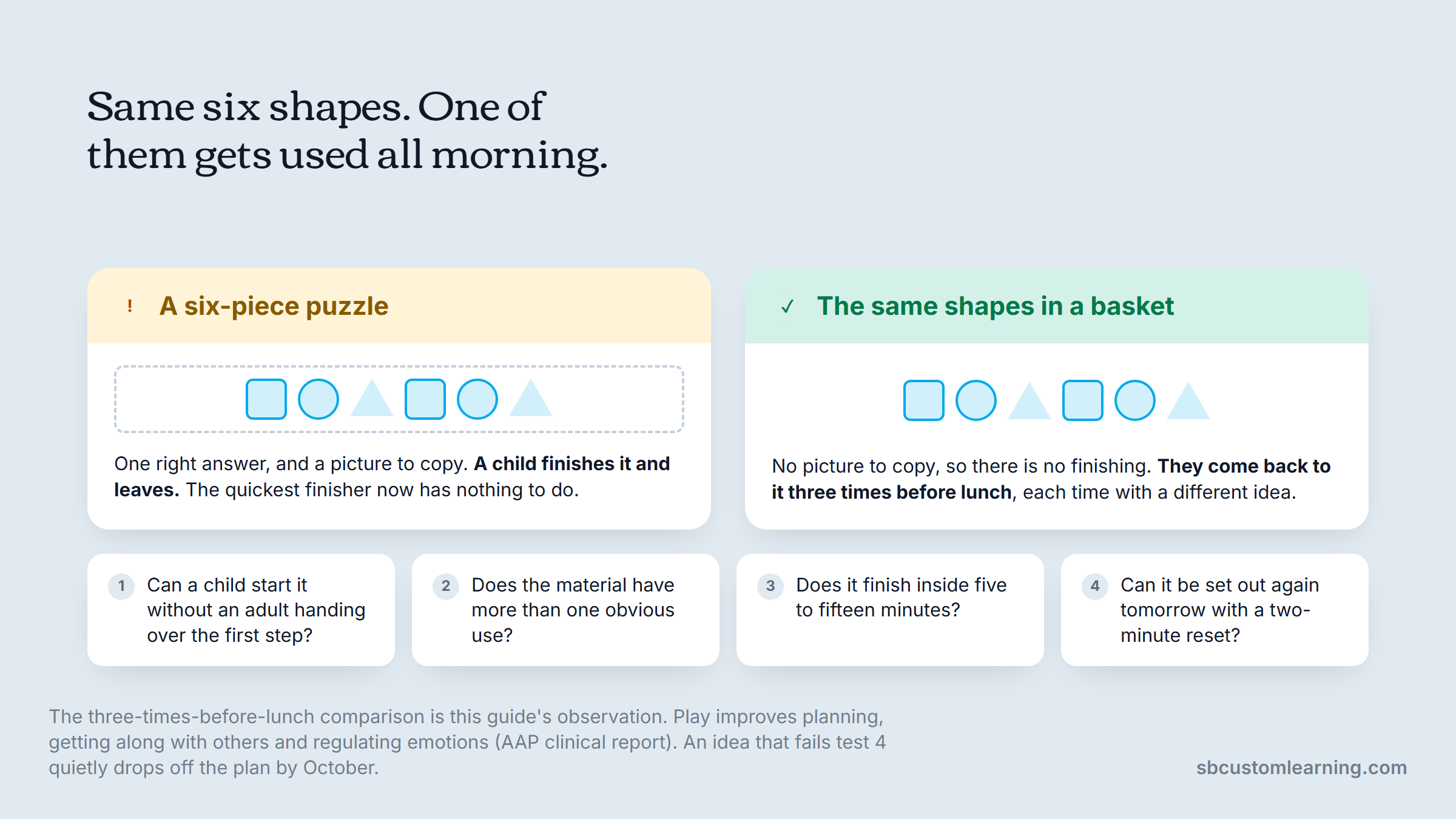
A basket of the same shapes, with no picture to copy, is one they return to three times before lunch, each time with a different idea. In practice, open-ended activities are the ones that stay interesting on the tenth turn, and they rarely cost more than the single-use version.
What Children Actually Do All Day
Watch a well-run room for an hour and most of the day is not crafts. Children move between defined areas, carry blocks, pour water, pretend to cook, and return to the same shelf again and again. The activity is the vehicle; the repetition is the point.
That is also why the setup matters as much as the idea. A sensory bin that lives on a low shelf gets used every day. The same bin kept in a closet gets used when a teacher has time to find it, which is rarely. The room is doing the teaching, and it either invites the activity or hides it.
Run any new idea through four questions before you give it floor space.
- Can a child start it without an adult handing over the first step?
- Does the material have more than one obvious use?
- Does it finish in five to fifteen minutes?
- Can it be set out again tomorrow with a two-minute reset?
An activity that clears all four earns its place. One that fails the last question is the kind that quietly drops off the plan by October, and then nobody remembers it was ever there.
For crib rooms the same thinking looks different, and low open shelving does much of the work. A Montessori-inspired room keeps every material within reach so a child can choose one without a teacher handing it out.
Activities for Infants (Under 12 Months)
Infants do their learning on the floor, so their activities are mostly positions and materials rather than a schedule of projects. Give them open space to move, a few safe things to reach for, and an adult close enough to talk with them. The table below is the core of the infant day, and none of it needs a store-bought kit.
| Infant activity | What it needs | What it builds |
|---|---|---|
| Tummy time | A firm mat kept clear of traffic lanes | Neck, shoulder and core strength |
| Low mirrors | A floor mirror anchored at child height | Self-recognition and visual tracking |
| Treasure baskets | A shallow basket of household objects too large to swallow | Grasping, mouthing and focus |
| Board books | A low basket a child can reach alone | Early language and shared reading |
| Sensory bottles | Bottles of water, beads or rice, lids glued shut | Tracking and cause and effect |
The container matters as much as the contents. A treasure basket a baby can tip over themselves teaches more than the same objects handed out one at a time, because reaching and choosing are part of the lesson.
Check what goes into it, though, because everything in a treasure basket ends up in a mouth. Every object has to be too large to swallow, with nothing that can splinter or pull apart, and a sensory bottle needs its lid glued shut rather than only screwed on.
Sensory activities in a crib room stay simple for the same reason: one texture at a time holds attention better than a busy bin.
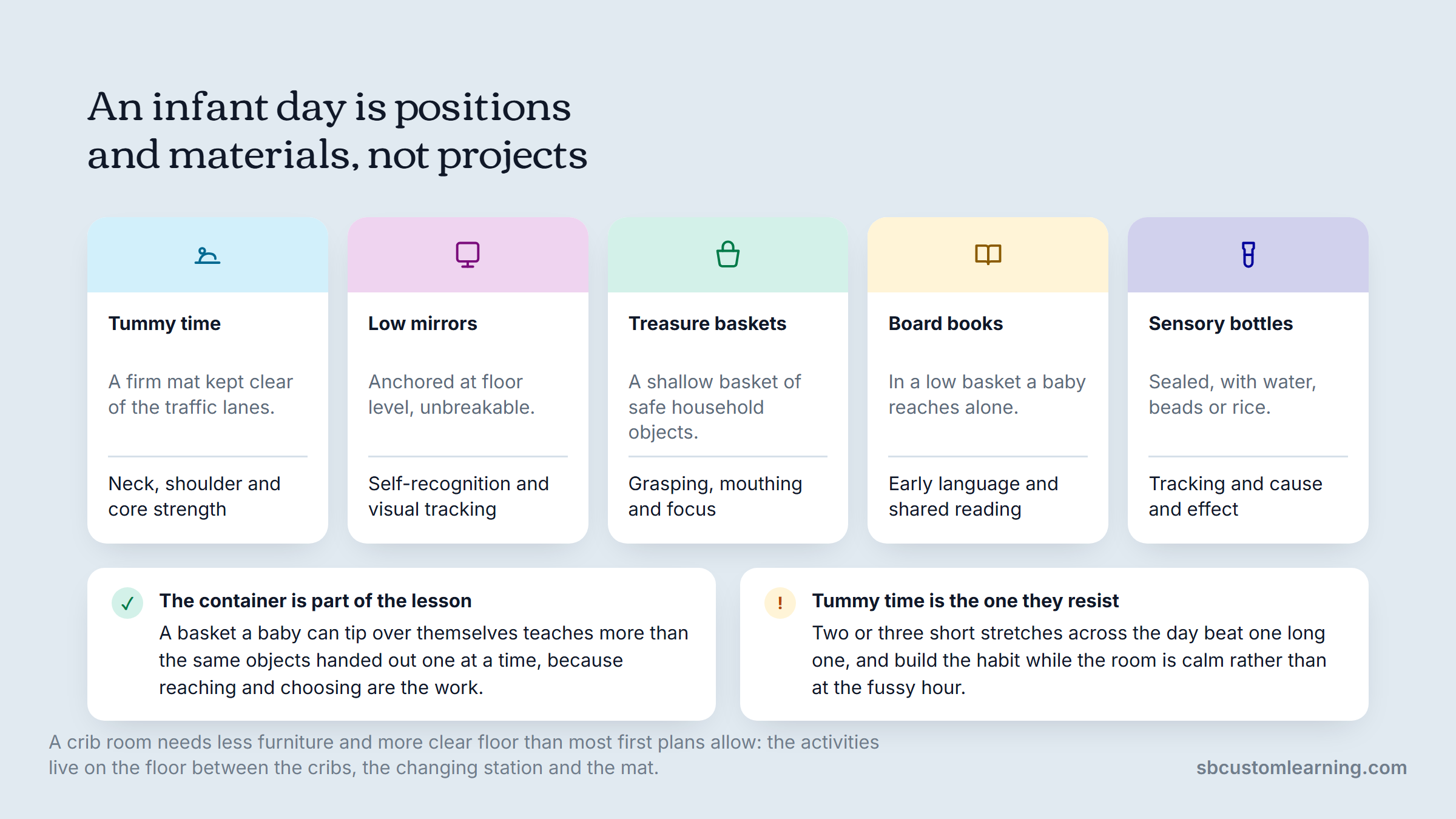
Tummy time earns its place because it is the activity infants need most and resist most. Two or three short stretches across the day work better than one long one, and a mirror or an older child nearby turns a chore into a game.
Keep the mat out of the main walkway so a child crossing the room does not step on a baby mid-roll, and build the habit while the room is calm rather than at the fussy hour.
The rest of the infant day is floor play, feeding and sleep, which is why a crib room needs less furniture and more clear floor than a first plan usually leaves room for. The basics are few enough to fit a short list, and our classroom supplies list keeps the earliest version that spare.
Cribs, a changing station and a soft play mat cover the room; the activities live on the floor between them.
Toddler Activities (12 to 36 Months)
Toddlers learn by moving and by making a mess on purpose, so their best activities are wet, loud and easy to repeat. The five below cover most of a toddler room's day without much setup.
A water table is the workhorse. Pouring, scooping and floating teach volume and cause and effect, and the only real requirement is a spot beside the sink, on a surface that can take a splash.
Push and pull toys give a toddler a job with a destination, which is why a wagon to fill and empty holds attention longer than a shelf of toys to look at, and why those toys are worth the floor space they take.
Simple puzzles belong on a low shelf at child height, with three or four chunky pieces rather than twenty. A toddler solving the same puzzle on Monday and Friday is not bored; they are practicing. Scribbling needs a surface and an adult who lets the result be whatever it turns out to be, so a half-sheet of paper and a fat crayon do more than a coloring page, because the child decides what appears.
Music and movement close the loop. A song with a freeze, a march around the rug and a basket of instruments turn a restless ten minutes into a transition children run themselves. Keep the instrument basket by the rug so the activity needs no setup, and let one child choose the song to give the group a small amount of control.
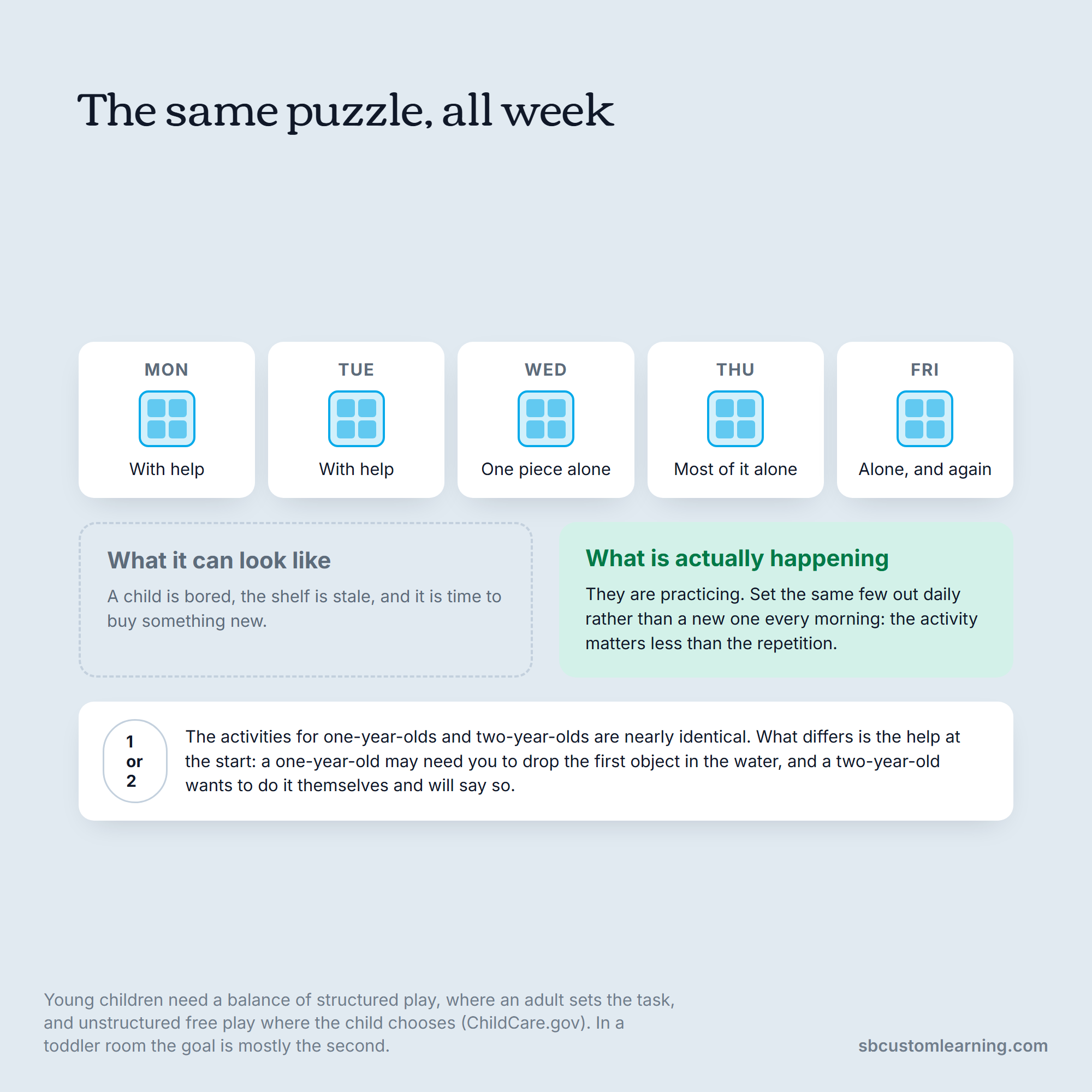
The ChildCare.gov guide on learning through play draws a useful line here: young children need a balance of structured play, where an adult sets the task, and unstructured free play, where the child chooses what to do. In a toddler room the goal is mostly the second kind, with just enough of the first to teach a routine.
The activities for 1-year-olds and the activities for 2-year-olds look nearly identical, differing mainly in how much help the child needs at the start. A one-year-old may need you to drop the first object in the water. A two-year-old wants to do it themselves and will say so, which is exactly the independence these toddler activities are building.
Childcare Activities for Children 3 to 5, by Learning Center
By age three, children can follow a plan, take turns and stay with a task longer, which is when setting activities by learning center pays off. Each center gets three ideas and one piece of furniture that keeps it repeatable, and children rotate on a schedule the room itself makes obvious.
| Learning center | Three activities | What keeps it repeatable |
|---|---|---|
| Blocks | Build a bridge, sort by size, map a road | A low shelf with one shape per bin |
| Dramatic play | Kitchen, doctor's office, grocery store | A shelf of props sorted by theme |
| Art | Easel painting, collage, clay | An easel that stays loaded and a drying line |
| Sensory | Water, sand, dry rice and scoops | A water table at child height |
| Science | Magnets, sinking and floating, growing seeds | A tray that holds the whole experiment |
| Library | Picture books, felt board, story retell | A forward-facing book display |
| Outdoor | Balls and hoops, chalk, digging | A bin by the door so setup is one trip |
The list is deliberately plain, because the value is in the logistics. A center that takes ten minutes to assemble gets used twice a week. The same center opened from a labeled shelf gets used daily.
Blocks reward open-ended activities best. Give a group a common set of shapes and no picture to copy, and the bridge, the road and the tower all come from the same bin. When one child wants to knock the bridge down and another wants to keep it, the teacher has a real negotiation to coach, which is the point of the center.
Dramatic play needs a theme children recognize and props that invite a role, so a stocked kitchen shelf beats a single pretend stove. Art activities want an easel and a drying line more than they want supplies. When the easel is always loaded, painting becomes a five-minute option instead of a project a teacher has to schedule.
Sensory activities and science share a table for good reason, since both are about watching something change. Library is the quiet counterweight that keeps a loud room usable, and outdoor time is the one center where the room extends past the walls. A room that fits its own centers matters more than a room that fits a catalog, which is the difference we work through in custom classroom design.
One failure mode is worth naming, because the usual response to it is the expensive one. A center that looks lovely can still fall flat when it is pitched slightly above or below the age using it, and the instinct is to replace the materials. Sitting down and modeling the play once costs nothing and works more often.
For school-age activities, these centers scale up with harder materials and more independent choices, which is why a room planned for the 3-to-5 group often keeps working as the children age.
Rainy Days and Indoor Gross Motor
Some weeks the playground is out for days, and children who miss their running time make it up on the rug. A little planning keeps that energy in a defined place instead of the middle of the room, and it turns a hard afternoon into a manageable one.
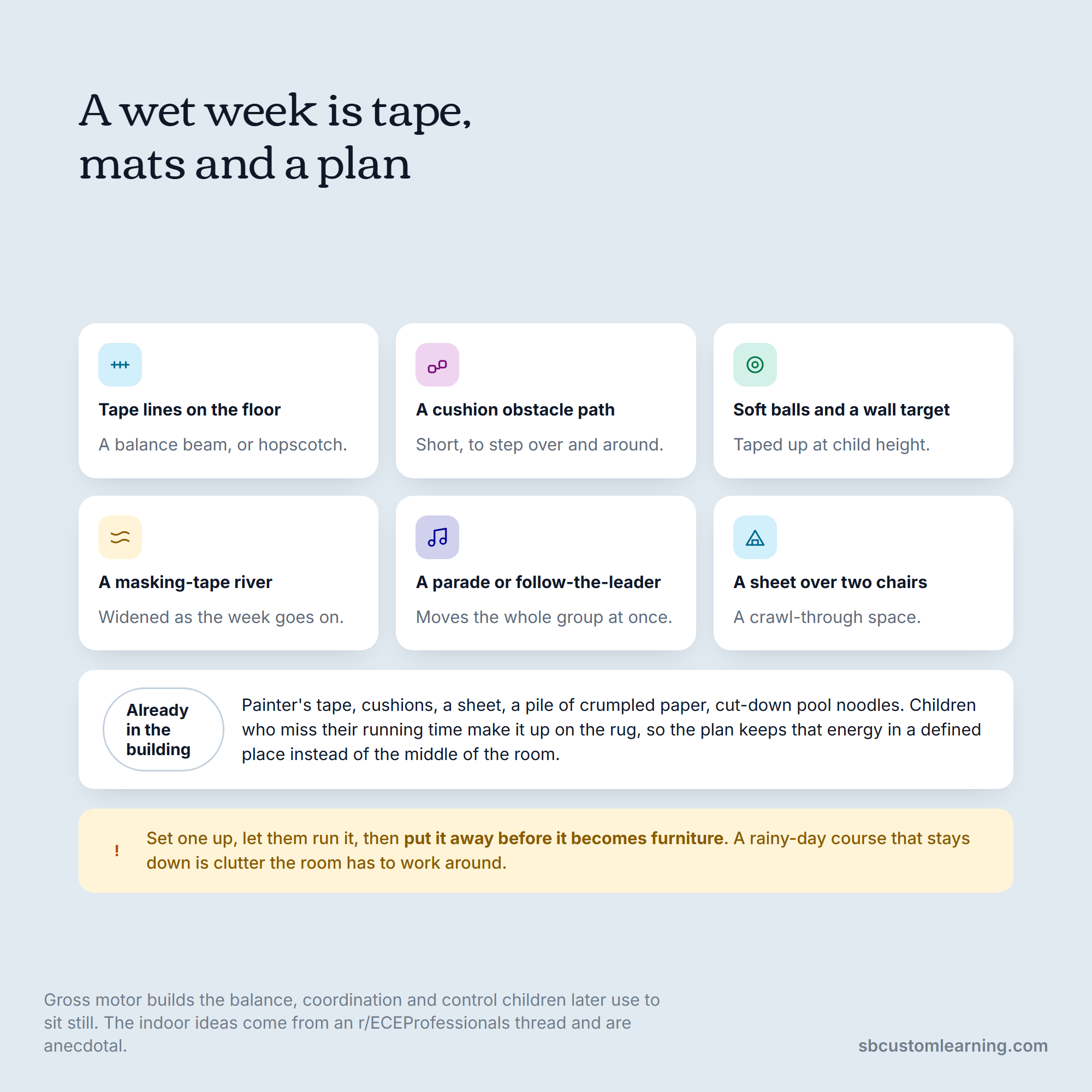
Indoor gross-motor setups are mostly tape, mats and a plan. Set one up, let children run it, then put it away before it becomes furniture.
- Painter's tape lines on the floor for a balance beam or hopscotch.
- A short obstacle path of cushions to step over and around.
- A basket of soft balls and a target taped to a wall.
- A masking-tape river to jump across, widened as the week goes on.
- A parade or follow-the-leader song that moves the whole group.
- A tent or a sheet over two chairs for a crawl-through space.
Everything on that list is already in the building, which is the point, because a wet week is no time to be ordering anything. A row of pillows down the middle of the floor and a pile of crumpled paper to throw will stretch it further still.
Gross motor is how young children build the balance, coordination and control they later use to sit still, which is the argument behind a room that plans for gross motor play. A vertical surface to reach, a clear run and a soft landing spot are what let the energy out safely indoors.
Keeping Activities Fresh Without Buying More
Children tire of materials long before the materials wear out, which is why rotation beats shopping. A shelf of fifteen puzzles holds less attention than five puzzles swapped every few weeks. The novelty a child wants is a change in what is out, not a bigger pile of things to choose from.
The trick is to rotate the room, not rebuild it. Move the sensory bin from the art corner to the science table, put the blocks away for two weeks and bring out the road pieces, or trade the kitchen props for a doctor's kit. The child experiences a new center, and you spent nothing to create it.
Custom pieces earn their place at this point. Some rooms have a corner or a wall that no standard item fits, and that is the case for a built piece rather than another search through a catalog, the reason we commission a custom play loft when a tall or awkward space needs to become usable floor, as one did at Educare Chicago.
Keep a labeled bin in the closet for material that is resting, so rotation is a swap rather than a search. A room that changes what is out, without changing where it lives, stays interesting on furniture you already own.
What Each Activity Needs From the Room
The childcare activities and the room are one decision, and the room usually decides how often an activity happens. Give each core activity the one piece of furniture that lets it come out in under a minute, and you stop relying on a teacher's prep time to make it happen.
The pieces that do this are rarely expensive, and each one removes a reason not to set the activity out. Art is the clearest case: a loaded easel and a drying line turn painting into a five-minute option rather than a project a teacher has to schedule, which is why art activities live or die on readiness rather than on the size of the paint order.
The rest follow the same logic. A water table at child height saves lifting a heavy bin, a low shelf with one shape per bin makes clean-up a sort rather than a pile, and a forward-facing book display lets a cover sell a book to a child who cannot read the spine yet.
Music is the one that gets forgotten. A basket of instruments parked by the rug needs no setup at all, so a restless ten minutes has somewhere to go the moment a teacher notices it.

Two practical notes apply to any Illinois room. Child care licensing here sits with the Illinois Department of Early Childhood (IDEC), which assumes the duties the Illinois Department of Children and Family Services (DCFS) long carried, so sightlines, floor space and safe materials should be checked against your licensing agency's current standards rather than a summary of them.
Licensing standards also shape what furniture can sit where, which is why we buy to regulation rather than to a catalog page.
We at SB Custom Learning take a room from the first sketch to the last bookshelf: the floor plan, the pieces, anything we have to commission because no catalog makes it, and the crew that fits it all. That is what our design and installation services cover, and one quote carries the whole of it, sized to the room it is for.
Start With One Center, Not the Whole Room
The fastest way to see these childcare activities work is to change one center this week. Pick the one that gets used least, give it a clear footprint and one piece of furniture that makes setup quick, and watch whether it comes alive before you touch the rest of the room.
Directors who try this usually find the same thing we do on a first visit: the materials were fine, and the room was hiding them.
If an odd corner or a crowded schedule is the real blocker, that is a room question rather than an activity question, and it is one we are glad to talk through. Our service area reaches across the Midwest and keeps taking in new states, and the room you have is the room we plan around.
Samples ship out on request, so a bin or a table can be judged in place before a whole set follows.
The same four traits hold as children grow, which is why school-age activities are mostly a harder version of the centers above. When the room itself is the blocker, schedule a consultation and walk us through the ages you support and the corner that keeps failing.
FAQs
What are some good activities for infants?
For infants under 12 months, the best activities are floor-based: supervised tummy time on a firm mat, a low anchored mirror, a treasure basket of objects too large to swallow, board books in a reachable basket, and sensory bottles with the lids glued shut. They need open floor and safe objects to mouth far more than they need crafts or a schedule of projects.
What activities can a 1-year-old or 2-year-old do?
Activities for 1-year-olds and activities for 2-year-olds start in the same place: water play, push and pull toys, chunky simple puzzles, scribbling with fat crayons, and music with movement. The activity matters less than the repetition, so set the same few out daily rather than a new one every morning. A two-year-old repeating a puzzle is practicing, not stalling.
How do you set up activities by learning center?
Give each center a clear footprint, three rotating activities, and one piece of equipment that makes setup fast, such as a loaded easel for art or a water table for sensory. Label the storage so children can open a center themselves, and rotate what is out every few weeks instead of buying more materials.
What are good indoor activities for a rainy day?
Use the floor for gross motor: painter's tape lines for balance or hopscotch, a short cushion obstacle path, a masking-tape river to jump across, and a follow-the-leader song. Keep the setup in one defined area and put it away afterward, so a rainy-day activity does not quietly become permanent furniture.
How many activities should be out at once?
Fewer than most rooms plan for. Five to seven open activities, one per learning center, is enough for a group to rotate through, and it keeps both the room and the adults calm. Store the rest and swap them in when attention drops, which is cheaper and quieter than adding more at once.